


After the US warned that more strikes might follow its surprise Christmas Day attack on suspected terrorist targets in Nigeria, officials in the West African nation suggested they would be open to continued intervention.
“I believe this is an ongoing thing and we’re working with the US,” Nigerian Minister of Foreign Affairs Yusuf Tuggar said on Friday. “It’s a new phase of an old conflict.”
Nigeria is coordinating the effort with Washington and more US attacks are expected, said senior Nigerian officials, who asked not to be named.
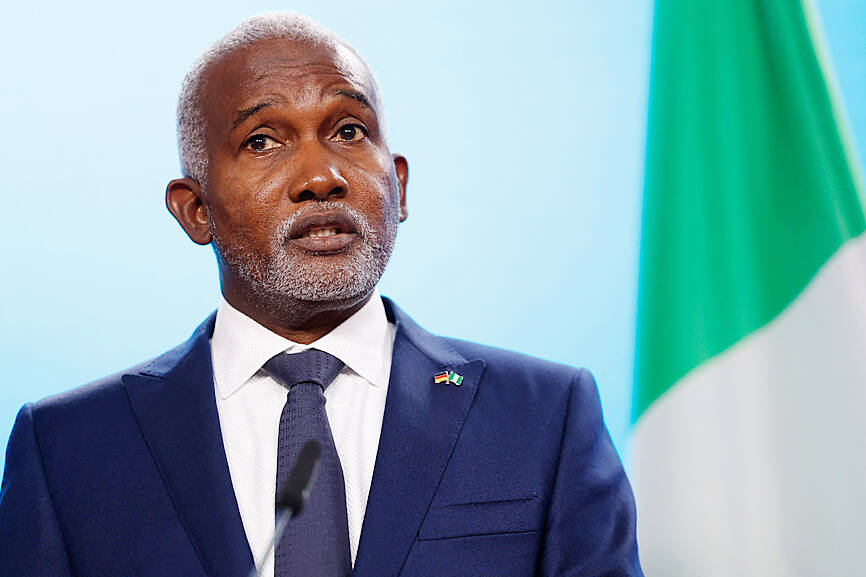
Photo: AFP
The US has not said anything publicly about possible further strikes, but US Secretary of Defense Pete Hegseth included the words, “more to come” in his social media post announcing the attack on Christmas Day. US President Donald Trump, spending the holidays at his Mar-a-Lago club in Florida, reposted the announcement.
The president has called out Nigeria for what he and his supporters said were attacks targeting Christians.
Nigerian officials strongly rejected that characterization, saying the threat was from terrorists and part of broader unrest across that part of Africa, highlighting the political complexities around the administration’s latest international military action.
“Simplistic labels don’t solve complex threats,” Tuggar said. “Terrorism in Nigeria is not a religious conflict; it is a regional security threat.”
The US strikes were based on intelligence from the government in Abuja and followed a conversation with US Secretary of State Marco Rubio, he said.
The US released no details on the strikes themselves — beyond a video of a missile being launched from a warship in a social media post from the Pentagon — or what damage they had done.
Trump said the attack “decimated” terrorist camps.
He also said he had delayed the strike by a day to land on Thursday, calling it a “Christmas present.”
The attack hit the Sokoto region of northwestern Nigeria, an area where a local Catholic bishop said in October that Christians are not facing persecution.
Nigerian Minister of Information and National Orientation Mohammed Idris said the strikes were launched from vessels in the Gulf of Guinea and used MQ-9 Reaper drones. They fired 16 GPS-guided munitions that neutralized Islamic State elements seeking to enter the country from the Sahel corridor, he said.
“Given what we know for now about the attacks, they are largely a signal for something larger,” SB Morgen Intelligence security analyst Confidence MacHarry said. “It is very likely that future attacks will do more damage.”
The country of about 230 million people, by far the most populous in Africa, is split roughly evenly between Muslim and Christian populations, and has been riven by violence for decades.
“It seems as if we’re at the moment where the Nigerian authorities have finally realized that they can’t do this thing alone, they need help, and the United States government appears more than willing to give that help,” Council on Foreign Relations senior fellow for Africa studies Ebenezer Obadare said.
Trump last month threatened military action if attacks continued. Shortly afterward, terrorists abducted more than 200 children from a Catholic school.
They were released earlier this week, according to the government.

Indonesia and Malaysia have become the first countries to block Grok, the artificial intelligence (AI) chatbot developed by Elon Musk’s xAI, after authorities said it was being misused to generate sexually explicit and nonconsensual images. The moves reflect growing global concern over generative AI tools that can produce realistic images, sound and text, while existing safeguards fail to prevent their abuse. The Grok chatbot, which is accessed through Musk’s social media platform X, has been criticized for generating manipulated images, including depictions of women in bikinis or sexually explicit poses, as well as images involving children. Regulators in the two Southeast Asian
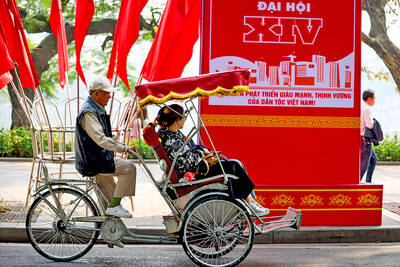
COMMUNIST ALIGNMENT: To Lam wants to combine party chief and state presidency roles, with the decision resting on the election of 200 new party delegates next week Communist Party of Vietnam General Secretary To Lam is seeking to combine his party role with the state presidency, officials said, in a move that would align Vietnam’s political structure more closely to China’s, where President Xi Jinping (習近平) heads the party and state. Next week about 1,600 delegates are to gather in Hanoi to commence a week-long communist party congress, held every five years to select new leaders and set policy goals for the single-party state. Lam, 68, bade for both top positions at a party meeting last month, seeking initial party approval ahead of the congress, three people briefed by

The Chinese Embassy in Manila yesterday said it has filed a diplomatic protest against a Philippine Coast Guard spokesman over a social media post that included cartoonish images of Chinese President Xi Jinping (習近平). Philippine Coast Guard spokesman Jay Tarriela and an embassy official had been trading barbs since last week over issues concerning the disputed South China Sea. The crucial waterway, which Beijing claims historic rights to despite an international ruling that its assertion has no legal basis, has been the site of repeated clashes between Chinese and Philippine vessels. Tarriela’s Facebook post on Wednesday included a photo of him giving a
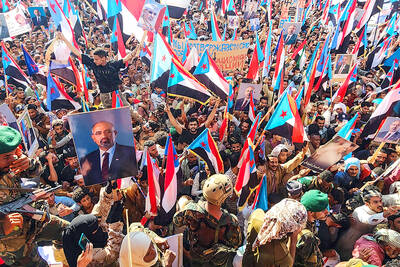
Yemen’s separatist leader has vowed to keep working for an independent state in the country’s south, in his first social media post since he disappeared earlier this month after his group briefly seized swathes of territory. Aidarous al-Zubaidi’s United Arab Emirates (UAE)-backed Southern Transitional Council (STC) forces last month captured two Yemeni provinces in an offensive that was rolled back by Saudi strikes and Riyadh’s allied forces on the ground. Al-Zubaidi then disappeared after he failed to board a flight to Riyadh for talks earlier this month, with Saudi Arabia accusing him of fleeing to Abu Dhabi, while supporters insisted he was


 RSS
RSS