


Protests in rural China have thwarted government attempts to enforce cremation in place of traditional burials, demonstrators say, as economic pressures fuel unrest in poor areas.
Such outbursts of dissent are rare in China, where authorities act swiftly to stamp out civil disobedience on the ground and online, although monitors said localized protests appear to be increasing.
Since last month, videos have shown crowds in mountainous Guizhou Province confronting officials who allegedly tried to force the cremation of dead people despite the strong local preference for burials.
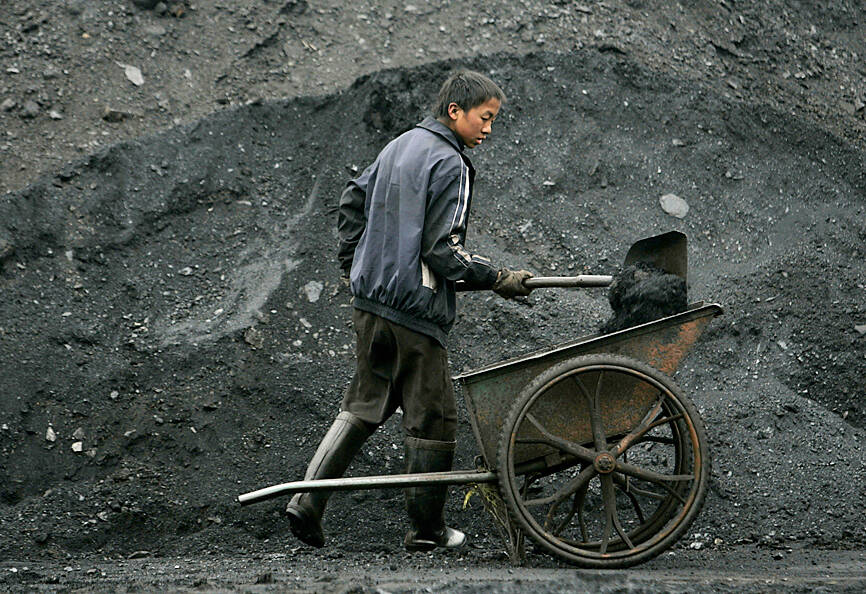
Photo: Reuters
The Chinese government has promoted cremation for decades, saying it preserves land, reduces costs and represents “modern” funeral practice.
Cremation is commonplace in cities, but many rural communities view burials as an essential rite for the dead.
The recent unrest in Guizhou’s Mushan Village in Xifeng County began after officials tried to force the cremation of a recently buried resident, locals and relatives of the deceased said.
“They would come every day to harass my family,” one relative said, adding that drones monitored the site overhead. Videos — many of them now apparently removed by China’s online censors — showed crowds of dozens of people guarding burial grounds from local officials who residents said wanted to exhume the body.
A 37-year-old Xifeng resident surnamed Shen said he and many others had traveled to Mushan to support the family of the deceased in undertaking a burial.
Authorities showed “disrespect for local customs,” Shen said.
The family “worried that the body would be forcibly dug up and cremated,” he said, adding that their watch continued throughout the night.
By the end of last month, police blocked roads into Mushan, stopping supplies and supporters from entering, Shen said.
Local authorities were “forcibly preventing the incident from spreading and stopping the people from protecting their rights,” he said.
While exceptions exist for 10 mainly Muslim ethnic minorities, the state encourages cremation wherever local conditions allow.
George Mason University anthropology associate professor Liu Huwy-min said that for China’s Han majority — which makes up more than 90 percent of the population — burial has ancient roots.
Traditionally, body burials were “at the core of thinking about what being a person means for Han Chinese,” she said.
So when cremation is done “by force, and people aren’t ready for it,” opposition is likely, Liu added.
In 2016, some elderly residents in Anqing, a city in Anhui Province, reportedly killed themselves to ensure they were buried before a new cremation mandate.
A 2018 campaign against burials in Jiangxi Province sparked an outcry, including from state media, after videos showed officials destroying coffins.
After nearly a month-long standoff in Mushan, authorities have stayed away, another relative of the deceased said.
“Everything has now subsided,” they said, confirming the body remains buried.

‘CROSSING THE LINE’: China’s embassy in Seoul criticized US Forces Korea Commander General Xavier Brunson, asking if his ‘hostile’ remarks were authorized by Washington South Korea and the US are in talks over recent public remarks by the commander of US Forces Korea, Seoul’s presidential office said yesterday, after the comments drew sharp criticism from China. In a recent podcast interview, US Forces Korea Commander General Xavier Brunson described South Korea as “the dagger in the heart of Asia” from China’s east coast, prompting the Chinese embassy in Seoul to say that he had “truly crossed the line.” The interview came amid growing speculation that Washington might seek to expand the role of US Forces Korea in countering the growing regional influence of China, a key

SEEKING ORDER: Rodrigo Paz said that ‘anyone who wants to destroy the nation will have to deal with this president and the full force of the constitution’ Bolivian President Rodrigo Paz on Wednesday said that the nation was at a “breaking point” after nearly a month of protests that have caused shortages of food, fuel and medicine. Paz, who took office six months ago amid the worst economic crisis there in four decades, is battling a groundswell of fury over his policies. The political capital, La Paz, has been besieged by low-income workers and members of the indigenous majority calling for his resignation. “The country needs order and is reaching breaking point,” the 58-year-old said at a public event in La Paz, renewing his appeal for dialogue. On Tuesday, the Bolivian

Through the noise of rushing papers and whirring belts at a print factory in Kyoto, two creators watch their photo essay come to life in broadsheet form — part of an effort to win new audiences in the age of artificial intelligence (AI). Despite the decline of the publishing industry, self-publication and handmade “zine” magazines are growing in popularity in Japan, reflecting the nation’s enduring love of paper in the digital era. While speaking to Agence France-Presse at the plant, his hands black with ink, one of the creators, Kazuma Obara, said: “I think [paper] is a medium that engages all five

Australian researchers have trained lab-grown brain cells on a silicon computer chip to play the 1990s shooter game Doom and said they are just scratching the surface of what the neurons could be capable of doing. It is the science-fiction work of biotech boffins at Cortical Labs, who researched and developed the technology that harnesses the workings of the brain’s networking system. Each so-called “biological computer” contains about 200,000 living human brain cells, grown from stem cells that were harvested from blood donations. Having mastered the simple computer game Pong, where a paddle is moved up and down to send a ball


 RSS
RSS