


The WHO yesterday opened a major conference on traditional medicine, arguing that new technologies, including artificial intelligence (AI), can bring scientific scrutiny to centuries-old healing practices.
The summit in New Delhi, which runs until tomorrow, is to examine how governments can regulate traditional medicine while using emerging scientific tools to validate safe and effective treatments.
“Traditional medicine is not a thing of the past,” WHO Director-General Tedros Adhanom Ghebreyesus said in a video released ahead of the three-day conference. “There is a growing demand for traditional medicine across countries, communities, and cultures.”
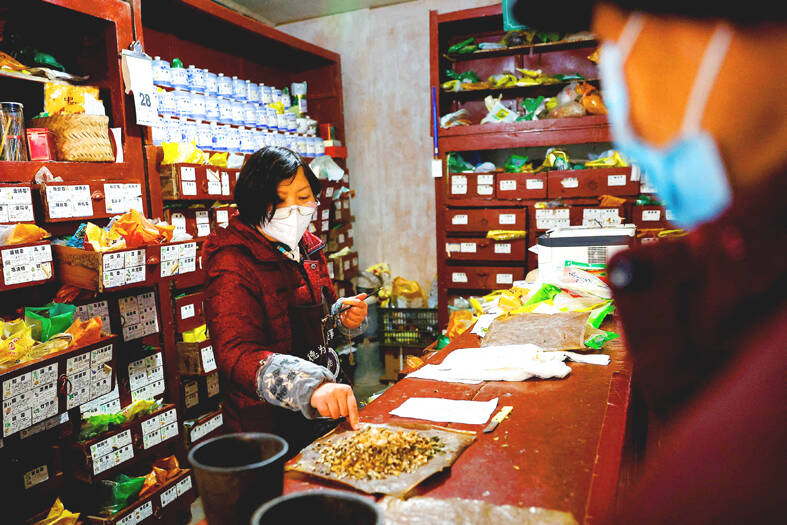
Photo: Reuters
Indian Prime Minister Narendra Modi, a longtime advocate of yoga and traditional health practices, has backed the WHO Global Tradition Medicine Centre, launched in 2022 in his home state of Gujarat.
Center Acting Director Shyama Kuruvilla said that 40 to 90 percent of populations in 90 percent of WHO member states use them.
“With half the world’s population lacking access to essential health services, traditional medicine is often the closest — or only care — available for many people,” she said in New Delhi.
The UN agency defines traditional medicines as the accumulated knowledge, skills and practices used over time to maintain health and prevent, diagnose and treat physical and mental illness.
However, many lack proven scientific value, while conservationists warn that demand for certain products drives trafficking in endangered wildlife, including tigers, rhinos and pangolins.
The “WHO’s role, therefore, is to help countries ensure that, as with any other medicine, traditional medicine is safe, evidence-informed and equitably integrated in systems,” Kuruvilla added.
She said that “40 percent or more of biomedical Western medicine, pharmaceuticals, derive from natural products.”
She cited aspirin drawing on formulations using willow tree bark, contraceptive pills developed from yam plant roots and child cancer treatments based on Madagascar’s rosy periwinkle flower.
The WHO also lists the development of the anti-malaria treatment artemisinin as drawing on ancient Chinese medicine texts.
“It’s a huge, huge opportunity — and industry has realized this,” Kuruvilla said.
Rapid technological advancements, including AI, had pushed research to a “transformative moment,” to apply scientific rigor to traditional remedies.
The WHO is also to launch what it calls the world’s largest digital repository of research on the subject — a library of 1.6 million scientific records intended to strengthen evidence and improve knowledge-sharing.
WHO Chief Scientist Sylvie Briand said that AI can assist in analyzing drug interactions.
“Artificial intelligence, for instance, can screen millions of compounds, helping us understand the complex structure of herbal products and extract relevant constituents to maximize benefit and minimize adverse effects,” she told reporters ahead of the conference.
Briand said advanced imaging technologies, including brain scans, were shedding light on how practices such as meditation and acupuncture affect the body.
Kuruvilla said she was excited by the possibilities.
“It is the frontier science that’s allowing us to make this bridge ... connecting the past and the future,” she said.
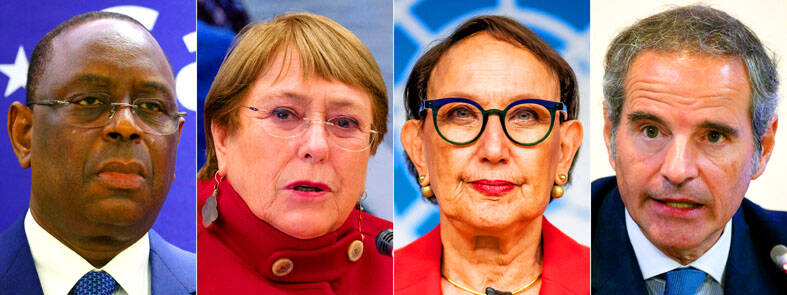
Four contenders are squaring up to succeed Antonio Guterres as secretary-general of the UN, which faces unprecedented global instability, wars and its own crushing budget crisis. Chile’s Michelle Bachelet, Argentina’s Rafael Grossi, Costa Rica’s Rebeca Grynspan and Senegal’s Macky Sall are each to face grillings by 193 member states and non-governmental organizations for three hours today and tomorrow. It is only the second time the UN has held a public question-and-answer, a format created in 2016 to boost transparency. Ultimately the five permanent members of the UN’s top body, the Security Council, hold the power, wielding vetoes over who leads the

South Korea’s air force yesterday apologized for a 2021 midair collision involving two fighter jets, a day after auditors said the pilots were taking selfies and filming during the flight and held them responsible for the accident. “We sincerely apologize to the public for the concern caused by the accident that occurred in 2021,” an air force spokesman told a news conference, adding that one of the pilots involved had been suspended from flying duties, received severe disciplinary action and has since left the military. The apology followed a report released on Wednesday by the South Korean Board of Audit and Inspection,

Young Chinese, many who fear age discrimination in their workplace after turning 35, are increasingly starting “one-person companies” that have artificial intelligence (AI) do most of the work. Smaller start-ups are already in vogue in Silicon Valley and elsewhere, with rapidly advancing AI tools seen as a welcome teammate even as they threaten layoffs at existing firms. More young people in China are subscribing to the model, as cities pledge millions of dollars in funding and rent subsidies for such ventures, in alignment with Beijing’s political goal of “technological self-reliance.” “The one-person company is a product of the AI era,” said Karen Dai

About 240 Indians claiming descent from a Biblical tribe landed at Tel Aviv airport on Thursday as part of a government operation to relocate them to Israel. The newcomers passed under a balloon arch in blue and white, the colors of the Israeli flag, as dozens of well-wishers welcomed them with a traditional Jewish song. They were the first “bnei Menashe” (“sons of Manasseh”) to arrive in Israel since the government in November last year announced funding for the immigration of about 6,000 members of the community from the states of Manipur and Mizoram in northeast India. The community claims to descend from


 RSS
RSS