


Thailand’s parliament was dissolved yesterday for new elections early next year as the country engaged in deadly fighting with Cambodia.
Thai Prime Minister Anutin Charnvirakul dissolved the House of Representatives after getting approval from King Maha Vajiralongkorn, whose endorsement became effective with its publication in the Royal Gazette.
Anutin on Thursday signaled the move with a Facebook post saying: “I’d like to return power to the people.”
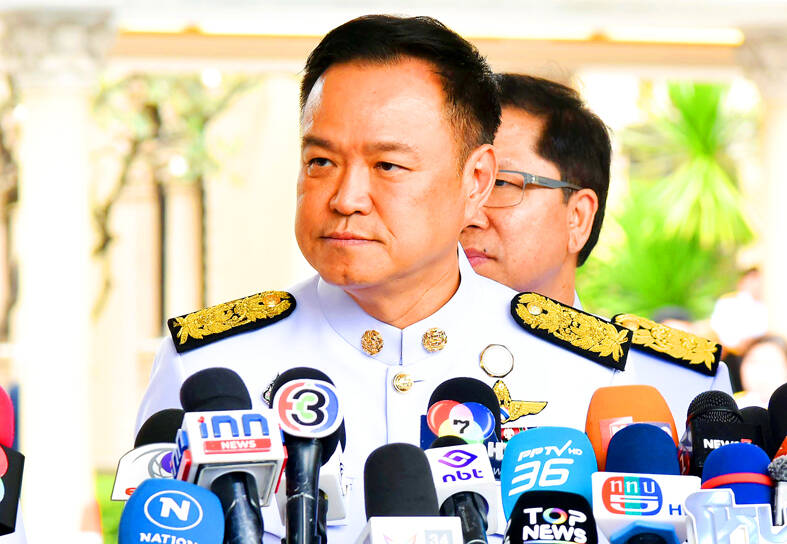
Photo: EPA, Royal Thai Government
The election must be held 45 to 60 days after the royal endorsement, a period during which Anutin would head a caretaker government with limited powers that cannot approve a new budget.
The move comes at a tricky political moment, as Thailand is engaged in large-scale combat with Cambodia over a longstanding border dispute.
Anutin has been prime minister for just three months. He won the September vote in the Thai parliament with support from the main opposition People’s Party in exchange for a promise to dissolve the parliament within four months and organize a referendum on the drafting of a new Thai constitution by an elected constituent assembly.
The party, which runs on progressive platforms, has long sought changes to the constitution, imposed during a military government, saying they want to make it more democratic.
The issue of constitutional change appeared to trigger the dissolution, after the People’s Party on Thursday prepared to call a no-confidence vote. That threat came after lawmakers from Anutin’s Bhumjaithai Party voted in favor of a bill to amend the constitution, which the opposition felt ran against the spirit of the agreement they reached in September.
The People’s Party holds the largest number of seats in the Thai House of Representatives and is seen as the main challenger to Bhumjaithai.
Opposition leaders said they hoped Anutin would honor the agreement to arrange a constitutional referendum.
With Thailand now again engaged in heavy combat against Cambodia, Anutin has embraced an aggressive military posture to appeal to nationalistic public sentiment, and has said Thailand would keep fighting until its sovereignty and safety are guaranteed.
After the five days of border fighting in July, US President Donald Trump pushed the two countries to agree on a ceasefire by threatening to withhold trade privileges from them.
Trump has vowed again to make peace between them, after widespread fighting flared up again this week. If he employs the cudgel of high tariffs on Thai exports should Bangkok fail to comply with his peacemaking effort, it could cause serious damage to its already sluggish economy.
Trump twice this week said he expected to speak by phone with Thai and Cambodian leaders, expressing confidence that he could persuade them to stop the fighting.
Anutin yesterday confirmed that he was scheduled to speak with Trump later in the evening, saying he would brief him on the latest situation along the border.
As of Thursday, about two dozen people had been reported killed in this week’s fighting, while hundreds of thousands have been displaced on both sides. The Thai military estimates that 165 Cambodian soldiers have been killed, although no number has been officially announced by Phnom Penh.

SPEAKING OUT: After Siranudh Scott’s allegations surfaced, celebrities and public figures took to social media to share their own experiences of sexual misconduct and abuse A high-profile alleged sexual abuse case within a wealthy Thai beer brewing family has prompted a wave of painful accounts from survivors of unconnected abuse in the conservative nation. Siranudh Scott, a member of the billionaire Thai family that founded the ubiquitous Singha beer brand, posted an emotional video this month accusing his elder brother Sunit of repeatedly abusing him when he was a teenager. Sunit, who is in his 30s, later denied the allegations in a video posted online, but Singha parent Boonrawd dismissed him from his executive role with the company on Tuesday last week. “I felt I needed to speak

SEEKING ORDER: Rodrigo Paz said that ‘anyone who wants to destroy the nation will have to deal with this president and the full force of the constitution’ Bolivian President Rodrigo Paz on Wednesday said that the nation was at a “breaking point” after nearly a month of protests that have caused shortages of food, fuel and medicine. Paz, who took office six months ago amid the worst economic crisis there in four decades, is battling a groundswell of fury over his policies. The political capital, La Paz, has been besieged by low-income workers and members of the indigenous majority calling for his resignation. “The country needs order and is reaching breaking point,” the 58-year-old said at a public event in La Paz, renewing his appeal for dialogue. On Tuesday, the Bolivian
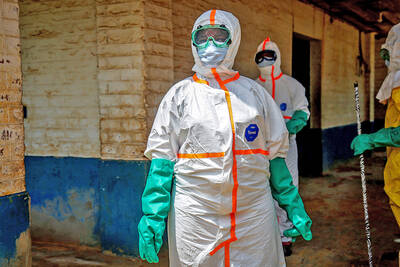
COMMUNITY CONFLICT: Concerns about disease spread from corpses has run up against friends and families’ desire to bury their dead as infection spreads in the area Angry residents of a town at the epicenter of the Ebola outbreak in the Democratic Republic of the Congo (DR Congo) attacked and burned a tent that was part of a health center where people are being treated for the virus, the staff there said Saturday. It was the second such attack in the region in a week. No one was hurt in the attack, according to reports but as patients ran out to escape the fire, 18 people with suspected Ebola infections fled the facility and are unaccounted for, a hospital director said. Angry residents arrived at the clinic in the

Forecasters in Europe yesterday warned of exceptional heat as record temperatures driven by a “heat dome” push temperatures well above seasonal norms across the continent. The surge follows a record-breaking Monday, with France logging its hottest day in the month of May on record, its weather agency said, and the UK also posting unprecedented highs. A so-called “heat dome” of warm air from northern Africa trapped under a high-pressure system over western Europe is behind the high temperatures not usually seen until high summer. Restrictions on outdoor work were imposed in parts of Italy, beaches in southwest France filled earlier than usual and


 RSS
RSS