


The first giant panda cub born in Indonesia is noisy, nursing well and showing other signs of good health, the conservation park where he was born said on Sunday.
Indonesian Safari Park released video and photos showing the fuzzy newborn in an incubator, and squirming and squealing while being cuddled by his mother.
The mother, 15-year-old Hu Chun, gave birth to Satrio Wiratama — nicknamed Rio — on Nov. 27 at the park in Cisarua, West Java Province.
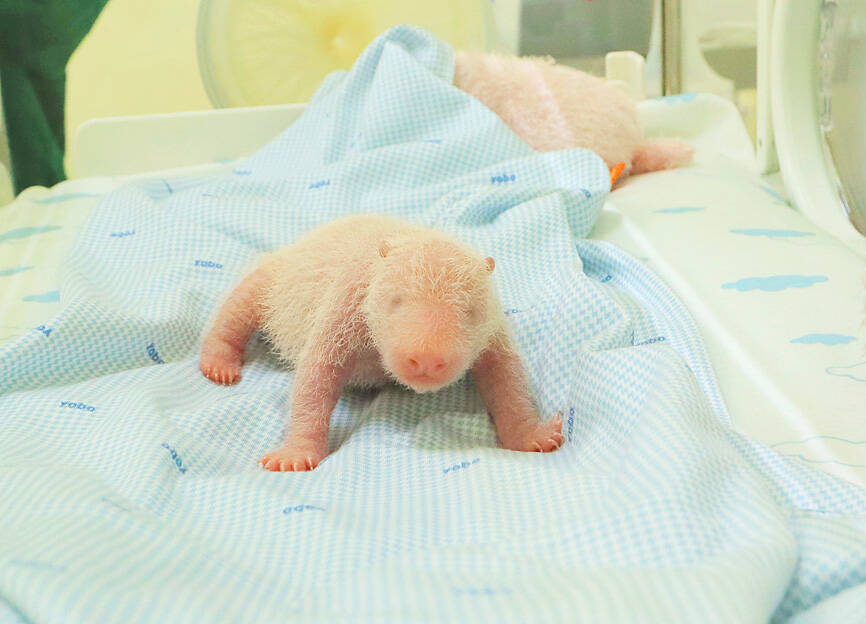
Photo: Taman Safari Indonesia via AP
The name symbolizes the hope, resilience, and shared commitment of Indonesia and China in protecting endangered species, the park said in a statement.
Indonesian President Prabowo Subianto announced the baby panda’s name on Thursday and showed his photo when he met Chinese People’s Political Consultative Conference Chairman Wang Huning (王滬寧).
Rio is stable and showing healthy early signs such as strong vocalization, effective nursing and steady weight gain while being monitored constantly. He is expected to develop better temperature control, fur growth, open his eyes and move more in the next several weeks.
The park said it was prioritizing the health and welfare of the mother and baby, and that he would not yet be accessible to the public.
The adult pandas, Cai Tao and Hu Chun, arrived in Indonesia in 2017 on a 10-year conservation partnership with China. They live in an enclosure built for them at the park about 70km from Jakarta.
Pandas are widely considered as China’s unofficial mascot and its loans of the animals to overseas zoos have long been seen as a tool of Beijing’s soft-power diplomacy, also known as “panda diplomacy.”
Giant pandas have difficulty breeding and births are particularly welcomed. There are fewer than 1,900 giant pandas in their only wild habitats in the Chinese provinces of Sichuan, Shaanxi and Gansu.
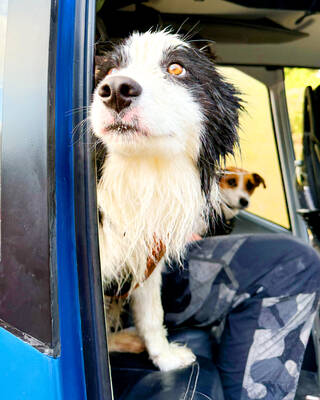
When a hiker fell from a 55m waterfall in wild New Zealand bush, rescuers were forced to evacuate the badly hurt woman without her dog, which could not be found. After strangers raised thousands of dollars for a search, border collie Molly was flown to safety by a helicopter pilot who was determined to reunite the pet and the owner. A week earlier, an emergency rescue helicopter found the woman with bruises and lacerations after a fall at a rocky spot at the waterfall on the South Island’s West Coast. She was airlifted on March 24, but they were forced to
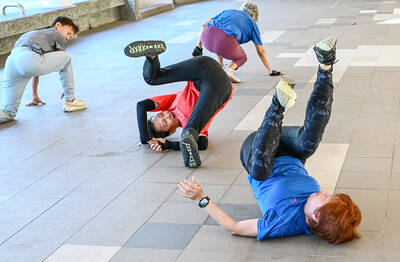
CONFIDENCE BOOSTER: ’After parkour ... you dare to do a lot of things that you think only young people can do,’ a 67-year-old parkour enthusiast said In a corner of suburban Singapore, Betty Boon vaults a guardrail, crawls underneath a slide, executes forward shoulder rolls and scales a steep slope, finishing the course to applause. “Good job,” the 69-year-old’s coach cheers. This is “geriatric parkour,” where about 20 retirees learned to tackle a series of relatively demanding exercises, building their agility and enjoying a sense of camaraderie. Boon, an upbeat grandmother, said learning parkour has aided her confidence and independence as she ages. “When you’re weak, you will be dependent on someone,” she said after sweating it out with her parkour classmates in suburban Toa Payoh,
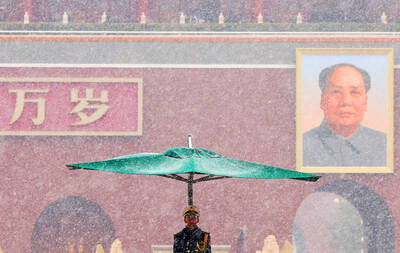
Chinese dissident artist Gao Zhen (高兟), famous for making provocative satirical sculptures of former Chinese leader Mao Zedong (毛澤東), was tried on Monday over accusations of “defaming national heroes and martyrs,” his wife and a rights group said. Gao, 69, who was detained in 2024 during a visit from the US, faces a maximum three-year prison sentence, said his wife, Zhao Yaliang (趙雅良), and Shane Yi, a researcher at the Chinese Human Rights Defenders group which operates outside the nation. The closed-door, one-day trial took place at Sanhe City People’s Court in Hebei Province neighboring the capital, Beijing, and ended without a
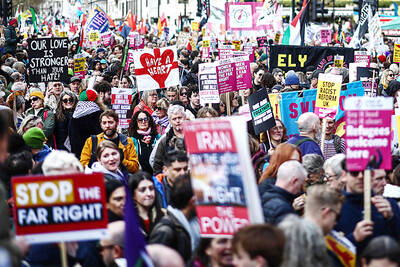
‘TOXIC CLIMATE’: ‘I don’t really recognize Labour anymore... The idea that you can implement far-right ideas in order to stop the far right is nonsense,’ a protester said Tens of thousands of people on Saturday marched through central London to protest against the far right, weeks ahead of local elections and six months after Britain saw one of its largest far-right demonstrations. Organized by hundreds of civic groups, including trade unions, anti-racism campaigners and Muslim representative bodies, Saturday’s Together Alliance event was billed as the biggest in UK history to counter right-wing extremism. A separate pro-Palestinian march had also converged with the main rally. While organizers claimed 500,000 had turned out in total, the police gave a figure of about 50,000. Protesters carrying placards with slogans such as


 RSS
RSS