


The UN yesterday hit out at global “apathy” over widespread suffering as it launched its appeal for humanitarian assistance, which is limited in scope as aid operations confront major funding cuts.
“This is a time of brutality, impunity and indifference,” UN humanitarian chief Tom Fletcher said, condemning “the ferocity and the intensity of the killing, the complete disregard for international law, horrific levels of sexual violence” he had seen on the ground this year.
“This is a time when the rules are in retreat, when the scaffolding of coexistence is under sustained attack, when our survival antennae have been numbed by distraction and corroded by apathy,” he said.
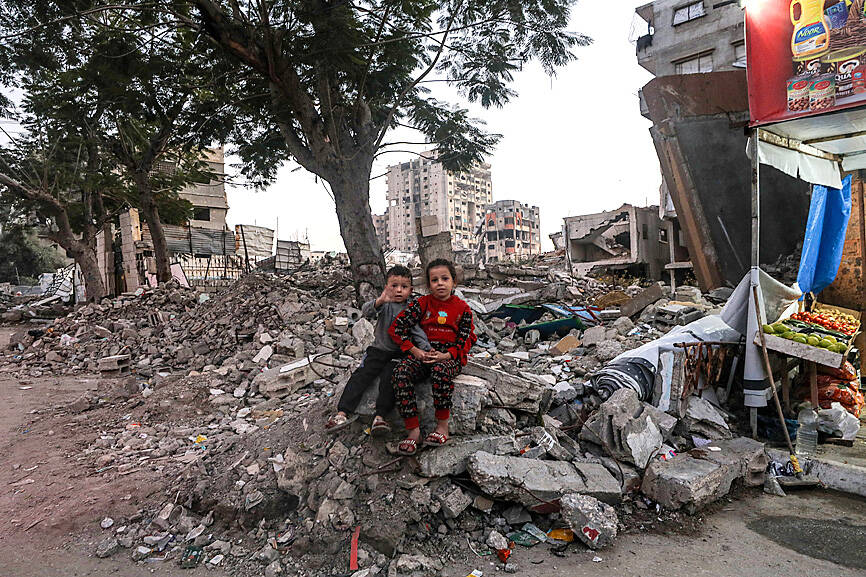
Photo: EPA
It was also a time “when politicians boast of cutting aid,” Fletcher said, as he unveiled a streamlined plan to raise at least US$23 billion to help 87 million people in the world’s most dangerous places, such as Gaza, Ukraine, Sudan, Haiti and Myanmar.
The UN would like to ultimately raise US$33 billion to help 135 million people next year, but is painfully aware that its overall goal might be difficult to reach, given US President Donald Trump’s slashing of foreign aid.
The “highly prioritized appeal” was “based on excruciating life-and-death choices,” Fletcher said, adding that he hoped Washington would see the choices made and the reforms undertaken to improve aid efficiency, and choose to “renew that commitment” to help.
The world body estimates that 240 million people in conflict zones, suffering from epidemics, or victims of natural disasters and climate change are in need of emergency aid.
This year, the UN’s appeal for more than US$45 billion was only funded to the US$12 billion mark — the lowest in a decade, the world body said.
That only allowed it to help 98 million people, 25 million fewer than the year before.
The US remains the top humanitarian aid donor in the world, but that amount fell dramatically this year to US$2.7 billion, down from US$11 billion last year, UN data showed.
Atop the list of priorities for next year are Gaza and the West Bank.
The UN is asking for US$4.1 billion for the occupied Palestinian territories, to provide assistance to 3 million people.
Another country with urgent need is Sudan, where deadly conflict has displaced millions: the UN is hoping to collect US$2.9 billion to help 20 million people.
In Tawila, where residents of Sudan’s western city of El-Fasher fled ethnically targeted violence, Fletcher said he met a young mother who saw her husband and child murdered.
She fled, with the malnourished baby of her slain neighbors along what he called “the most dangerous road in the world” to Tawila.
Men “attacked her, raped her, broke her leg, and yet something kept her going through the horror and the brutality,” he said.
“Does anyone, wherever you come from, whatever you believe, however you vote, not think that we should be there for her?” Fletcher said.
The UN would ask member states to open their government coffers over the next 87 days — one day for each million people who need assistance.
If the UN comes up short, it would widen the campaign, he said, appealing to civil society, the corporate world and everyday people.
“We’re asking for only just over one percent of what the world is spending on arms and defense right now,” Fletcher said. “I’m not asking people to choose between a hospital in Brooklyn and a hospital in Kandahar — I’m asking the world to spend less on defense and more on humanitarian support.”
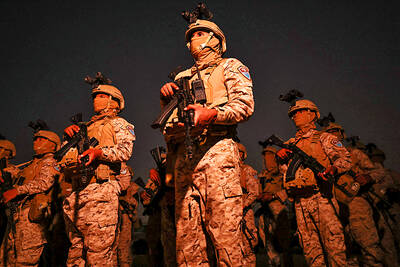
PRECARIOUS RELATIONS: Commentators in Saudi Arabia accuse the UAE of growing too bold, backing forces at odds with Saudi interests in various conflicts A Saudi Arabian media campaign targeting the United Arab Emirates (UAE) has deepened the Gulf’s worst row in years, stoking fears of a damaging fall-out in the financial heart of the Middle East. Fiery accusations of rights abuses and betrayal have circulated for weeks in state-run and social media after a brief conflict in Yemen, where Saudi airstrikes quelled an offensive by UAE-backed separatists. The United Arab Emirates is “investing in chaos and supporting secessionists” from Libya to Yemen and the Horn of Africa, Saudi Arabia’s al-Ekhbariya TV charged in a report this week. Such invective has been unheard of
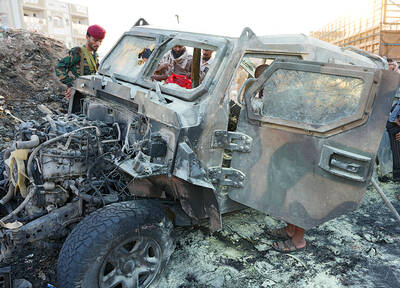
‘TERRORIST ATTACK’: The convoy of Brigadier General Hamdi Shukri resulted in the ‘martyrdom of five of our armed forces,’ the Presidential Leadership Council said A blast targeting the convoy of a Saudi Arabian-backed armed group killed five in Yemen’s southern city of Aden and injured the commander of the government-allied unit, officials said on Wednesday. “The treacherous terrorist attack targeting the convoy of Brigadier General Hamdi Shukri, commander of the Second Giants Brigade, resulted in the martyrdom of five of our armed forces heroes and the injury of three others,” Yemen’s Saudi Arabia-backed Presidential Leadership Council said in a statement published by Yemeni news agency Saba. A security source told reporters that a car bomb on the side of the road in the Ja’awla area in
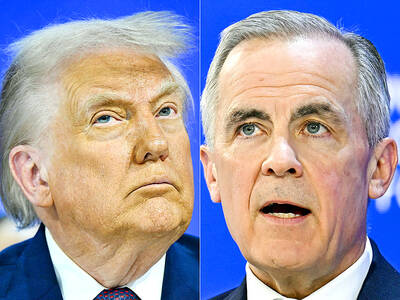
US President Donald Trump on Saturday warned Canada that if it concludes a trade deal with China, he would impose a 100 percent tariff on all goods coming over the border. Relations between the US and its northern neighbor have been rocky since Trump returned to the White House a year ago, with spats over trade and Canadian Prime Minister Mark Carney decrying a “rupture” in the US-led global order. During a visit to Beijing earlier this month, Carney hailed a “new strategic partnership” with China that resulted in a “preliminary, but landmark trade agreement” to reduce tariffs — but
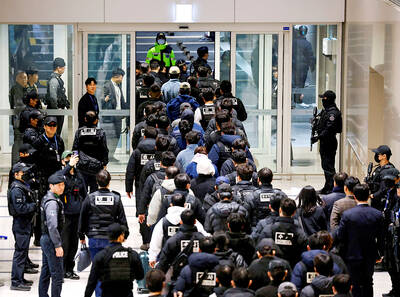
SCAM CLAMPDOWN: About 130 South Korean scam suspects have been sent home since October last year, and 60 more are still waiting for repatriation Dozens of South Koreans allegedly involved in online scams in Cambodia were yesterday returned to South Korea to face investigations in what was the largest group repatriation of Korean criminal suspects from abroad. The 73 South Korean suspects allegedly scammed fellow Koreans out of 48.6 billion won (US$33 million), South Korea said. Upon arrival in South Korea’s Incheon International Airport aboard a chartered plane, the suspects — 65 men and eight women — were sent to police stations. Local TV footage showed the suspects, in handcuffs and wearing masks, being escorted by police officers and boarding buses. They were among about 260 South


 RSS
RSS