


EU countries yesterday were expected to approve a significant tightening of Europe’s immigration policy, including endorsing the concept of setting up “return hubs” for migrants outside the 27-nation bloc.
Fearful of far-right parties making gains at the ballot box, governments across Europe are scrambling to take a tougher stance. Interior ministers meeting in Brussels were to vote for the first time on a series of measures presented this year by the bloc’s executive to more strictly regulate the arrival and return of migrants.
If adopted, these measures would notably allow the opening of centers outside the EU’s borders, to which migrants whose asylum applications have been rejected would be sent, or the so-called “return hubs”; harsher penalties for migrants who refuse to leave European territory, including through longer periods of detention; and returning migrants to countries that are not their country of origin, but which Europe considers “safe.”
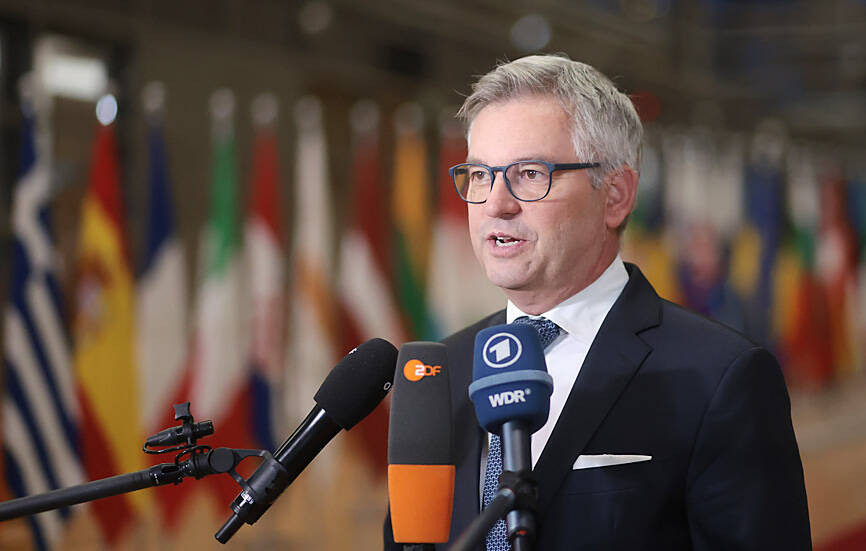
Photo: EPA
A decline in irregular entries to Europe — down by about 20 percent so far this year compared with last year — has not eased the pressure to act on the politically explosive issue.
The latest proposals come just a few months after the EU adopted a mammoth new migration law that is to come into effect in June next year.
“We have to speed up to give the people the feeling that we have control over what is happening,” European Commissioner for Internal Affairs and Migration Magnus Brunner said.
The new initiatives have caused consternation among activists working with migrants.
“Instead of investing in safety, protection, and inclusion, the EU is choosing policies that will push more people into danger and legal limbo,” Platform for International Cooperation on Undocumented Migrants advocacy officer Silvia Carta said.
Under the impetus of Denmark, which holds the EU’s rotating presidency and has long advocated for these measures, member states are moving forward at a rapid pace.
However, some in the bloc remain sceptical.
France is questioning the legality and effectiveness of some of the proposals, while Spain is not convinced that “return hubs” work after several unsuccessful trials by other countries.
They likely also discussed the distribution of at least 30,000 asylum seekers under the recent legal changes.
That move is part of a new “solidarity” system to help relieve pressure on countries that see large numbers of arrivals, such as Greece and Italy.
Other EU countries are expected to accept asylum seekers or to contribute 20,000 euros (US$23,304) per person to the countries under pressure.
However, with governments across the bloc being urged to tighten immigration policies, putting a hand up to take in extra asylum seekers is fraught with political risk.
The EU is nevertheless under pressure to hammer out a compromise on resettlement, with the clock ticking to come up with a final decision by the end of the year.

‘CROSSING THE LINE’: China’s embassy in Seoul criticized US Forces Korea Commander General Xavier Brunson, asking if his ‘hostile’ remarks were authorized by Washington South Korea and the US are in talks over recent public remarks by the commander of US Forces Korea, Seoul’s presidential office said yesterday, after the comments drew sharp criticism from China. In a recent podcast interview, US Forces Korea Commander General Xavier Brunson described South Korea as “the dagger in the heart of Asia” from China’s east coast, prompting the Chinese embassy in Seoul to say that he had “truly crossed the line.” The interview came amid growing speculation that Washington might seek to expand the role of US Forces Korea in countering the growing regional influence of China, a key

SEEKING ORDER: Rodrigo Paz said that ‘anyone who wants to destroy the nation will have to deal with this president and the full force of the constitution’ Bolivian President Rodrigo Paz on Wednesday said that the nation was at a “breaking point” after nearly a month of protests that have caused shortages of food, fuel and medicine. Paz, who took office six months ago amid the worst economic crisis there in four decades, is battling a groundswell of fury over his policies. The political capital, La Paz, has been besieged by low-income workers and members of the indigenous majority calling for his resignation. “The country needs order and is reaching breaking point,” the 58-year-old said at a public event in La Paz, renewing his appeal for dialogue. On Tuesday, the Bolivian

Forecasters in Europe yesterday warned of exceptional heat as record temperatures driven by a “heat dome” push temperatures well above seasonal norms across the continent. The surge follows a record-breaking Monday, with France logging its hottest day in the month of May on record, its weather agency said, and the UK also posting unprecedented highs. A so-called “heat dome” of warm air from northern Africa trapped under a high-pressure system over western Europe is behind the high temperatures not usually seen until high summer. Restrictions on outdoor work were imposed in parts of Italy, beaches in southwest France filled earlier than usual and

Australian researchers have trained lab-grown brain cells on a silicon computer chip to play the 1990s shooter game Doom and said they are just scratching the surface of what the neurons could be capable of doing. It is the science-fiction work of biotech boffins at Cortical Labs, who researched and developed the technology that harnesses the workings of the brain’s networking system. Each so-called “biological computer” contains about 200,000 living human brain cells, grown from stem cells that were harvested from blood donations. Having mastered the simple computer game Pong, where a paddle is moved up and down to send a ball


 RSS
RSS