


Architect Frank Gehry, whose daring and whimsical designs from the Guggenheim Bilbao to the Walt Disney Concert Hall in Los Angeles captivated fans and critics, died on Friday. He was 96.
Gehry was perhaps the biggest of the so-called “starchitects” — an elite group that includes architects Renzo Piano, Rem Koolhaas, Norman Foster and Zaha Hadid — and enjoyed his fame, but absolutely hated the label.
“There are people who design buildings that are not technically and financially good, and there are those who do,” he told The Independent in 2009. “Two categories, simple.”
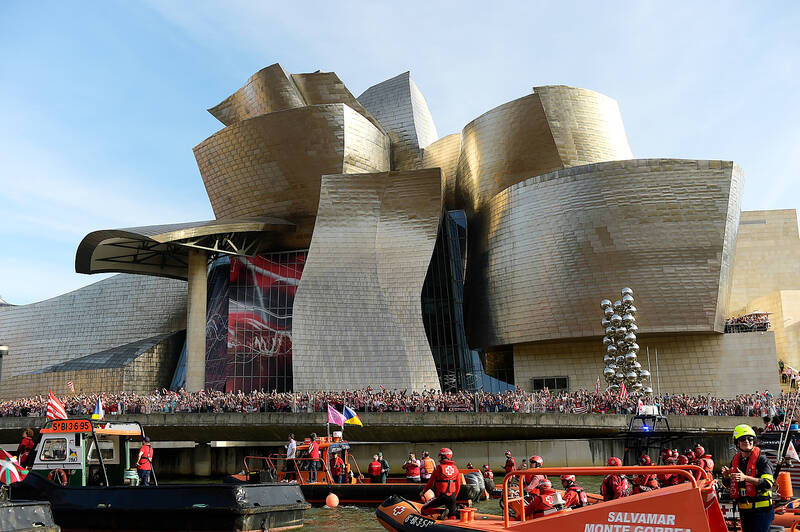
Photo: AP
His artistic genius and boldness shone through in his complex designs — such as the glass “sails” of the Fondation Louis Vuitton in Paris.
He popularized contemporary architecture, and became such a sensation that he was featured on The Simpsons — all while insisting he was a simple maker of buildings.
“I work with clients who respect the art of architecture,” he said in 2014, according to his biographer Paul Goldberger.
Gehry’s representative, Meaghan Lloyd, said he died at his home in Santa Monica following a brief respiratory illness.
The 1970s and 1980s would mark the rollout of a long series of his most audacious and innovative architectural achievements, many of them in southern California. Close to the avant-garde “funk” art scene in California, Gehry’s deconstructionist and experimental style is hard to categorize. Many of his buildings — irregularly shaped metal facades that could look like crumpled paper — could only be realized with the help of computer design tools, which he fully embraced.
This is maybe best reflected in his seminal reworking in 1978 of his own home in Santa Monica, where he long resided — it features corrugated metal wrapped around the original 1920s building.
Gehry received the highest architectural honor, the Pritzker Prize, in 1989.
Almost a decade later, he would unveil arguably his most iconic design: the Guggenheim Museum in Bilbao, which earned him international acclaim and notice.
The limestone and glass building with curvy walls clad in titanium scales is instantly recognizable as a Gehry design, and was once described by his colleague Philip Johnson as “the greatest building of our time.” The building helped revitalize the ancient industrial heart of the Spanish city, attracting visitors from around the world and leading to the coining of the term “Bilbao effect” to explain how beautiful architecture can transform an area.
“We will be forever grateful, and his spirit and legacy will always remain connected to Bilbao,” the museum said on social media.
Emboldened, Gehry would take even greater risks in his next projects, which included the Walt Disney Concert Hall (2003), the Beekman Tower in New York (2011) and the Fondation Louis Vuitton (2014).
LVMH chairman and CEO Bernard Arnault said he was “profoundly saddened” by Gehry’s death, calling him a “genius of lightness, transparency and grace.”
Facebook tapped Gehry for a major expansion of its Menlo Park campus in California, which opened in 2018.
Many of Gehry’s designs require complex computations — which he pushed to the limits.
For a period, architects avoided the use of rounded or curved shapes, as they caused headaches for engineers and led to spiraling construction costs.
Gehry pushed back, using 3D modelling software similar to that used by aerospace firms to create unique building shapes while keeping costs in line with what developers would pay for a more conventional building of similar dimensions.
The Lou Ruvo Center for Brain Health in Las Vegas — its walls and windows appearing to have melted under the hot desert sun — is a classic example of Gehry’s groundbreaking vision.

An American scientist convicted of lying to US authorities about payments from China while he was at Harvard University has rebuilt his research lab in Shenzhen, China, to pursue technology the Chinese government has identified as a national priority: embedding electronics into the human brain. Charles Lieber, 67, is among the world’s leading researchers in brain-computer interfaces. The technology has shown promise in treating conditions such as amyotrophic lateral sclerosis and restoring movement in paralyzed people. It also has potential military applications: Scientists at the Chinese People’s Liberation Army have investigated brain interfaces as a way to engineer super soldiers by boosting

Indonesian police have arrested 13 people after shocking images of alleged abuse against small children at a daycare center went viral, sparking outrage across the nation, officials said on Monday. Police on Friday last week raided Little Aresha, a daycare center in Yogyakarta on Java island, following a report from a former employee. CCTV footage circulating on social media showed children, most younger than two, lying on the floor wearing only diapers, their hands and feet bound with rags. The police have confirmed that the footage is authentic. Police said they also found 20 children crammed into a room just 3m by 3m. “So
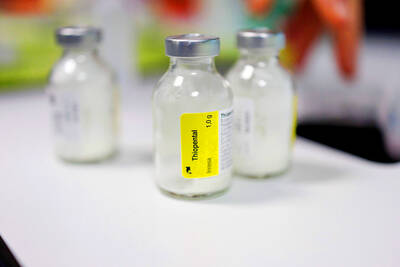
A grieving mother has ended her life at a clinic in Switzerland four years after the death of her only child. Wendy Duffy, 56, a physically healthy woman, died at the Pegasos clinic in Basel after struggling to cope with the death of her 23-year-old son, Marcus. The former care worker, from the West Midlands, England, had previously attempted to take her own life. The case comes as assisted dying would not become law in England and Wales after proposed legislation, branded “hopelessly flawed” by opponents, ran out of time. Ruedi Habegger, the founder of Pegasos, described Duffy’s death as
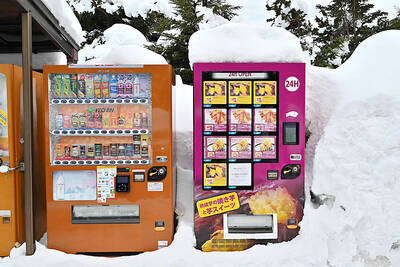
From post offices and parks to stations and even the summit of Mount Fuji, Japan’s vending machines are ubiquitous, but with the rapid pace of inflation cooling demand for their drinks, operators are being forced to rethink the business. Last month beverage giant DyDo Group Holdings announced it would remove about 20,000 vending machines — about 7 percent of their stock nationwide — by January next year, to “reconstruct a profitable network.” Pokka Sapporo Food & Beverage, based in Nagoya, also said last month it would sell its 40,000-machine operation to Osaka-based Lifedrink Co. “The strength of the vending machine


 RSS
RSS