


Light from 560,000 satellites that humanity is planning to launch into Earth’s orbit in the coming years could contaminate almost all the images taken by space telescopes, NASA astronomers warned on Wednesday.
Scientists have already been sounding the alarm about how light pollution from increasingly massive satellites threaten the future of dark skies seen from the ground.
A study published in the journal Nature is the first to estimate how the immense number of planned satellites could stray into the view of nearby telescopes attempting to probe the universe.
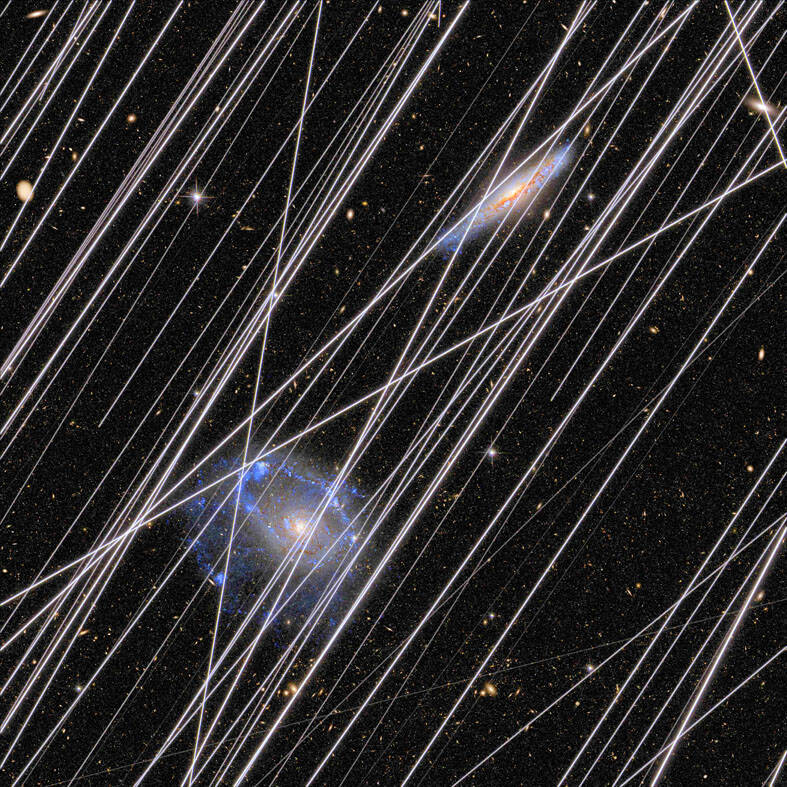
Photo: NASA / Borlaff, Marcum, Howell (Nature, 2025) / AFP
Since 2019, the number of satellites in low Earth orbit has skyrocketed from about 2,000 to 15,000, according to the study — many of them part of billionaire Elon Musk’s Starlink Internet constellation.
That is a drop in the bucket compared with what is coming.
If all of the plans filed to regulators launch into space, there would be 560,000 satellites orbiting Earth by the end of the 2030s, the study said.
That poses “a very severe threat” to space telescopes, said the study’s lead author, Alejandro Borlaff of the NASA Ames Research Center in California.
“To give an idea of how much this number increased recently, we have launched more satellites to low Earth orbit in the last four years — 2021 to 2025 — than in the previous seven decades of space flight combined,” Borlaff said.
For the research, the astronomers simulated how the 560,000 satellites would affect four space telescopes.
Reflected light from the satellites would affect 96 percent of all images taken by NASA’s SPHEREx telescope, the European Space Agency’s planned ARRAKIHS telescope and China’s planned Xuntian telescope, the study found.
The Hubble Space Telescope, which is less likely to snap a satellite as it takes in a narrower view of the universe, would have one-third of its images tainted.
That could affect all sorts of scientific endeavors.
“Imagine that you are trying to find asteroids that may be potentially harmful for Earth,” Borlaff said.
An asteroid streaking through the sky “looks exactly like a satellite ... it’s really hard to figure out which one is the bad one,” he added.
Some space telescopes, such as the famous James Webb Space Telescope, are unaffected because they are hovering at a stable spot 1.5 million kilometers from Earth called the second Lagrange point.
One solution could be to deploy satellites at lower altitudes than space telescopes, but that could potentially deplete Earth’s ozone layer, the study said.
The most straightforward solution might just be to launch fewer satellites, but competition from rival satellite Internet companies — and the surging needs of an artificial intelligence (AI) boom — make that unlikely.
Nearly three-quarters of the satellites in orbit are part of Musk’s Starlink network, Borlaff said.
However, Starlink is expected to represent just 10 percent of all satellites in a couple of decades as competition blasts off, the study said.
Another problem is that satellites are getting much bigger.
To the naked eye, satellites that are 100m2 in size are “as bright as the brightest star that you can see in the sky,” Borlaff said.
However, to handle AI’s data requirements, there are plans to build ones 3km2 wide.
Such giants could be “as bright as a planet,” Borlaff added.
Additional reporting by Reuters

SPEAKING OUT: After Siranudh Scott’s allegations surfaced, celebrities and public figures took to social media to share their own experiences of sexual misconduct and abuse A high-profile alleged sexual abuse case within a wealthy Thai beer brewing family has prompted a wave of painful accounts from survivors of unconnected abuse in the conservative nation. Siranudh Scott, a member of the billionaire Thai family that founded the ubiquitous Singha beer brand, posted an emotional video this month accusing his elder brother Sunit of repeatedly abusing him when he was a teenager. Sunit, who is in his 30s, later denied the allegations in a video posted online, but Singha parent Boonrawd dismissed him from his executive role with the company on Tuesday last week. “I felt I needed to speak

SEEKING ORDER: Rodrigo Paz said that ‘anyone who wants to destroy the nation will have to deal with this president and the full force of the constitution’ Bolivian President Rodrigo Paz on Wednesday said that the nation was at a “breaking point” after nearly a month of protests that have caused shortages of food, fuel and medicine. Paz, who took office six months ago amid the worst economic crisis there in four decades, is battling a groundswell of fury over his policies. The political capital, La Paz, has been besieged by low-income workers and members of the indigenous majority calling for his resignation. “The country needs order and is reaching breaking point,” the 58-year-old said at a public event in La Paz, renewing his appeal for dialogue. On Tuesday, the Bolivian
COMMUNITY CONFLICT: Concerns about disease spread from corpses has run up against friends and families’ desire to bury their dead as infection spreads in the area Angry residents of a town at the epicenter of the Ebola outbreak in the Democratic Republic of the Congo (DR Congo) attacked and burned a tent that was part of a health center where people are being treated for the virus, the staff there said Saturday. It was the second such attack in the region in a week. No one was hurt in the attack, according to reports but as patients ran out to escape the fire, 18 people with suspected Ebola infections fled the facility and are unaccounted for, a hospital director said. Angry residents arrived at the clinic in the

Forecasters in Europe yesterday warned of exceptional heat as record temperatures driven by a “heat dome” push temperatures well above seasonal norms across the continent. The surge follows a record-breaking Monday, with France logging its hottest day in the month of May on record, its weather agency said, and the UK also posting unprecedented highs. A so-called “heat dome” of warm air from northern Africa trapped under a high-pressure system over western Europe is behind the high temperatures not usually seen until high summer. Restrictions on outdoor work were imposed in parts of Italy, beaches in southwest France filled earlier than usual and


 RSS
RSS