


Pope Leo XIV wrapped up a four-day trip to Turkey yesterday after a warm welcome by its tiny Christian community, before heading to Lebanon with a message of peace for the crisis-mired nation.
On his first overseas trip since being elected leader of the world’s 1.4 billion Catholics, Leo met Turkish President Recep Tayyip Erdogan before traveling to Iznik for a celebration marking 1,700 years since the First Council of Nicaea, one of the early Church’s most important gatherings.
On Saturday, the American pope hosted thousands of worshipers who battled the rain to attend a public mass in Istanbul, with many traveling from across Turkey to join the multilingual service, which left many moved by its beautiful and haunting choral interludes.
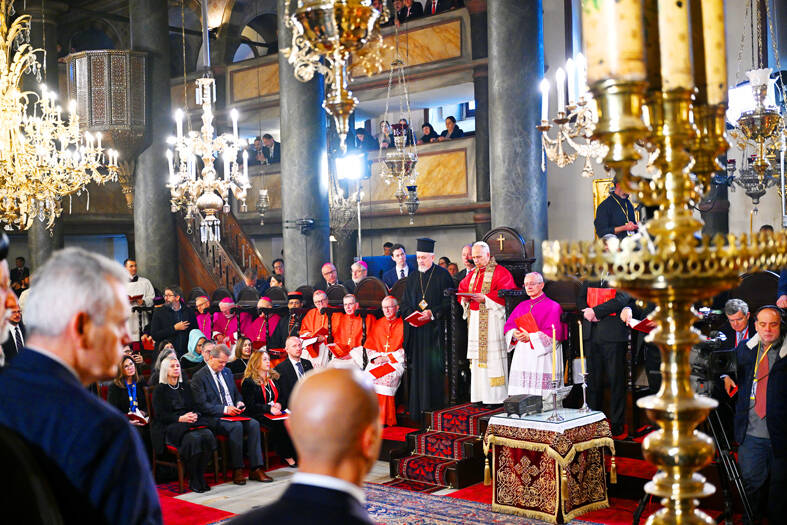
Photo: EPA/STRINGER
On his final morning, Leo attended a prayer service at the Armenian cathedral then joined a divine liturgy — the Orthodox equivalent of Mass — at the Patriarchal Church of St. George before a final blessing.
He was to have lunch with Patriarch Bartholomew I, the leader of the world’s Orthodox Christians, a day after they signed a joint declaration in which they pledged to take “new and courageous steps on the path towards unity.”
Despite doctrinal differences that led to the Great Schism of 1054, resulting in a split between the Roman Catholic Church in the West and the Eastern Orthodox Church, the two sides maintain dialogue and hold joint celebrations.
They also agreed to continue their efforts to establish a common date for Easter, which is currently celebrated by Catholics and Orthodox Christians on different days.
The pope’s trip comes as the Orthodox world appears more fragmented than ever, with Russia’s invasion of Ukraine accelerating the split between the Moscow and Constantinople patriarchates.
Pope Leo is the fifth pontiff to visit Turkey, after Paul VI in 1967, John Paul II in 1979, Benedict XVI in 2006 and Francis in 2014.
He was yesterday scheduled to leave Istanbul and fly to Beirut for a visit lasting until tomorrow.
The six-day two-nation trip is the first major international test for the first pope from the US, who was elected head of the Catholic Church in May and whose understated style contrasts with that of his charismatic and impulsive predecessor, Francis.
Although Leo’s visit drew little attention in Turkey, a Muslim-majority nation of 86 million whose Christian community numbers only about 100,000, it is eagerly awaited in Lebanon, a religiously diverse country of 5.8 million people.
Since 2019 Lebanon has been ravaged by crises, including an economic collapse, a devastating port blast in Beirut in 2020 and the recent war with Israel.

It began as a satirical online project. Now millions of young people in India are flocking to it as an outlet for their frustration. A parody political party called the Cockroach Janta Party, with the insect as its symbol, has exploded across India’s social media by turning absurdist humor into protest. Memes and short videos mocking corruption, joblessness and political dysfunction have flooded social media sites, where millions of users are embracing the cockroach — known for its ability to survive harsh conditions — as a tongue-in-cheek symbol of endurance. The online movement’s rise has been unusually rapid. The Cockroach Janta Party (CJP)
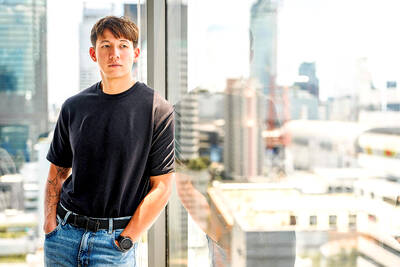
SPEAKING OUT: After Siranudh Scott’s allegations surfaced, celebrities and public figures took to social media to share their own experiences of sexual misconduct and abuse A high-profile alleged sexual abuse case within a wealthy Thai beer brewing family has prompted a wave of painful accounts from survivors of unconnected abuse in the conservative nation. Siranudh Scott, a member of the billionaire Thai family that founded the ubiquitous Singha beer brand, posted an emotional video this month accusing his elder brother Sunit of repeatedly abusing him when he was a teenager. Sunit, who is in his 30s, later denied the allegations in a video posted online, but Singha parent Boonrawd dismissed him from his executive role with the company on Tuesday last week. “I felt I needed to speak
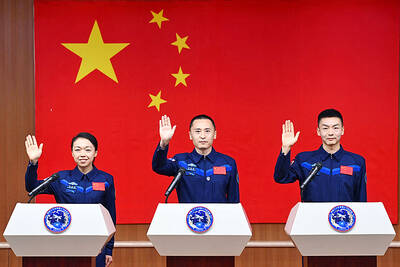
A Hong Kong astronaut is to join a Chinese space mission for the first time as part of a three-person crew launching today, as Beijing edges closer to its goal of landing people on the moon. The Tiangong space station — crewed by teams of three astronauts that are typically rotated every six months — is the crown jewel of China’s space program, boosted by billions in state investment in a bid to catch up with the US and Russia. The Shenzhou-23 mission is to blast off at 11:08pm from the Jiuquan Satellite Launch Center in northwestern China, carrying three astronauts to
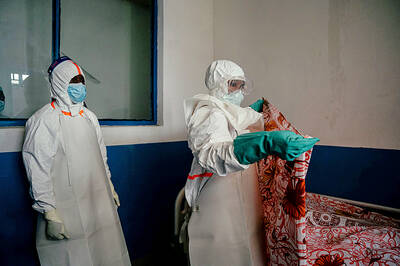
UPGRADED ALERT: The risk inside DR Congo is now considered ‘very high,’ while neighboring countries face a ‘high’ threat as the outbreak continues, the WHO said Ebola is spreading faster than responders can track it in eastern Congo, where health workers managed to follow up with barely one in five identified contacts in a single day. Authorities in the Democratic Republic of the Congo (DR Congo) reported 83 confirmed infections, 746 suspected cases and 1,603 identified contacts as of Thursday, but health workers were able to follow up on only 342 contacts that day — about 21 percent of the total under monitoring — data released by the DR Congo Ministry of Public Health on Friday showed. The figures suggest the response is falling behind the outbreak itself,


 RSS
RSS