


Britain’s Royal Mint is celebrating Freddie Mercury with a new coin design that marks 40 years since his iconic Live Aid concert performance.
The coin features an image of the Queen front man, head thrown back and holding the microphone stand midperformance. A musical stave that runs around the edge of the coin represents his four-octave vocal range.
The first coin was struck by Mercury’s sister Kashmira Bulsara at the Royal Mint in Wales last week.
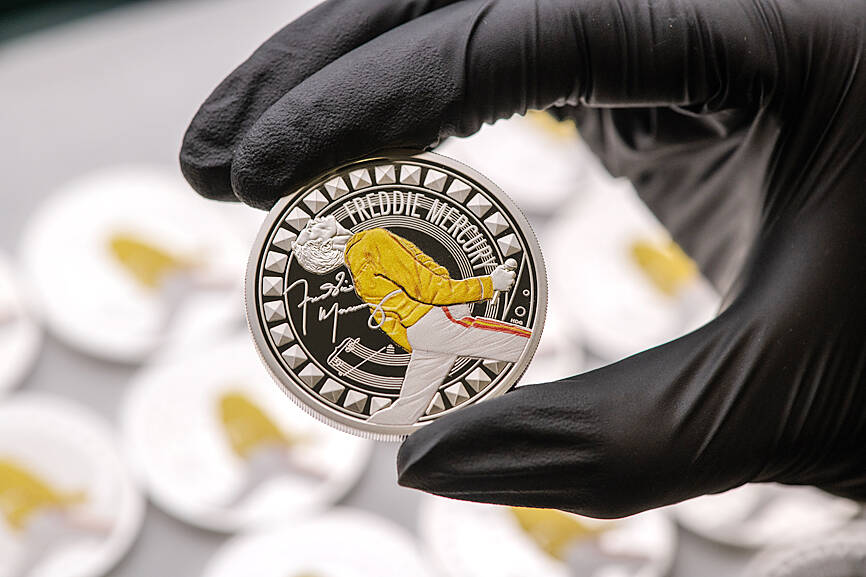
Photo: AP
“As Freddie died young, he didn’t get the chance of being awarded a royal medal for his talents in the music world. So to have a royal coin this way is wonderful and very fitting,” she said.
“The coin perfectly captures his passion and the joy he brought to millions through his music,” she added. “I think the design is very impressive and they managed to catch the most iconic pose of Freddie, which is so recognizable worldwide.”
Royal Mint director of commemorative coin Rebecca Morgan said the timing was perfect for Mercury to be celebrated with his own coin.

Photo: AP
She said fans had been “calling out” for it and “this felt like the year to do it,” because it’s 40 years since he captivated audiences at the 1985 Live Aid concert, hailed by many as the greatest live gig of all time.
This year also marks the 40th anniversary of Mercury’s solo studio album, Mr Bad Guy.
Mercury died at age 45 in 1991, just one day after he publicly announced he was HIV positive.
The Royal Mint has issued special coins to celebrate other music legends, including David Bowie, George Michael, Shirley Bassey and Paul McCartney.
The coins went on sale yesterday on the Royal Mint Web site.
Prices start at £18.50 (US$24.32) for an uncirculated £5 denomination version.
A 2 oz gold proof coin costs £9,350.
The Royal Mint said it would donate a special gold edition of the coin to the Mercury Phoenix Trust, a charity that was started in the singer’s memory and donates funds to those living with AIDS and HIV.
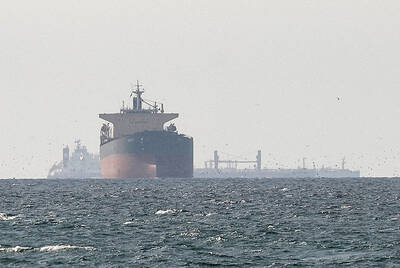
A ship that appears to be taking on the identity of a scrapped gas carrier exited the Strait of Hormuz on Friday, showing how strategies to get through the waterway are evolving as the Middle East war progresses. The vessel identifying as liquefied natural gas (LNG) carrier Jamal left the Strait on Friday morning, ship-tracking data show. However, the same tanker was also recorded as having beached at an Indian demolition yard in October last year, where it is being broken up, according to market participants and port agent’s reports. The ship claiming to be Jamal is likely a zombie vessel that

Cannabis-based medicines have shown little evidence of effectiveness for treating most mental health and substance-use disorders, according to a large review of past studies published in a major medical journal on Monday. Medical use of cannabinoids has been expanding, including in the US, Canada and Australia, where many patients report using cannabis products to manage conditions such as anxiety, post-traumatic stress disorder and sleep problems. Researchers reviewed data from 54 randomized clinical trials conducted between 1980 and May last year involving 2,477 participants for their analysis published in The Lancet. The studies assessed cannabinoids as a primary treatment for mental disorders or substance-use
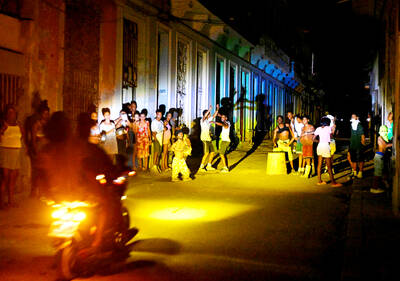
NATIONWIDE BLACKOUT: US President Donald Trump cut off Venezuelan oil shipments to Cuba, strangling the Caribbean island’s already antiquated grid Cuba’s national electric grid collapsed on Monday, the nation’s grid operator said, leaving about 10 million people without power amid a US-imposed oil blockade that has crippled the already obsolete generation system. Grid operator UNE on social media said that it is investigating the causes of the blackout, the latest in a series of widespread outages that last for hours or days and that this weekend sparked a rare violent protest in the communist-run nation. Officials ruled out a major power plant failure, but had still not pinpointed the root cause of the grid collapse, suggesting a problem with transmission. Officials said that

‘HEALTH ISSUE’: More than 250 women are hospitalized every day due to complications from unsafe abortions, and about three die, a study showed Jane had been bleeding heavily for days before finally seeking help, not from a hospital, but from the man who sold her the pills meant to end her six-week pregnancy. Abortions are strictly outlawed in the mainly Catholic Philippines, forcing women to turn to a patchwork of providers operating in the online shadows. While rare in practice, Philippine law allows for prison terms of up to six years for abortion patients and providers, leaving thousands of Filipinas to search for solutions in online forums where unlicensed sellers promote abortifacients. “It was very painful, as if my abdomen was being twisted,” said Jane, whose


 RSS
RSS