


US President Donald Trump bought at least US$82 million in corporate and municipal bonds from late August to early last month including new investments in sectors benefiting from his policies, financial disclosures made public on Saturday showed.
Trump carried out more than 175 financial purchases from Aug. 28 through Oct. 2, according to the forms released by the US Office of Government Ethics.
The disclosures, made under a 1978 transparency law called the Ethics in Government Act, do not list exact amounts for each purchase, only providing a broad range.
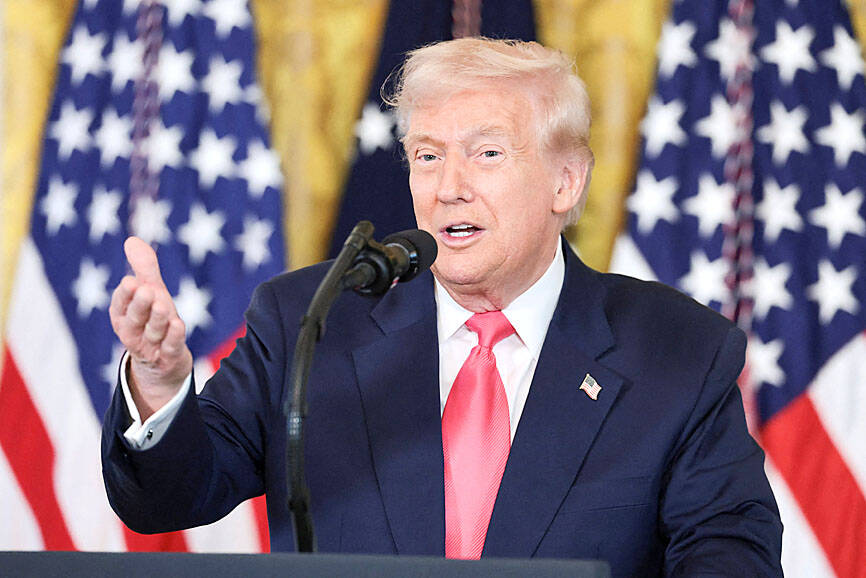
Photo: Reuters
The maximum total value of the bond purchases exceeded US$337 million, according to the filings.
Most of the assets listed in Saturday’s disclosures consist of bonds issued by municipalities, states, counties, school districts and other entities with ties to public agencies.
Trump’s new bond investments span several industries, including sectors that have already benefited, or are benefiting, from his administration’s policy changes such as financial deregulation.
Corporate bonds acquired by Trump include offerings from chipmakers such as Broadcom and Qualcomm, tech companies such as Meta Platforms, retailers such as Home Depot and CVS Health, and Wall Street banks such as Goldman Sachs and Morgan Stanley.
Purchases of the debt of investment banks in late August included bonds of JP Morgan.
On Friday, Trump asked the US Department of Justice to investigate JP Morgan over its ties to the late financier and convicted sex offender Jeffrey Epstein. The bank has said it regrets its past ties with Epstein and did not help him commit “heinous acts.”
Trump also acquired Intel bonds after the US government, under his direction, acquired a stake in the company.
The White House did not immediately respond to a request for comment on Saturday.
The administration has said before that Trump has continued to file mandatory disclosures about his investments, but that neither he nor his family has a role in running the portfolio, which is managed by a third-party financial institution.
Trump, who became wealthy in the real-estate sector before entering politics, has previously said that he placed his companies into a trust overseen by his children.
A disclosure filed in August indicated that Trump had purchased more than US$100 million in bonds since returning to the presidency on Jan. 20.
Trump also submitted his annual disclosure form in June, which indicated that income from his various ventures still ultimately goes to him, raising concerns of potential conflicts of interest.
In that annual disclosure, which appeared to cover last year, Trump reported more than US$600 million in income from cryptocurrencies, golf properties, licensing and other ventures. It also showed Trump’s push into crypto had added substantially to his wealth.
Overall, the US president’s June disclosure reported assets worth at least US$1.6 billion, according to a Reuters calculation at the time.
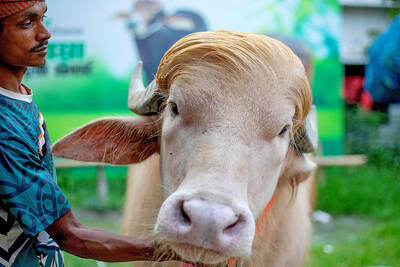
Crowds in Bangladesh are flocking to snap photographs with an unlikely social media star — an albino buffalo with flowing blond hair nicknamed “Donald Trump” that is due to be sacrificed within days. Owner Zia Uddin Mridha, 38, said his brother named the 700kg bull over its flowing helmet of hair resembling the signature look of the US president. “My younger brother picked this name because of the buffalo’s extraordinary hair,” he said at his farm in Narayanganj, just outside the capital, Dhaka. Mridha said that a constant stream of curious visitors — social media fans, onlookers and children — have come throughout

It began as a satirical online project. Now millions of young people in India are flocking to it as an outlet for their frustration. A parody political party called the Cockroach Janta Party, with the insect as its symbol, has exploded across India’s social media by turning absurdist humor into protest. Memes and short videos mocking corruption, joblessness and political dysfunction have flooded social media sites, where millions of users are embracing the cockroach — known for its ability to survive harsh conditions — as a tongue-in-cheek symbol of endurance. The online movement’s rise has been unusually rapid. The Cockroach Janta Party (CJP)
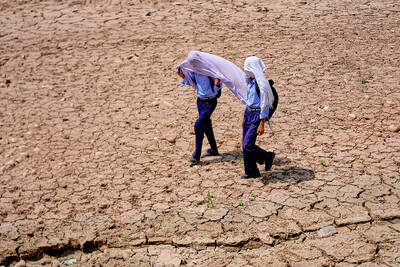
HOTTER: While Indians are accustomed to summer heat, climate change has caused northwestern India to warm faster than other parts of the country, an academic said Roads and markets have emptied during afternoons and some farmers have switched to nighttime work to avoid scorching temperatures as a heat wave grips large parts of India. The India Meteorological Department forecast maximum temperatures for yesterday of about 45°C in the capital, New Delhi, where authorities have opened temporary “cooling zones” to help people cope. The weather department warned that conditions would likely persist across several northern regions in the coming days, with temperatures staying well above seasonal averages. Authorities urged people to stay indoors during the hottest hours and take precautions against heat-related illnesses. India declares a heat wave whenever maximum temperatures
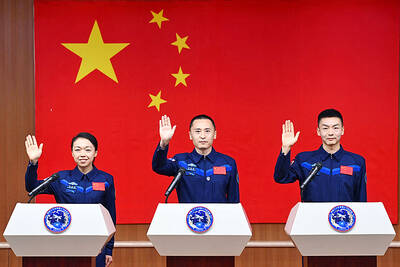
A Hong Kong astronaut is to join a Chinese space mission for the first time as part of a three-person crew launching today, as Beijing edges closer to its goal of landing people on the moon. The Tiangong space station — crewed by teams of three astronauts that are typically rotated every six months — is the crown jewel of China’s space program, boosted by billions in state investment in a bid to catch up with the US and Russia. The Shenzhou-23 mission is to blast off at 11:08pm from the Jiuquan Satellite Launch Center in northwestern China, carrying three astronauts to


 RSS
RSS