


More than 100 people were injured and 20 arrested on Saturday during a massive protest in Mexico City against the Mexican president’s handling of violent crime, local government officials said.
Thousands marched on the capital’s historic main public square, the Zocalo, in a demonstration fueled by young Mexicans with ties to a global wave of Gen Z protests as well as supporters of the domestic “Sombrero movement,” which emerged after the recent assassination of a mayor known for his fight against organized crime.
Participants of all ages took part in the rally in front of the Mexican National Palace, where Mexican President Claudia Sheinbaum lives and works.
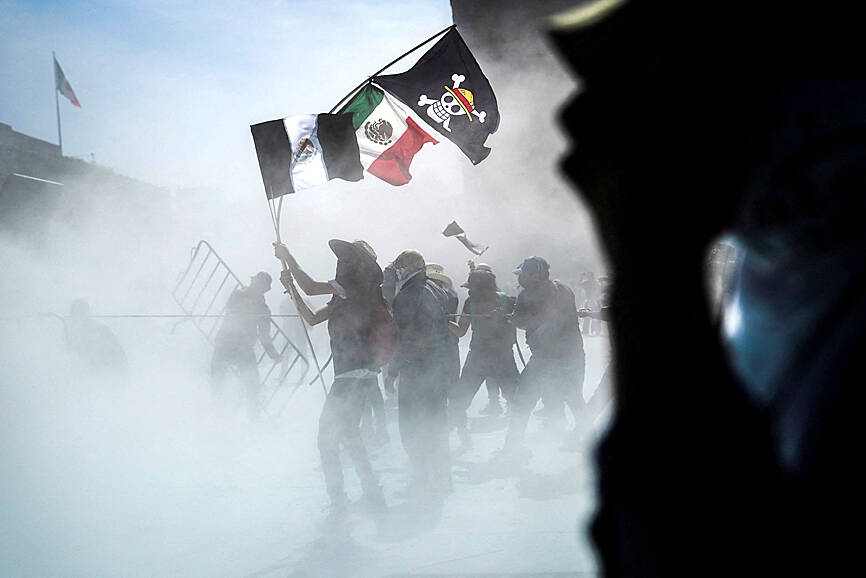
Photo: Reuters
Several protesters, some wearing balaclavas, toppled the metal barriers protecting the palace and threw paving stones at riot police, who responded with tear gas.
“For many hours, this mobilization proceeded and developed peacefully, until a group of hooded individuals began to commit acts of violence,” Pablo Vazquez, Mexico City’s security chief, told reporters.
Twenty protesters and 100 police were injured, with 40 officers hospitalized for cuts and bruises, he added.
Police arrested 20 people for theft and assault, Vazquez said, adding that they also launched an investigation into the assault of a journalist from La Jornada newspaper, which alleged police officers were behind the incident.
Sheinbaum, in power since October last year, maintained approval ratings above 70 percent in her first year in office, but faced growing criticism of her security policies in the wake of several high-profile murders.
“This is one of the most corrupt governments we’ve ever had,” said Valentina Ramirez, a student. “It’s a corrupt narco-government that wants to defend the corrupt and the cartels instead of the people.”
On Saturday, several protesters wore sombreros similar to the style of hat made famous by Carlos Manzo, a mayor in western Michoacan state who was assassinated on Nov. 1. He had been known for his crusade against drug-trafficking gangs in his hometown Uruapan.
However, the assassinated mayor’s widow distanced her husband’s movement from the demonstration on Saturday.
Bernardo Bravo, a leader of lime producers in the same region, had also been shot dead late last month.
Earlier this week, Sheinbaum questioned the motivations for the demonstration and said at her regular morning news conference that the protest was “inorganic” and “paid for.”
“It is a movement promoted from abroad against the government,” she said.
Demonstrators displayed banners bearing messages such as “We are all Carlos Manzo” alongside the iconic pirate flag from the Japanese manga One Piece, which has become a symbol of youth protest around the world, from Madagascar to the Philippines and Peru.

‘CROSSING THE LINE’: China’s embassy in Seoul criticized US Forces Korea Commander General Xavier Brunson, asking if his ‘hostile’ remarks were authorized by Washington South Korea and the US are in talks over recent public remarks by the commander of US Forces Korea, Seoul’s presidential office said yesterday, after the comments drew sharp criticism from China. In a recent podcast interview, US Forces Korea Commander General Xavier Brunson described South Korea as “the dagger in the heart of Asia” from China’s east coast, prompting the Chinese embassy in Seoul to say that he had “truly crossed the line.” The interview came amid growing speculation that Washington might seek to expand the role of US Forces Korea in countering the growing regional influence of China, a key

SEEKING ORDER: Rodrigo Paz said that ‘anyone who wants to destroy the nation will have to deal with this president and the full force of the constitution’ Bolivian President Rodrigo Paz on Wednesday said that the nation was at a “breaking point” after nearly a month of protests that have caused shortages of food, fuel and medicine. Paz, who took office six months ago amid the worst economic crisis there in four decades, is battling a groundswell of fury over his policies. The political capital, La Paz, has been besieged by low-income workers and members of the indigenous majority calling for his resignation. “The country needs order and is reaching breaking point,” the 58-year-old said at a public event in La Paz, renewing his appeal for dialogue. On Tuesday, the Bolivian

Through the noise of rushing papers and whirring belts at a print factory in Kyoto, two creators watch their photo essay come to life in broadsheet form — part of an effort to win new audiences in the age of artificial intelligence (AI). Despite the decline of the publishing industry, self-publication and handmade “zine” magazines are growing in popularity in Japan, reflecting the nation’s enduring love of paper in the digital era. While speaking to Agence France-Presse at the plant, his hands black with ink, one of the creators, Kazuma Obara, said: “I think [paper] is a medium that engages all five

Australian researchers have trained lab-grown brain cells on a silicon computer chip to play the 1990s shooter game Doom and said they are just scratching the surface of what the neurons could be capable of doing. It is the science-fiction work of biotech boffins at Cortical Labs, who researched and developed the technology that harnesses the workings of the brain’s networking system. Each so-called “biological computer” contains about 200,000 living human brain cells, grown from stem cells that were harvested from blood donations. Having mastered the simple computer game Pong, where a paddle is moved up and down to send a ball


 RSS
RSS