


At least 26 people have been killed and hundreds of thousands displaced, as rains driven by Typhoon Kalmaegi yesterday flooded swathes of the central Philippines.
Entire towns on the island of Cebu have been inundated, while cars, trucks and even massive shipping containers could be seen swept along by muddy floodwaters in videos verified by Agence France-Presse.
In Cebu alone, 21 people were confirmed dead, Philippine Office of Civil Defense Deputy Administrator Rafaelito Alejandro said by telephone, giving the storm’s current death toll as 26.
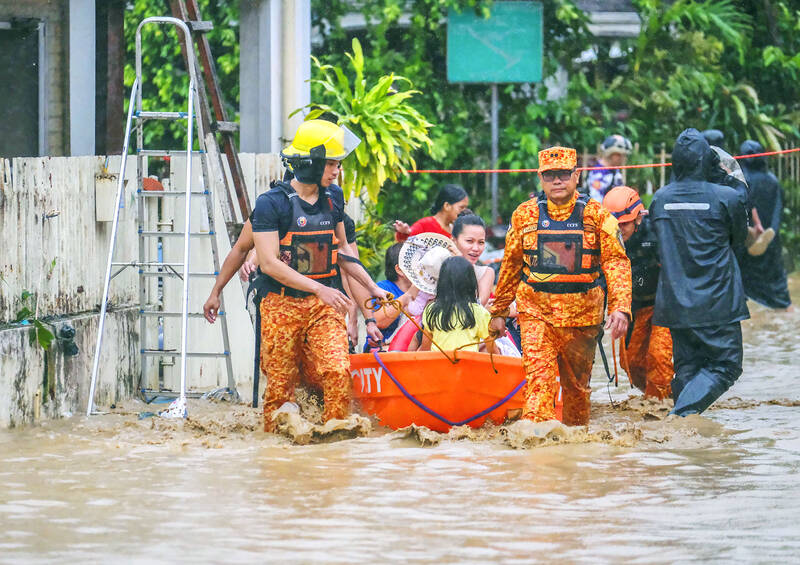
Photo: EPA
“Based on information that we have, most of them died from drowning,” he said.
In the 24 hours before Kalmaegi’s landfall, the area around provincial capital Cebu City was deluged with 183mm of rain, well over its 131mm monthly average, state weather specialist Charmagne Varilla said.
“The situation in Cebu is really unprecedented,” Cebu Governor Pamela Baricuatro wrote on Facebook.
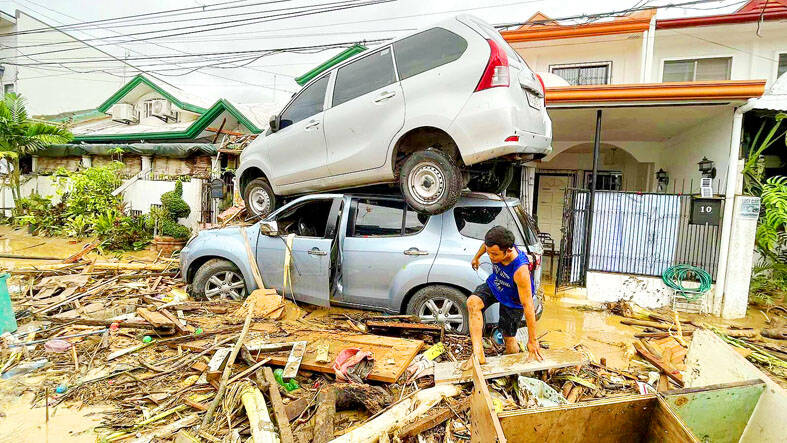
Photo: AP
“We were expecting the winds to be the dangerous part, but ... the water is what’s truly putting our people at risk,” she said. “The floodwaters are just devastating.”
Local disaster official Ethel Minoza said the bodies of two children had been recovered in Cebu City, where rescuers were still attempting to reach residents trapped by floodwaters.
Deaths in other provinces included an elderly resident who drowned in an upper floor of their home in Leyte province and a man struck by a falling tree in Bohol.
Don del Rosario, 28, was among those in Cebu City who sought refuge on an upper floor as the storm raged.
“The water rose so fast,” he said. “By 4am, it was already uncontrollable — people couldn’t get out [of their houses].”
“I’ve been here for 28 years, and this is by far the worst we’ve experienced.”
Scientists warn that storms are becoming more powerful due to human-driven climate change. Warmer oceans allow typhoons to strengthen rapidly, and a warmer atmosphere holds more moisture, meaning heavier rainfall.
Hundreds still living in tent cities after a magnitude 6.9 quake rocked the island in late September were “forcibly evacuated for their own safety,” Cebu information officer Rhon Ramos said by telephone.
In total, nearly 400,000 people were pre-emptively moved from the typhoon’s path, Alejandro said at an earlier news briefing yesterday.
Late yesterday afternoon, the Philippine military confirmed that a helicopter with five personnel deployed to assist relief efforts had crashed on northern Mindanao island.
The Super Huey helicopter went down while en route to the coastal city of Butuan “in support of relief operations” related to the powerful storm, Eastern Mindanao Command said in a statement, adding that search and recovery operations were under way.
A spokesperson declined to say if there were any survivors.
The typhoon is now moving westward through the Visayan island chain, with winds of 130kph and gusts of 180kph toppling trees and downing power lines.
In related news, the death toll from a week of flooding and record rains in central Vietnam yesterday rose to 40, authorities said, as Typhoon Kalmaegi loomed.
Vietnam’s central belt has been deluged by torrential rains turning streets into canals, bursting riverbanks and inundating some of the nation’s most-visited historic sites.
Up to 1.7m fell over one 24-hour period in a downpour breaking national records.
The fatalities occurred in Hue, Da Nang, Lam Dong and Quang Tri provinces, the Vietnam Disaster Management Authority said, adding that six people remained missing.
The onslaught of extreme weather is set to continue, with Typhoon
Kalmaegi is forecast to make landfall in the early hours of Friday morning, the National Center for Hydro-Meteorological Forecasting said.
It could hit Vietnam’s coast with winds of up to 166kph, as it approaches tomorrow, it said.
The region was yesterday reeling from the past week’s extreme weather, with some remote areas still isolated by road-blocking landslides.
Nearly 80,000 houses remain flooded, the disaster agency said, while more than 10,000 hectares of crops have been destroyed and more than 68,000 cattle killed.

SPEAKING OUT: After Siranudh Scott’s allegations surfaced, celebrities and public figures took to social media to share their own experiences of sexual misconduct and abuse A high-profile alleged sexual abuse case within a wealthy Thai beer brewing family has prompted a wave of painful accounts from survivors of unconnected abuse in the conservative nation. Siranudh Scott, a member of the billionaire Thai family that founded the ubiquitous Singha beer brand, posted an emotional video this month accusing his elder brother Sunit of repeatedly abusing him when he was a teenager. Sunit, who is in his 30s, later denied the allegations in a video posted online, but Singha parent Boonrawd dismissed him from his executive role with the company on Tuesday last week. “I felt I needed to speak

A Hong Kong astronaut is to join a Chinese space mission for the first time as part of a three-person crew launching today, as Beijing edges closer to its goal of landing people on the moon. The Tiangong space station — crewed by teams of three astronauts that are typically rotated every six months — is the crown jewel of China’s space program, boosted by billions in state investment in a bid to catch up with the US and Russia. The Shenzhou-23 mission is to blast off at 11:08pm from the Jiuquan Satellite Launch Center in northwestern China, carrying three astronauts to

UPGRADED ALERT: The risk inside DR Congo is now considered ‘very high,’ while neighboring countries face a ‘high’ threat as the outbreak continues, the WHO said Ebola is spreading faster than responders can track it in eastern Congo, where health workers managed to follow up with barely one in five identified contacts in a single day. Authorities in the Democratic Republic of the Congo (DR Congo) reported 83 confirmed infections, 746 suspected cases and 1,603 identified contacts as of Thursday, but health workers were able to follow up on only 342 contacts that day — about 21 percent of the total under monitoring — data released by the DR Congo Ministry of Public Health on Friday showed. The figures suggest the response is falling behind the outbreak itself,

SEEKING ORDER: Rodrigo Paz said that ‘anyone who wants to destroy the nation will have to deal with this president and the full force of the constitution’ Bolivian President Rodrigo Paz on Wednesday said that the nation was at a “breaking point” after nearly a month of protests that have caused shortages of food, fuel and medicine. Paz, who took office six months ago amid the worst economic crisis there in four decades, is battling a groundswell of fury over his policies. The political capital, La Paz, has been besieged by low-income workers and members of the indigenous majority calling for his resignation. “The country needs order and is reaching breaking point,” the 58-year-old said at a public event in La Paz, renewing his appeal for dialogue. On Tuesday, the Bolivian


 RSS
RSS