


India trialed cloud seeding over its smog-filled capital for the first time, spraying a chemical from an airplane to encourage rain and wash deadly particles out of the air.
Cloud seeding is the practice of using airplanes to fire salt or other chemicals into clouds to induce rain.
New Delhi city authorities, working with the government’s Indian Institute of Technology Kanpur, launched a test run on Thursday afternoon using a Cessna light airplane over the city’s northern Burari area.
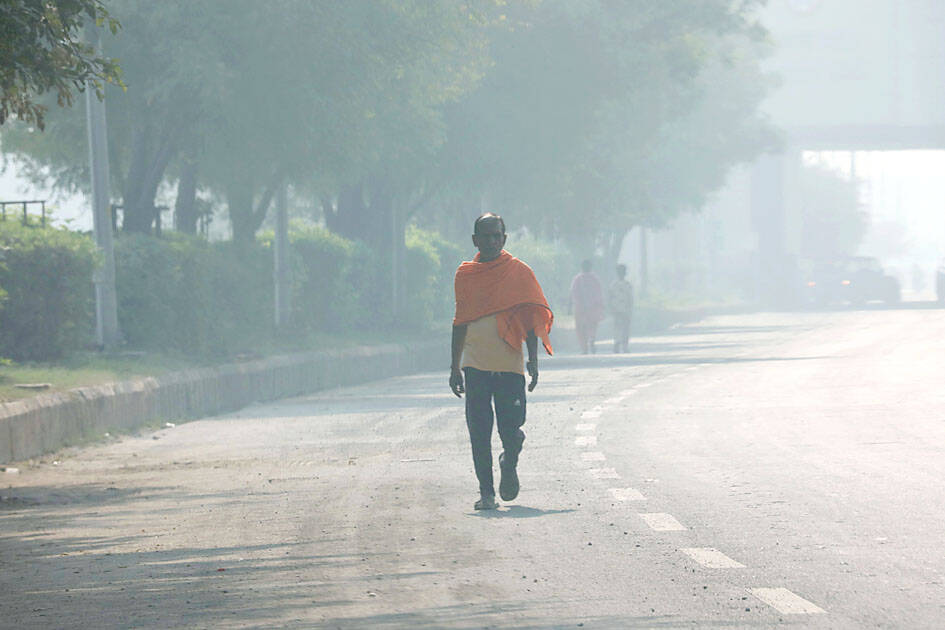
Photo: EPA
“A trial seeding flight was done... in which cloud seeding flares were fired,” Delhi Minister for Environment, Forest and Wildlife Manjinder Singh Sirsa said in a statement on Thursday.
It comes ahead of a planned rollout of the scheme.
Delhi Chief Minister Rekha Gupta said that “if conditions remain favorable, Delhi will experience its first artificial rain on Oct. 29.”
It was not immediately clear what chemical was used in the test to encourage the rain.
New Delhi and its sprawling metropolitan region of 30 million people are regularly ranked among the world’s most polluted capitals, with acrid smog blanketing the skyline each winter.
Cooler air traps pollutants close to the ground, creating a deadly mix of emissions from crop burning, factories and heavy traffic.
Levels of PM2.5 — cancer-causing microparticles small enough to enter the bloodstream — at times rise to as much as 60 times UN daily health limits.
Pollution rose this week after days of fireworks launched to mark the Hindu festival of lights, Diwali, shooting PM2.5 levels to more than 56 times the limit.
That came after the Indian Supreme Court this month eased a blanket ban on fireworks to allow the use of the less-polluting “green” crackers — developed to reduce particulate emission.
At dawn on Thursday, PM2.5 levels were 154 micrograms per cubic meter in parts of New Delhi, according to monitoring organization IQAir, just more than 10 times WHO limits.
A study last month found that the noxious air is even turning Delhi’s iconic 17th-century Red Fort black.
Invented in the 1940s, countries have been seeding clouds for decades to alleviate drought, fight forest fires and even to disperse fog at airports.
However, research on the effects of cloud seeding on neighboring regions is mixed, and some evidence suggests it does not work very well even in the target area.
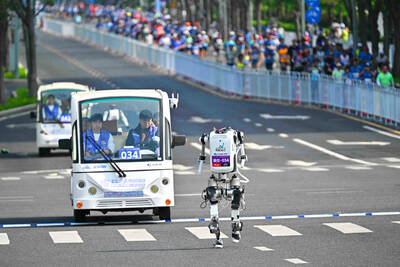
A humanoid robot that won a half-marathon race for robots in Beijing on Sunday ran faster than the human world record in a show of China’s technological leaps. The winner from Honor, a Chinese smartphone maker, completed the 21km race in 50 minutes and 26 seconds, said a WeChat post by the Beijing Economic-Technological Development Area, also known as Beijing E-Town, where the race began. That was faster than the human world record holder, Ugandan Jacob Kiplimo, who finished the same distance in about 57 minutes in March at the Lisbon road race. The performance by the robot marked a significant step forward
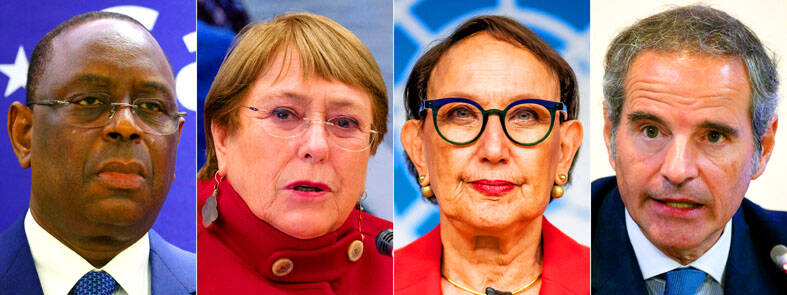
Four contenders are squaring up to succeed Antonio Guterres as secretary-general of the UN, which faces unprecedented global instability, wars and its own crushing budget crisis. Chile’s Michelle Bachelet, Argentina’s Rafael Grossi, Costa Rica’s Rebeca Grynspan and Senegal’s Macky Sall are each to face grillings by 193 member states and non-governmental organizations for three hours today and tomorrow. It is only the second time the UN has held a public question-and-answer, a format created in 2016 to boost transparency. Ultimately the five permanent members of the UN’s top body, the Security Council, hold the power, wielding vetoes over who leads the
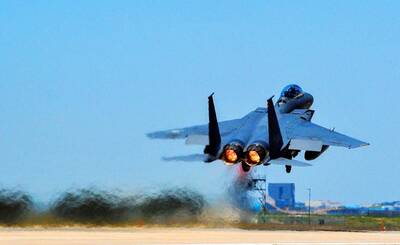
South Korea’s air force yesterday apologized for a 2021 midair collision involving two fighter jets, a day after auditors said the pilots were taking selfies and filming during the flight and held them responsible for the accident. “We sincerely apologize to the public for the concern caused by the accident that occurred in 2021,” an air force spokesman told a news conference, adding that one of the pilots involved had been suspended from flying duties, received severe disciplinary action and has since left the military. The apology followed a report released on Wednesday by the South Korean Board of Audit and Inspection,
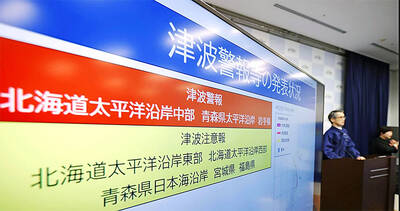
An earthquake registering a preliminary magnitude of 7.7 off northern Japan on Monday prompted a short-lived tsunami alert and the advisory of a higher risk of a possible mega-quake for coastal areas there. The Cabinet Office and the Japan Meteorological Agency said there was a 1% chance for a mega-quake, compared to a 0.1% chance during normal times, in the next week or so following the powerful quake near the Chishima and Japan trenches. Officials said the advisory was not a quake prediction but urged residents in 182 towns along the northeastern coasts to raise their preparedness while continuing their daily lives. Prime


 RSS
RSS