


US Secretary of State Marco Rubio late on Wednesday warned that moves by the Israeli parliament toward the annexation of the West Bank could threaten US President Donald Trump’s plan to end the war in Gaza, which has yielded a shaky ceasefire so far.
“That’s a vote in the Knesset, but obviously I think the president’s made clear that’s not something we’d be supportive of right now, and we think it’s potentially threatening to the peace deal,” Rubio told reporters before leaving for Israel.
Rubio’s visit is the latest by a senior US official seeking to keep alive the brittle truce between Israel and Palestinian militant group Hamas after two years of devastating war that has upended the Middle East.

Photo: AFP
Repeated bouts of gunfire and explosions have shaken the deal and the two sides have traded blame for violations of its first phase, which has seen the return of Israeli hostages in exchange for Palestinian prisoners, a handover of bodies of some deceased hostages and a partial pullout of Israeli troops.
Witnesses reported almost constant heavy gunfire and tank shelling overnight in eastern areas of Khan Younis in the southern Gaza Strip and also east of Gaza City in the north of the Palestinian enclave.
“Gunfire and explosions almost didn’t stop until the morning, my three children woke up and asked me if the war had come back,” said Mohammad Abu Mansour, 40, a farmer living in central Gaza Strip.
“When is this all going to end and we regain our normal lives without fears?” he said in a chat message.
Rubio was visiting Israel to support the implementation of Trump’s 20-point plan to end Gaza’s war and pave the way toward reconstruction, stable governance and possible steps toward Palestinian statehood, the US Department of State said.
A bill applying Israeli law to the occupied West Bank, a move tantamount to annexation of land that Palestinians want for an independent state, won preliminary approval from Israel’s parliament on Wednesday.
About 700,000 Jewish settlers live in settlements across the West Bank. The UN and much of the international community consider the settlements illegal under international law.
The vote was the first of four needed to pass the law and coincided with US President J.D. Vance’s visit to Israel, a month after Trump said that he would not allow Israel to annex the territory it took in the 1967 Middle East war.
Meanwhile, the International Court of Justice on Wednesday said in an advisory opinion that Israel is obligated to ensure that the basic needs of the civilian population in Gaza are met.
The panel of 11 judges added that Israel has to support relief efforts provided by the UN in the Gaza Strip.
“As an occupying power, Israel is obliged to ensure the basic needs of the local population, including the supplies essential for their survival,” presiding Judge Yuji Iwasawa said.
He added that basic needs include food, water, shelter, fuel and medical services.

SPEAKING OUT: After Siranudh Scott’s allegations surfaced, celebrities and public figures took to social media to share their own experiences of sexual misconduct and abuse A high-profile alleged sexual abuse case within a wealthy Thai beer brewing family has prompted a wave of painful accounts from survivors of unconnected abuse in the conservative nation. Siranudh Scott, a member of the billionaire Thai family that founded the ubiquitous Singha beer brand, posted an emotional video this month accusing his elder brother Sunit of repeatedly abusing him when he was a teenager. Sunit, who is in his 30s, later denied the allegations in a video posted online, but Singha parent Boonrawd dismissed him from his executive role with the company on Tuesday last week. “I felt I needed to speak

SEEKING ORDER: Rodrigo Paz said that ‘anyone who wants to destroy the nation will have to deal with this president and the full force of the constitution’ Bolivian President Rodrigo Paz on Wednesday said that the nation was at a “breaking point” after nearly a month of protests that have caused shortages of food, fuel and medicine. Paz, who took office six months ago amid the worst economic crisis there in four decades, is battling a groundswell of fury over his policies. The political capital, La Paz, has been besieged by low-income workers and members of the indigenous majority calling for his resignation. “The country needs order and is reaching breaking point,” the 58-year-old said at a public event in La Paz, renewing his appeal for dialogue. On Tuesday, the Bolivian

COMMUNITY CONFLICT: Concerns about disease spread from corpses has run up against friends and families’ desire to bury their dead as infection spreads in the area Angry residents of a town at the epicenter of the Ebola outbreak in the Democratic Republic of the Congo (DR Congo) attacked and burned a tent that was part of a health center where people are being treated for the virus, the staff there said Saturday. It was the second such attack in the region in a week. No one was hurt in the attack, according to reports but as patients ran out to escape the fire, 18 people with suspected Ebola infections fled the facility and are unaccounted for, a hospital director said. Angry residents arrived at the clinic in the
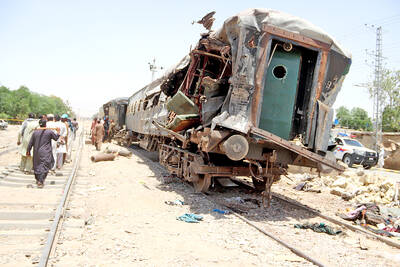
INSURGENT ACTION: A local independence movement in Balochistan, alleged by Pakistan’s government to be backed by India, claimed responsibility for the strike A suicide bomber detonated an vehicle-borne IED near a railway as a passenger train passed through the southwestern Pakistani city of Quetta yesterday, killing at least 23 people and wounding over 70, officials said. The explosion caused two of the train cars to overturn and catch fire, according to footage shared online. The attack happened in an area where security forces are usually stationed, badly damaging several nearby buildings and smashing more than a dozen vehicles parked along the road, according to witnesses and images circulating on social media. Doctors at local hospitals said they had received the wounded, with 20 in critical


 RSS
RSS