


The special delivery arrived in a plastic storage box after a chartered flight in bouncy, single-propeller plane. Veterinarian Susan Shaffer Sookram snipped the zip ties securing the lid and greeted the cargo: four dogs, one with a gray collar bearing its name, Happy.
“What a scary ride!” she said. “You made it!”
As officials in Alaska work around the clock on one of the most significant airlift operations in state history — evacuating more than 1,000 people from remote, flood-battered villages on the coast of the Bering Sea — another rescue operation is playing out: getting the dogs left behind to safety, in hopes of reuniting them with their owners.
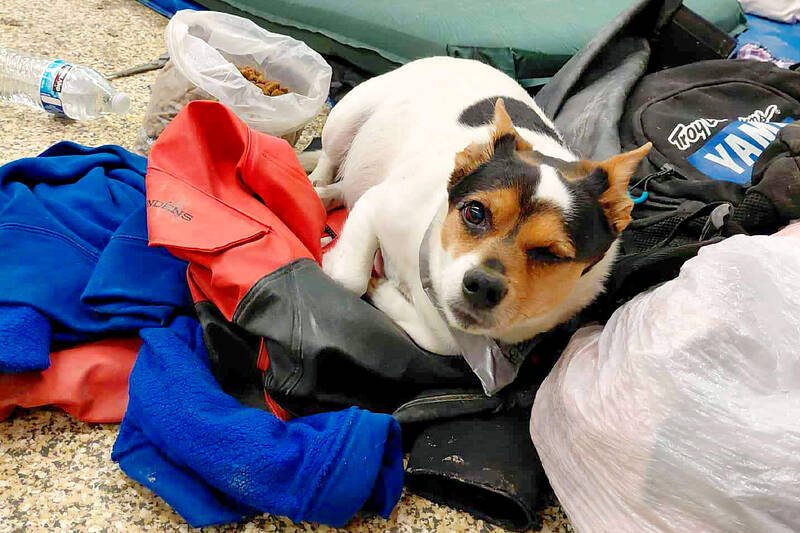
Photo: Lacqui Lang via AP
The pet shelters closest to the devastated villages are in Bethel, Alaska.
When Bethel Friends of Canines, a nonprofit that helps rehome animals, learned that 50 to 100 dogs might be abandoned in Kipnuk, it scrambled to charter a plane to evacuate them.
“It costs us US$3,000 to do this so and we don’t know how many times we’re gonna have to do it,” organizer Jesslyn Elliott said. “We’ve never had a natural disaster to this, like, magnitude. So this is all very, very foreign and new to us. So we’re just kind of winging it.”
The first flight arrived in Bethel on Wednesday night, and more happened Thursday. Dozens of dogs have passed through her kennel since the floods began. The nonprofit had raised more than US$22,000 after pleading on Facebook for donations.
The flooding, caused by remnants of Typhoon Halong, has damaged homes in 11 small rural communities, with no more than a few hundred residents, the Federal Emergency Management Agency said.
State officials began airlifting people to Anchorage on Wednesday, as local leaders in Kipnuk and Kwigillingok, near the Bering Sea, asked to evacuate residents and as shelters in Bethel neared capacity.
Pets were not allowed on the military evacuation flights, as the evacuation of people is the priority, state officials said.
Bethel Friends of Canines received dogs throughout the week as people fleeing their homes arrived by boat and by plane. There are no roads connecting towns in the area.
Before the devastating floods, Bethel Friends of Canines typically held 15 to 20 dogs at any one time. Now, as many as 15 dogs have arrived on a single flight.
Elliott said at least eight dogs had been reunited with owners in Anchorage as of Thursday morning.
With the human population in Kipnuk shrinking each day, the animal caretakers in Bethel realized they had to act fast, before everyone who knew the dogs was gone.
Some of the last people to stay behind and serve the community are teachers. Schools in flooded towns have served as emergency shelters and meeting places through the relief effort.
Back in Kipnuk, Happy was found waiting on its owner’s clothes, refusing to move or eat, by teacher Jacqui Lang.
The dog has since been reunited with its family, she said.
Lang is one of two or three teachers who helped wrangle the pets to be loaded at the airstrip, Lower Kuskokwim School District Superintendent Andrew Anderson said.
When Bethel Friends of Canines worker Matthew Morgan landed in Kipnuk on Wednesday, the teachers had fed the dogs, coaxed them into crates and labeled them with tags listing their owners.
“You’ve got some heroes out in Kipnuk. They’re like the last people left there,” Morgan said. Without them, “it would have been chasing dogs all night in the mud.”

Crowds in Bangladesh are flocking to snap photographs with an unlikely social media star — an albino buffalo with flowing blond hair nicknamed “Donald Trump” that is due to be sacrificed within days. Owner Zia Uddin Mridha, 38, said his brother named the 700kg bull over its flowing helmet of hair resembling the signature look of the US president. “My younger brother picked this name because of the buffalo’s extraordinary hair,” he said at his farm in Narayanganj, just outside the capital, Dhaka. Mridha said that a constant stream of curious visitors — social media fans, onlookers and children — have come throughout

It began as a satirical online project. Now millions of young people in India are flocking to it as an outlet for their frustration. A parody political party called the Cockroach Janta Party, with the insect as its symbol, has exploded across India’s social media by turning absurdist humor into protest. Memes and short videos mocking corruption, joblessness and political dysfunction have flooded social media sites, where millions of users are embracing the cockroach — known for its ability to survive harsh conditions — as a tongue-in-cheek symbol of endurance. The online movement’s rise has been unusually rapid. The Cockroach Janta Party (CJP)
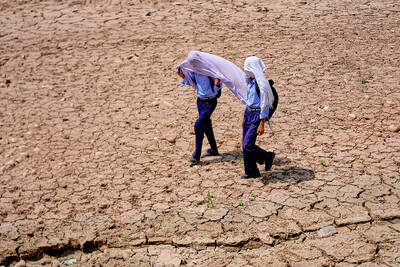
HOTTER: While Indians are accustomed to summer heat, climate change has caused northwestern India to warm faster than other parts of the country, an academic said Roads and markets have emptied during afternoons and some farmers have switched to nighttime work to avoid scorching temperatures as a heat wave grips large parts of India. The India Meteorological Department forecast maximum temperatures for yesterday of about 45°C in the capital, New Delhi, where authorities have opened temporary “cooling zones” to help people cope. The weather department warned that conditions would likely persist across several northern regions in the coming days, with temperatures staying well above seasonal averages. Authorities urged people to stay indoors during the hottest hours and take precautions against heat-related illnesses. India declares a heat wave whenever maximum temperatures

A Hong Kong astronaut is to join a Chinese space mission for the first time as part of a three-person crew launching today, as Beijing edges closer to its goal of landing people on the moon. The Tiangong space station — crewed by teams of three astronauts that are typically rotated every six months — is the crown jewel of China’s space program, boosted by billions in state investment in a bid to catch up with the US and Russia. The Shenzhou-23 mission is to blast off at 11:08pm from the Jiuquan Satellite Launch Center in northwestern China, carrying three astronauts to


 RSS
RSS