


India’s wild elephant population estimates have dropped sharply by one-quarter, a government survey incorporating a new DNA system has found.
India is home to the majority of the world’s wild Asian elephants, a species listed as endangered by the International Union for Conservation of Nature (IUCN) and increasingly threatened by shrinking habitats.
The Wildlife Institute of India’s new All-India Elephant Estimation report released this week put the wild elephant population at 22,446 — down from nearly 29,964 estimated in 2017, a fall of 25 percent.
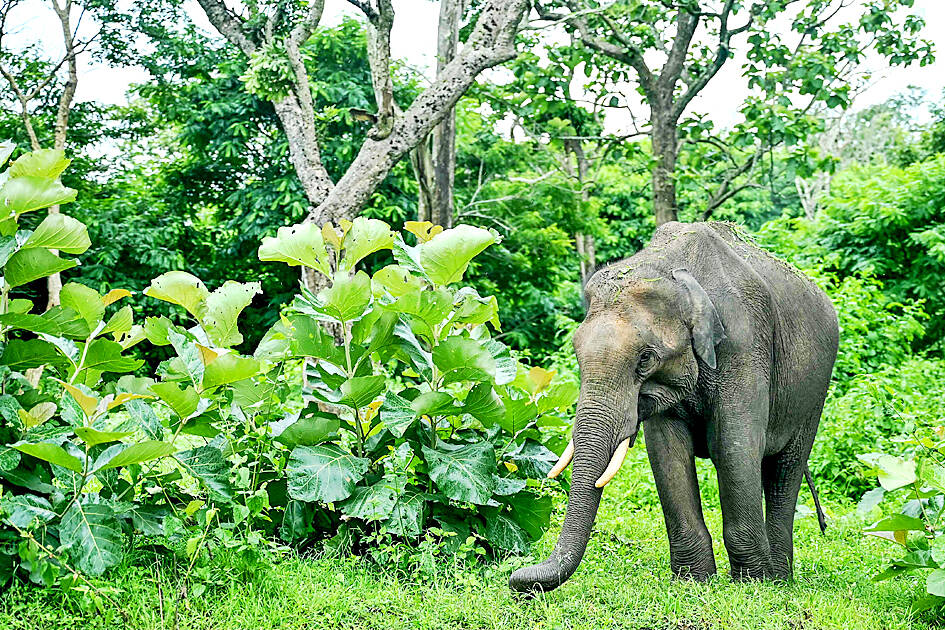
Photo: AFP
The survey drew on genetic analysis of more than 21,000 dung samples, alongside a vast network of camera traps and 667,000km of foot surveys.
However, researchers said that the methodological overhaul meant the results were “not comparable to past figures and may be treated as a new monitoring baseline.”
The report also warned that the figures reflect deepening pressures on one of India’s most iconic animals.
“The present distribution of elephants in India represents a mere fraction of their historical range,” it said, estimating that they now occupy only about 3.5 percent of the area they once roamed.
Habitat loss, fragmentation and increasing human-elephant conflict are driving the decline.
“Electrocution and railway collisions cause a significant number of elephant fatalities, while mining and highway construction disrupt habitats, intensifying man-wildlife conflicts,” the report said.
The Western Ghats, lush southern highlands stretching through Karnataka, Tamil Nadu and Kerala, remain a key stronghold with nearly 12,000 elephants.
However, even there, populations are increasingly cut off from one another by commercial plantations, farmland fencing and human encroachment.
Another major population center lies in India’s northeast, including Assam and the Brahmaputra floodplains, which host more than 6,500 elephants.
“Strengthening corridors and connectivity, restoring habitat, improving protection, and mitigating the impact of development projects are the need of the hour to ensure the well-being of these gentle giants,” the report said.

A US YouTuber who caused outrage for filming himself kissing a statue commemorating Korean wartime sex slaves has been sentenced to six months in prison, a court in Seoul said yesterday. Johnny Somali, 25, gained notoriety several years ago for recording himself doing a series of provocative stunts in South Korea and Japan, and streaming them on platforms such as YouTube and Twitch. South Korean authorities indicted Somali — whose real name is Ramsey Khalid Ismael — in 2024 on public order violations and obstruction of business, and banned him from leaving the country. “The court has sentenced him to six months in

Former Lima mayor Rafael Lopez Aliaga, a Peruvian presidential hopeful, gathered hundreds of supporters in Lima on Tuesday and gave authorities 24 hours to annul the first round of the country’s election over allegations of fraud. Lopez Aliaga is locked in a tight three-way race with two other candidates for second place in Sunday’s vote. The election runner-up wins a ticket to June’s presidential run-off against front-runner Keiko Fujimori. “I am giving them 24 hours to declare this electoral fraud null and void,” said Lopez Aliaga, surrounded by a crowd of several hundred supporters. “If it is not declared null and void tomorrow,

Four contenders are squaring up to succeed Antonio Guterres as secretary-general of the UN, which faces unprecedented global instability, wars and its own crushing budget crisis. Chile’s Michelle Bachelet, Argentina’s Rafael Grossi, Costa Rica’s Rebeca Grynspan and Senegal’s Macky Sall are each to face grillings by 193 member states and non-governmental organizations for three hours today and tomorrow. It is only the second time the UN has held a public question-and-answer, a format created in 2016 to boost transparency. Ultimately the five permanent members of the UN’s top body, the Security Council, hold the power, wielding vetoes over who leads the

A humanoid robot that won a half-marathon race for robots in Beijing on Sunday ran faster than the human world record in a show of China’s technological leaps. The winner from Honor, a Chinese smartphone maker, completed the 21km race in 50 minutes and 26 seconds, said a WeChat post by the Beijing Economic-Technological Development Area, also known as Beijing E-Town, where the race began. That was faster than the human world record holder, Ugandan Jacob Kiplimo, who finished the same distance in about 57 minutes in March at the Lisbon road race. The performance by the robot marked a significant step forward


 RSS
RSS