


NASA on Saturday rolled out its towering Space Launch System (SLS) rocket and Orion spacecraft as it began preparations for its first crewed mission to the Moon in more than 50 years.
The maneuver, which takes up to 12 hours, would allow the US space agency to begin a string of tests for the Artemis 2 mission, which could blast off as early as Feb. 6.
The immense orange and white SLS rocket, and the Orion vessel were slowly wheeled out of the Vehicle Assembly Building at the Kennedy Space Center in Florida, and painstakingly moved 6.5km to Launch Pad 39B.
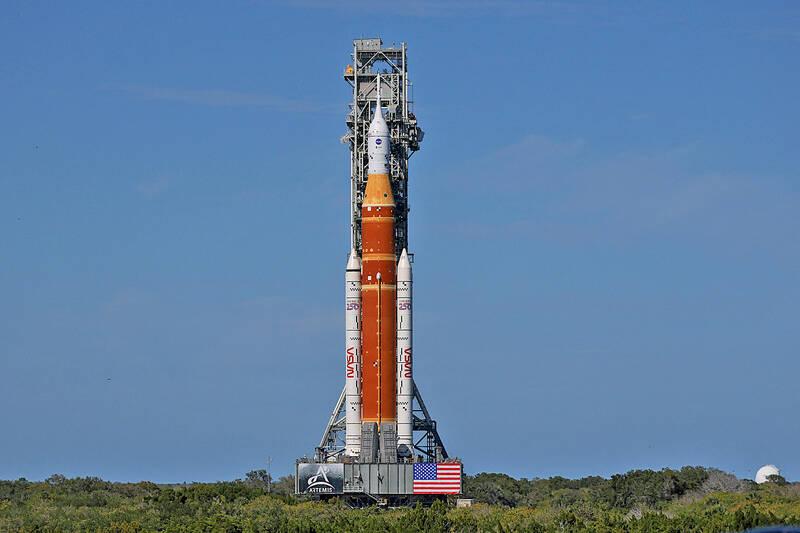
Photo: Getty Images via AFP
If the tests are all satisfactory, three Americans and one Canadian would head to the Moon sometime between Feb. 6 and the end of April — they would not land, but instead fly around Earth’s satellite.
The mission — which would last about 10 days — would be a huge step towards Americans once again setting foot on the lunar surface, a goal announced by US President Donald Trump in his first term.
“We’re making history,” Artemis 2 mission management team chair John Honeycutt told a press conference on Friday.
US astronauts Reid Wiseman, Victor Glover and Christina Koch, along with Canada’s Jeremy Hansen, were on site on Saturday for the rocket’s rollout.
“I’m actually pretty pumped to see that,” Hansen told reporters. “In just a few weeks, you’re going to see four humans fly around the moon, and if we’re doing that now, imagine what we can do next.”
“We’re swinging for the fence, trying to make the impossible possible,” Glover added.
Before the mission can take off, engineers must ensure the SLS rocket is safe and viable. After a battery of tests, a prelaunch simulation would be carried out. The uncrewed Artemis 1 mission took place in November 2022 after multiple postponements and two failed launch attempts.
NASA hopes to put humans back on the Moon, as China forges ahead with a rival effort that is targeting 2030 at the latest for its first crewed mission.
Its uncrewed Chang’e 7 mission is expected to be launched this year for an exploration of the Moon’s south pole, and testing of its crewed Mengzhou spacecraft is also set to go ahead this year.
NASA is hoping that the Moon could be used to help prepare future missions to Mars.
However, the program has been plagued by delays. The US space agency surprised many late last year when it said Artemis 2 could happen as soon as next month — an acceleration explained by the Trump administration’s wish to beat China to the punch. Artemis 3, scheduled for next year, is expected to be pushed back, as industry experts say Elon Musk’s SpaceX is behind on delivering the Starship megarocket needed for the mission.

MONEY GRAB: People were rushing to collect bills scattered on the ground after the plane transporting money crashed, which an official said hindered rescue efforts A cargo plane carrying money on Friday crashed near Bolivia’s capital, damaging about a dozen vehicles on highway, scattering bills on the ground and leaving at least 15 people dead and others injured, an official said. Bolivian Minister of Defense Marcelo Salinas said the Hercules C-130 plane was transporting newly printed Bolivian currency when it “landed and veered off the runway” at an airport in El Alto, a city adjacent to La Paz, before ending up in a nearby field. Firefighters managed to put out the flames that engulfed the aircraft. Fire chief Pavel Tovar said at least 15 people died, but

LIKE FATHER, LIKE DAUGHTER: By showing Ju-ae’s ability to handle a weapon, the photos ‘suggest she is indeed receiving training as a successor,’ an academic said North Korea on Saturday released a rare image of leader Kim Jong-un’s teenage daughter firing a rifle at a shooting range, adding to speculation that she is being groomed as his successor. Kim’s daughter, Ju-ae, has long been seen as the next in line to rule the secretive, nuclear-armed state, and took part in a string of recent high-profile outings, including last week’s military parade marking the closing stages of North Korea’s key party congress. Pyongyang’s official Korean Central News Agency (KCNA) released a photo of Ju-ae shooting a rifle at an outdoor shooting range, peering through a rifle scope

South Korea would soon no longer be one of the few countries where Google Maps does not work properly, after its security-conscious government reversed a two-decade stance to approve the export of high-precision map data to overseas servers. The approval was made “on the condition that strict security requirements are met,” the South Korean Ministry of Land, Infrastructure and Transport said. Those conditions include blurring military and other sensitive security-related facilities, as well as restricting longitude and latitude coordinates for South Korean territory on products such as Google Maps and Google Earth, it said. The decision is expected to hurt Naver and Kakao
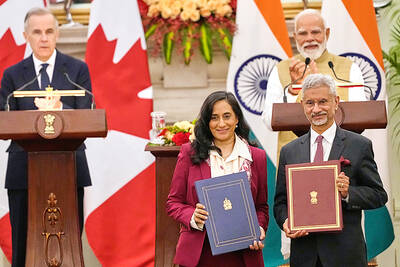
India and Canada yesterday reached a string of agreements, including on critical mineral cooperation and a “landmark” uranium supply deal for nuclear power, the countries’ leaders said in New Delhi. The pacts, which also covered technology and promoting the use of renewable energy, were announced after Indian Prime Minister Narendra Modi and Canadian Prime Minister Mark Carney hailed a fresh start in the relationship between their nations. “Our ties have seen a new energy, mutual trust and positivity,” Modi said. Carney’s visit is a key step forward in ties that effectively collapsed in 2023 after Ottawa accused New Delhi


 RSS
RSS