


A New Orleans family cleaning up their overgrown backyard made an extremely unusual find: Under the weeds was a mysterious marble tablet with Latin characters that included the phrase “spirits of the dead.”
“The fact that it was in Latin that really just gave us pause, right?” said Daniella Santoro, a PhD candidate in anthropology at Tulane University. “I mean, you see something like that and you say, ‘Okay, this is not an ordinary thing.’”
Intrigued and slightly alarmed, Santoro reached out to her classical archeologist colleague Susann Lusnia, an associate professor and chair of the university’s Department of Classical Studies, who quickly realized that the slab was the 1,900-year-old grave marker of a Roman sailor named Sextus Congenius Verus.
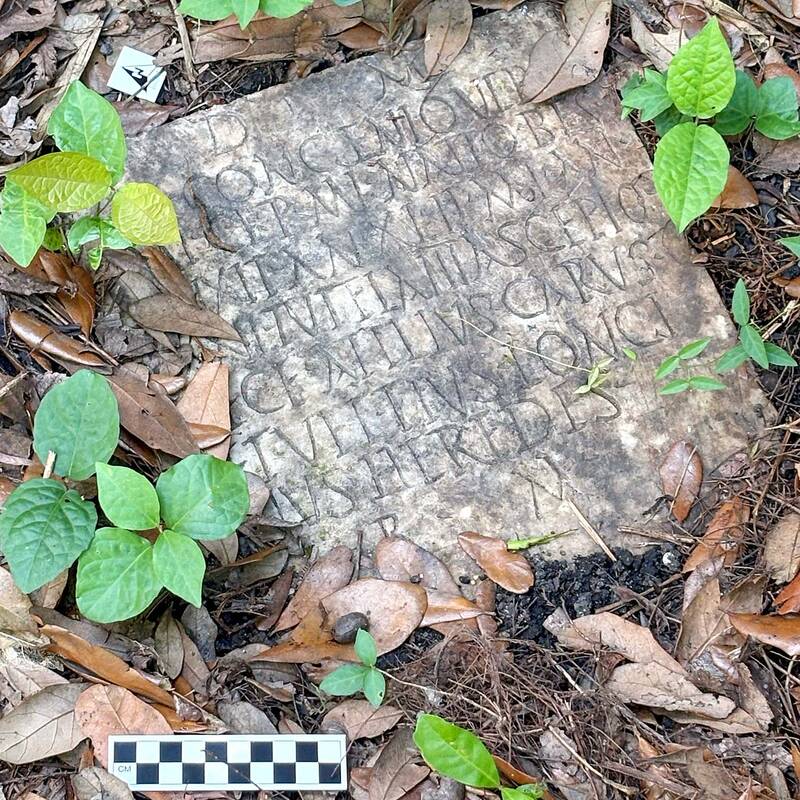
Photo: AP
“When I first saw the image that Daniella sent me, it really did send a shiver up my spine because I was just floored,” Lusnia said.
Further sleuthing by Lusnia revealed the tablet had been missing from an Italian museum for decades.
Sextus Congenius Verus had died at age 42, of unknown causes, after serving for more than two decades in the imperial navy on a ship named for the Roman god of medicine, Asclepius.

Photo: AP
The gravestone calls the sailor “well deserving” and was commissioned by two people described as his “heirs,” who were likely shipmates since Roman military personnel could not be married at the time, Lusnia said.
The tablet had been in an ancient cemetery of about 20 graves of military personnel, found in the 1860s in Civitavecchia, a seaside town in northwest Italy about 30 miles (48km) from Rome.
Its text had been recorded in 1910 and included in a catalog of Latin inscriptions, which noted that the tablet’s whereabouts were unknown.
The tablet was later documented at the National Archeological Museum in Civitavecchia prior to World War II, but the museum had been “pretty much destroyed” during Allied bombing and took several decades to rebuild, Lusnia said.
Museum staff confirmed to Lusnia that the tablet had been missing for decades.
Its recorded measurements — 1 square foot (0.09 square meters) and 1 inch (2.5cm) thick — matched the size of the tablet found in Santoro’s backyard.
“You can’t have better DNA than that,” Lusnia said.
She said the FBI is in talks with Italian authorities to repatriate the tablet. An FBI spokesperson said the agency could not respond to requests for comment during the US government shutdown.
A final twist to the story suggests how the tablet made its way to New Orleans.
As media reports of the find began circulating this week, Erin Scott O’Brien says her ex-husband called her and told her to watch the news. She immediately recognized the hunk of marble, which she had always seen as a “cool-ass piece of art.”
They had used it as a garden decoration and then forgot about it before selling the home to Santoro in 2018.
“None of us knew what it was,” O’Brien said. “We were watching the video, just like in shock.”
O’Brien said she received the tablet from her grandparents — an Italian woman and a New Orleans native who was stationed in the country during World War II.
Perhaps no one would be more thrilled by the tablet’s rediscovery than Sextus himself. Grave markers were important in Roman culture to uphold legacies, even of everyday citizens, Lusnia said.
“Now Sextus Congenius Verus is being talked about so much,” Lusnia said. “If there’s an afterlife and he’s in it and he knows, he’s very happy because this is what a Roman wants — to be remembered forever.”

Through the noise of rushing papers and whirring belts at a print factory in Kyoto, two creators watch their photo essay come to life in broadsheet form — part of an effort to win new audiences in the age of artificial intelligence (AI). Despite the decline of the publishing industry, self-publication and handmade “zine” magazines are growing in popularity in Japan, reflecting the nation’s enduring love of paper in the digital era. While speaking to Agence France-Presse at the plant, his hands black with ink, one of the creators, Kazuma Obara, said: “I think [paper] is a medium that engages all five

‘ABSURD MISTAKE’: The election commission said that there had been a failure to anticipate turnout after 14 polling stations ran short of ballot papers South Korean riot police yesterday cleared protesters from a Seoul polling station after a 35-hour blockade sparked by a shortage of ballot papers during local elections earlier this week. Wednesday’s election was the first nationwide vote since South Korean President Lee Jae-myung took office following the ouster of Yoon Suk-yeol over his short-lived martial law declaration. Lee’s ruling Democratic Party swept most races, but failed to flip the crucial Seoul mayoral seat. The South Korean National Election Commission apologized, blaming a failure to anticipate turnout after 14 polling stations in Seoul ran short of ballot papers. Some polling stations stayed open until 10pm to

Australian researchers have trained lab-grown brain cells on a silicon computer chip to play the 1990s shooter game Doom and said they are just scratching the surface of what the neurons could be capable of doing. It is the science-fiction work of biotech boffins at Cortical Labs, who researched and developed the technology that harnesses the workings of the brain’s networking system. Each so-called “biological computer” contains about 200,000 living human brain cells, grown from stem cells that were harvested from blood donations. Having mastered the simple computer game Pong, where a paddle is moved up and down to send a ball

France experienced its hottest spring on record, the French weather service said on Tuesday, after an exceptional early heat wave that also broke highs for the season in England and Wales. Meteo-France said the average nationwide temperature over March to May was 13.8°C — about 1.7°C above the norm, and surpassing records set in 2011 and 2020. “The warmest spring since records began in 1900,” it said in a bulletin. All three months were warmer than average, but the onset of an “unprecedented heatwave” late last month pushed the mercury to highs typically seen at the height of the summer. “Our country had never


 RSS
RSS