


Rising oceans and flooding caused by climate change would threaten the homes and livelihoods of more than 1 million Australians by 2050, while deaths from heat-related illness would soar, a landmark report warned yesterday ahead of Canberra’s release of emission reduction targets this week.
The long-awaited national climate risk assessment found that rising temperatures would have “cascading, compounding, concurrent” impacts on life in Australia, home to more than 27 million people.
“We are living climate change now. It’s no longer a forecast, a projection or prediction — it is a live reality, and it’s too late to avoid any impacts,” Australian Minister for Climate Change and Energy Chris Bowen said.
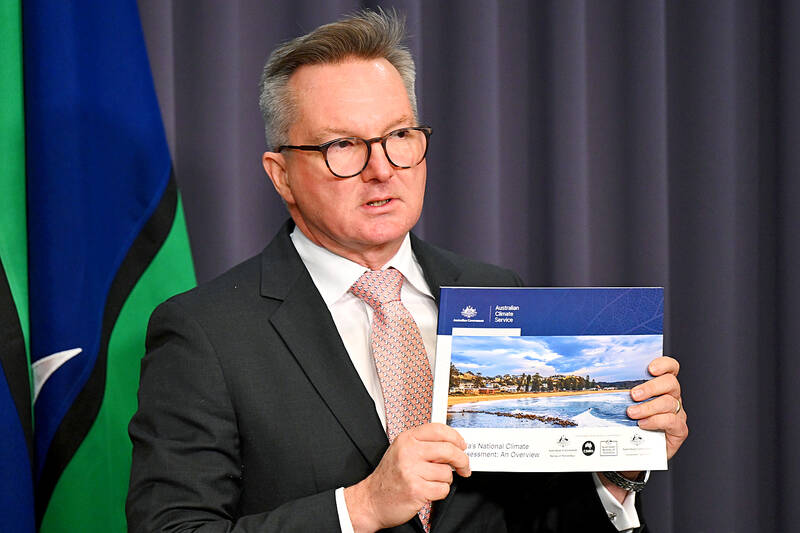
Photo: EPA
The report, prepared independently for the government, found that 1.5 million people living in coastal areas would be at risk of sea level rise and coastal flooding by 2050.
By 2090, about 3 million people would be at risk from rising oceans.
Sea level rises pose a significant threat to homes, livelihoods and cultural connections — particularly in locations such as the Torres Strait Islands, the report said.
Scattered through the warm waters off Australia’s northernmost tip, the sparsely populated islands are threatened by seas rising much faster than the global average.
Joanne Hill, community engagement coordinator at Edith Cowan University and an indigenous woman, said in response to the report that “we cannot delay this emergency response anymore.”
“Our coastal and island communities, particularly the Torres Strait Islands, are at immediate risk of losing their homes, their cultural practices and traditions if we do not do anything now,” Hill said.
The report came as Australia is set to release its next round of emissions reduction targets in the coming week, a key obligation under the landmark Paris climate agreement.
Many hope the country would reveal more ambitious targets.
Losses in Australian property values are estimated to soar to A$611 billion (US$407 billion) by 2050 and could increase to A$770 billion by 2090.
Should temperatures increase by 3°C, heat-related deaths could soar by more than 400 percent in Sydney, Australia’s most-populated city, the report said.
Australia’s unique species would also be forced to move, adapt to the new conditions or die out as climate change intensifies, the report said.
Amanda McKenzie, chief executive of the Climate Council non-governmental organization, described the report as “terrifying.”
“We can choose a better future by cutting climate pollution harder and faster now,” McKenzie said. “The first step is legislating the strongest possible 2035 climate target and stopping new polluting projects.”
One of the world’s biggest fossil fuel exporters, Australia has been criticized for treating climate action as a political and economic liability.
Bowen said moving to a greener future presented a “complicated and complex” set of challenges, and that gas would remain a necessary backup renewable in the energy mix.
“But we also face that challenge from a position of strength, because we have the best renewable resources in the world,” he said.
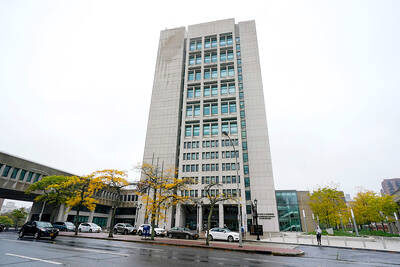
A coalition of civil rights groups on Tuesday asked a New York State judge to order one of its largest suburban counties to stop its deployment of nearly 600 license plate readers, calling it a warrantless and “indiscriminate surveillance system” that violates the state constitution. The class action lawsuit also alleged that Westchester County never got proper authorization to launch the program, which has amassed a database of 1.6 billion plate scans that has been shared with more than 50 outside law enforcement agencies. The complaint said the network “records the long-term travel patterns, daily habits, and intimate information of millions of

Pope Leo XIV on Wednesday blessed a giant new tower at Barcelona’s famed Sagrada Familia Basilica after celebrating mass inside what is now the world’s tallest church. A fireworks and light show illuminated the exterior of the temple at the end of the ceremony, bathing the unfinished basilica in shifting colours that highlighted its towering spires. A choir of 600 singers performed at the service which lasted around 90 minutes and was attended by Spanish Prime Minister Pedro Sanchez as well as King Felipe VI and Queen Letizia. The stained-glass windows in various colours shone brightly in between the tree-like

Voters in Switzerland yesterday cast their ballots on an initiative championed by the top right-wing party to cap the Alpine country’s population at 10 million. As of press time last night, early results showed that Swiss voters were leaning against it. The populist Swiss People’s Party, which has the most seats in parliament, has stirred up and fostered anti-migration sentiment over the years, notably about an influx of workers from the neighboring EU. Critics called the bid a self-inflicted wound, saying the boom in migration over the past generation has brought foreign labor and skills to sectors such as healthcare, finance, pharmaceuticals
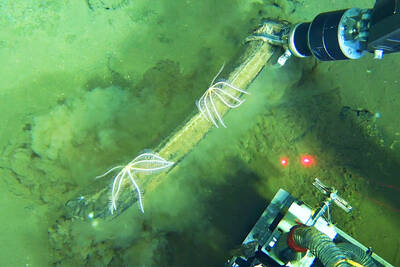
Scientists have discovered communities of marine life — including jellyfish, tubeworms and brittle stars — thriving on a whale graveyard. The graveyards form when whale carcasses fall to the sea floor, becoming a sustaining snack for nearby critters. This one, which is up to 7km below the surface of the southeastern Indian Ocean, spans the largest area, and is so far the deepest found. A whale’s sheer size and the unique chemistry of its bones are the keys to forming these unique underwater neighborhoods, said Song Xikun (宋希坤), a biologist with the Chinese Academy of Sciences’ Institute of Deep-sea Science and Engineering


 RSS
RSS