


Nepal’s new leader yesterday vowed to follow protesters’ demands to “end corruption” as she began work as interim prime minister, after “Gen Z” youth demonstrations ousted her predecessor.
Nepalese Interim Prime Minister Sushila Karki, the 73-year-old former chief justice, has been tasked with restoring order and addressing protesters’ demands for a corruption-free future ahead of elections in six months.
Protests began on Monday last week sparked by a ban on social media and quickly escalated, with parliament and key government buildings set ablaze, as they fed into long-standing economic woes in Nepal.
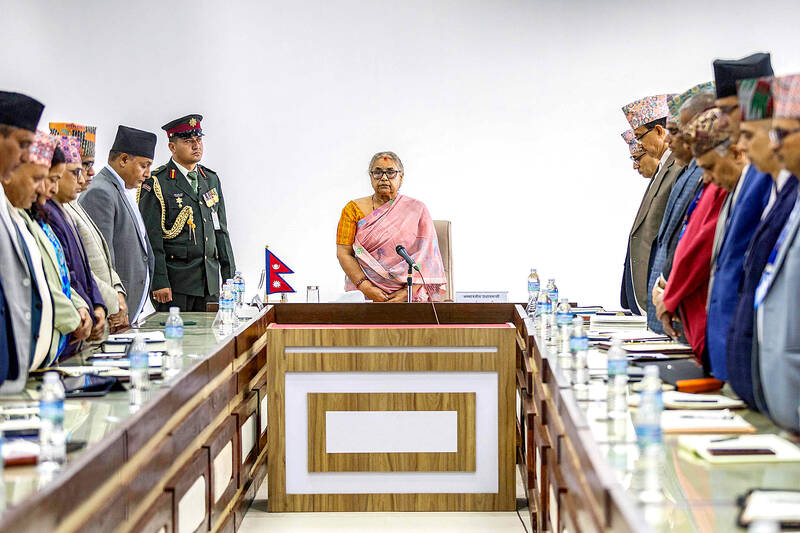
Photo: AFP
“We have to work according to the thinking of the Gen Z generation,” Karki said in her first public comments since taking office on Friday last week.
One-fifth of people in Nepal aged 15 to 24 are unemployed, according to the World Bank, with GDP per capita standing at just US$1,447.
“What this group is demanding is end of corruption, good governance and economic equality,” she added. “You and I have to be determined to fulfil that.”
Karki yesterday held a minute’s silence for those killed in the unrest, before meetings began in the key government complex of Singha Durbar — where several buildings were set on fire during mass protests on Tuesday last week.
At least 72 people were killed in two days of protests, and 191 injured, Nepalese Chief Secretary Eaknarayan Aryal said yesterday, increasing an earlier toll of 51.
It was the worst unrest since the end of a decade-long civil war and the abolition of the monarchy in 2008.
The appointment of Karki, known for her independence, came after intense negotiations by army chief General Ashok Raj Sigdel and Nepalese President Ram Chandra Paudel with representatives of “Gen Z,” the loose umbrella title of the youth protest movement.
Thousands of young activists used the Discord app to name Karki as their choice of leader.
“The situation that I have come in, I have not wished to come here. My name was brought from the streets,” Karki said.
Parliament has been dissolved and elections set for March 5 next year.
“We will not stay here more than six months in any situation, we will complete our responsibilities and pledge to hand over to the next parliament and ministers,” she added.
Workers put up a new signboard for the prime minister’s office in a building within the complex, but which was not torched.
Paudel, who swore Karki into office, said late on Saturday that “a peaceful solution has been found through a difficult process.”
Paudel called it a “very difficult, complicated, and grave situation” in the Himalayan nation of 30 million people.
“I sincerely appeal to everyone to make the most of this opportunity... in making the election on March 5 a success,” he said.
Soldiers have scaled back their presence on the streets, where they had been deployed in large numbers after the protests.
But more than 12,500 prisoners who escaped from jails during the chaos are on the run, and present a daunting security headache.
Regional leaders have congratulated Karki, including Nepal’s two giant neighbors, India and China.
Indian Prime Minister Narendra Modi said New Delhi supported “peace, progress and prosperity” in Hindu-majority Nepal, while Beijing’s foreign ministry said it wanted to “push China-Nepal relations steadily forward.”
Buddhism is the country’s second-largest religion, and the Dalai Lama, the exiled Tibetan spiritual leader, wished Karki “every success in fulfilling the hopes and aspirations of the people of Nepal in these challenging times.”

SPEAKING OUT: After Siranudh Scott’s allegations surfaced, celebrities and public figures took to social media to share their own experiences of sexual misconduct and abuse A high-profile alleged sexual abuse case within a wealthy Thai beer brewing family has prompted a wave of painful accounts from survivors of unconnected abuse in the conservative nation. Siranudh Scott, a member of the billionaire Thai family that founded the ubiquitous Singha beer brand, posted an emotional video this month accusing his elder brother Sunit of repeatedly abusing him when he was a teenager. Sunit, who is in his 30s, later denied the allegations in a video posted online, but Singha parent Boonrawd dismissed him from his executive role with the company on Tuesday last week. “I felt I needed to speak

A Hong Kong astronaut is to join a Chinese space mission for the first time as part of a three-person crew launching today, as Beijing edges closer to its goal of landing people on the moon. The Tiangong space station — crewed by teams of three astronauts that are typically rotated every six months — is the crown jewel of China’s space program, boosted by billions in state investment in a bid to catch up with the US and Russia. The Shenzhou-23 mission is to blast off at 11:08pm from the Jiuquan Satellite Launch Center in northwestern China, carrying three astronauts to

SEEKING ORDER: Rodrigo Paz said that ‘anyone who wants to destroy the nation will have to deal with this president and the full force of the constitution’ Bolivian President Rodrigo Paz on Wednesday said that the nation was at a “breaking point” after nearly a month of protests that have caused shortages of food, fuel and medicine. Paz, who took office six months ago amid the worst economic crisis there in four decades, is battling a groundswell of fury over his policies. The political capital, La Paz, has been besieged by low-income workers and members of the indigenous majority calling for his resignation. “The country needs order and is reaching breaking point,” the 58-year-old said at a public event in La Paz, renewing his appeal for dialogue. On Tuesday, the Bolivian
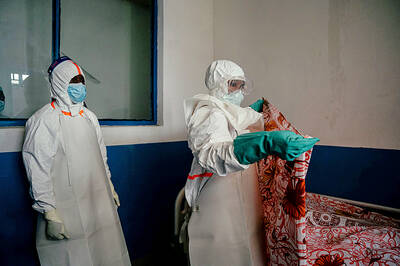
UPGRADED ALERT: The risk inside DR Congo is now considered ‘very high,’ while neighboring countries face a ‘high’ threat as the outbreak continues, the WHO said Ebola is spreading faster than responders can track it in eastern Congo, where health workers managed to follow up with barely one in five identified contacts in a single day. Authorities in the Democratic Republic of the Congo (DR Congo) reported 83 confirmed infections, 746 suspected cases and 1,603 identified contacts as of Thursday, but health workers were able to follow up on only 342 contacts that day — about 21 percent of the total under monitoring — data released by the DR Congo Ministry of Public Health on Friday showed. The figures suggest the response is falling behind the outbreak itself,


 RSS
RSS