


Colorful, speckled rocks found on the surface of Mars have offered among the most encouraging evidence yet of ancient life on the planet, NASA scientists announced on Wednesday.
The Perseverance Mars rover collected the “Sapphire Canyon” rock samples in July last year from what is thought to be an ancient lakebed, and its poppy seed and leopard-esque spots pointed to potential chemical reactions that piqued the interest of researchers.
If the features resulted from microbial activity that created minerals in the way they do on Earth — well, that might point to life on Mars.
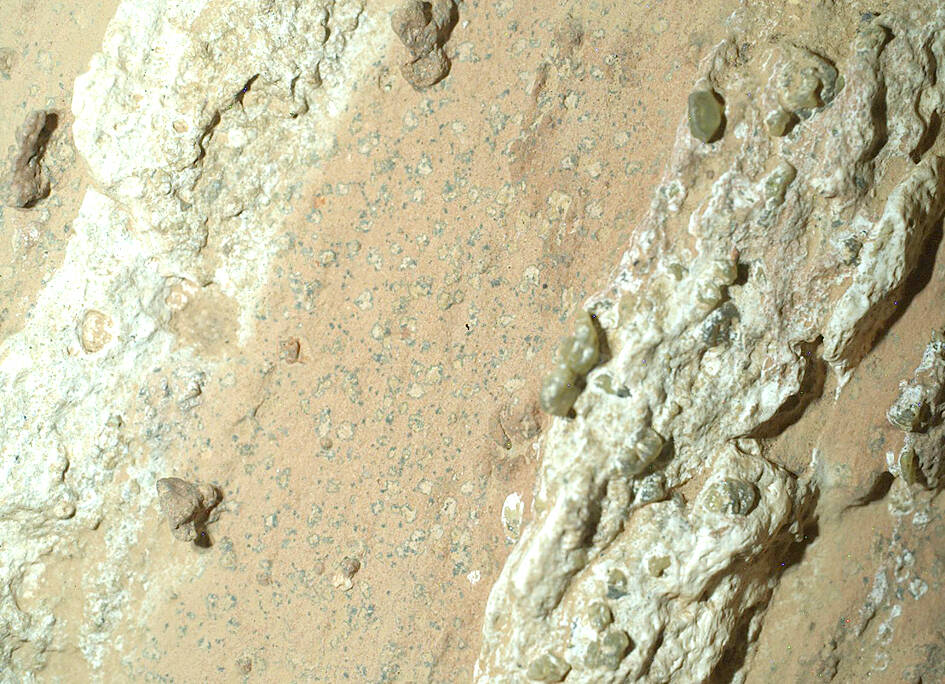
Photo: NASA / JPL-Caltech / Malin Space Science Systems / AFP
It is far too soon for scientists to say that definitively, but the findings, which were detailed in research published in the journal Nature, are alluring.
“We put it out to our scientific friends to pressure test it, to analyze it, and go: ‘Did we get this right? Do we think this is signs of ancient life on Mars?’” NASA Acting Administrator Sean Duffy told a news conference.
“They said: ‘Listen, we can’t find another explanation.’ So this very well could be the clearest sign of life that we’ve ever found on Mars,” he said.
“It’s kind of the equivalent of seeing like leftover fossils, leftovers from a meal, and maybe that meal has been excreted by a microbe,” NASA Science Mission Directorate Administrator Nicky Fox told journalists.
When those kinds of mineral and textured features form in sediment on Earth, it is frequently the product of reactions from mud and organic matter, a potential “biosignature,” or sign of life, the study’s lead author, Joel Hurowitz, said.
Specifically, Perserverance’s instruments identified the minerals vivianite and greigite. On Earth, vivianite is often found in sediments, peat bogs and around decaying organic matter. Some forms of microbial life on Earth can produce greigite.
“But there are nonbiological ways to make these features that we cannot completely rule out on the basis of the data that we collected,” Hurowitz said.
Still, the findings are “exciting,” he told journalists, adding that researchers would need to analyze the sample in person to better understand if microbial activity had created the “fantastic textures,” and colors including blue and green.

An American scientist convicted of lying to US authorities about payments from China while he was at Harvard University has rebuilt his research lab in Shenzhen, China, to pursue technology the Chinese government has identified as a national priority: embedding electronics into the human brain. Charles Lieber, 67, is among the world’s leading researchers in brain-computer interfaces. The technology has shown promise in treating conditions such as amyotrophic lateral sclerosis and restoring movement in paralyzed people. It also has potential military applications: Scientists at the Chinese People’s Liberation Army have investigated brain interfaces as a way to engineer super soldiers by boosting

Indonesian police have arrested 13 people after shocking images of alleged abuse against small children at a daycare center went viral, sparking outrage across the nation, officials said on Monday. Police on Friday last week raided Little Aresha, a daycare center in Yogyakarta on Java island, following a report from a former employee. CCTV footage circulating on social media showed children, most younger than two, lying on the floor wearing only diapers, their hands and feet bound with rags. The police have confirmed that the footage is authentic. Police said they also found 20 children crammed into a room just 3m by 3m. “So
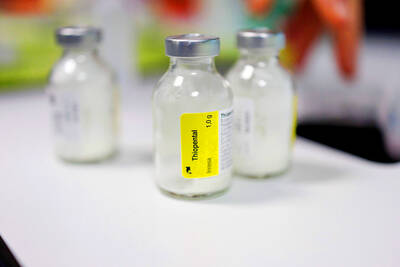
A grieving mother has ended her life at a clinic in Switzerland four years after the death of her only child. Wendy Duffy, 56, a physically healthy woman, died at the Pegasos clinic in Basel after struggling to cope with the death of her 23-year-old son, Marcus. The former care worker, from the West Midlands, England, had previously attempted to take her own life. The case comes as assisted dying would not become law in England and Wales after proposed legislation, branded “hopelessly flawed” by opponents, ran out of time. Ruedi Habegger, the founder of Pegasos, described Duffy’s death as

From post offices and parks to stations and even the summit of Mount Fuji, Japan’s vending machines are ubiquitous, but with the rapid pace of inflation cooling demand for their drinks, operators are being forced to rethink the business. Last month beverage giant DyDo Group Holdings announced it would remove about 20,000 vending machines — about 7 percent of their stock nationwide — by January next year, to “reconstruct a profitable network.” Pokka Sapporo Food & Beverage, based in Nagoya, also said last month it would sell its 40,000-machine operation to Osaka-based Lifedrink Co. “The strength of the vending machine


 RSS
RSS