


Polish Prime Minister Donald Tusk yesterday pledged to push ahead with a “great modernization program” for his country’s military, a day after Russian drones crossed into Poland and amplified international tensions around Russia’s invasion of Ukraine and what the Kremlin’s future territorial ambitions might be.
European officials described Wednesday’s incursion, which occurred during a wave of unrelenting Russian strikes on Ukraine, as a deliberate provocation, forcing the NATO alliance to confront a potential threat in its airspace for the first time.
It deepened longstanding fears that the three-year war between Poland’s neighbors could precipitate a wider conflict. US-led efforts to steer Moscow and Kyiv toward a peace settlement have so far failed to get traction.
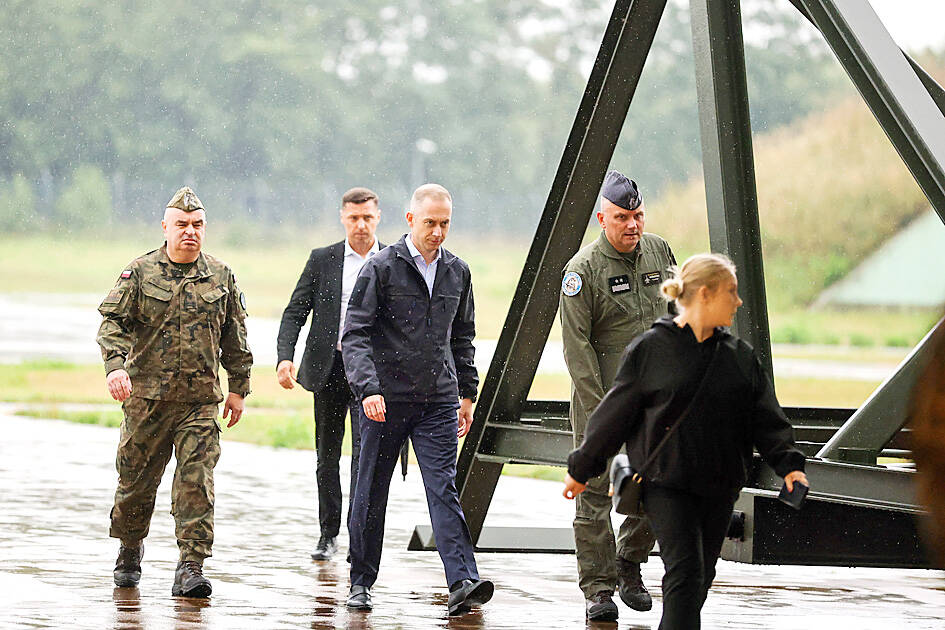
Photo: EPA
The UN Security Council yesterday was to hold an emergency meeting at Poland request to discuss the matter, the Polish Ministry of Foreign Affairs said.
The Polish Air Navigation Agency yesterday morning announced that Poland’s was introducing air traffic restrictions in the eastern part of the country.
It said the step was taken at the request of the Polish army for national security reasons, but did not elaborate.
Poland said that some of the drones that entered its airspace on Wednesday came from Belarus, where Russian and local troops have begun gathering for war games scheduled to start today. Poland was to close its border with Belarus at midnight last night, a planned move also associated with the military exercises.
Tusk addressed Polish troops at an air base in the central city of Lask, praising their quick action and that of NATO allied forces from the Netherlands that responded to the multiple Russian drone incursions.
The response also brought questions about the wisdom of using advanced fighter jets to shoot down relatively cheap drones.
Poland expects to receive its first F-35 jets from the US next year, he said.
It would be the first delivery of some of the 32 aircraft expected by 2030 as part of a support package finalized five years ago, Tusk said.
Polish President Karol Nawrocki also visited a military air base yesterday, striking a defiant tone in a statement that said Poland “doesn’t get scared by Russian drones.”
Nawrocki described the incursion as “an attempt to test our abilities, the ability to react.”
He was visiting a base in Poznan-Krzesiny, in western Poland.
The European Council on Foreign Relations, a think tank, also concluded that Putin is testing Europe’s resolve as it endeavors to address the threat from Moscow, while the US demands it shoulder more of the financial burden.
“Inconsistency between words and deeds seem to have eroded Europe’s credibility in Russia’s eyes,” it said in an analysis published on Friday last week.
US President Donald Trump on Wednesday offered an ambiguous initial response to Russia’s drone incursion.
“What’s with Russia violating Poland’s airspace with drones? Here we go!” he wrote on social media.
Trump last week told Nawrocki at the White House that the US would maintain a robust military presence.
Several European leaders said they believed the incursion amounted to an intentional expansion of Russia’s assault against Ukraine.
“Russia’s war is escalating, not ending,” EU High Representative for Foreign Affairs and Security Policy Kaja Kallas told reporters in Brussels on Wednesday.
“What [Russian President Vladimir] Putin wants to do is to test us. What happened in Poland is a game changer,” she said, adding that it should result in stronger sanctions.
In Taipei, the Ministry of Foreign Affairs yesterday expressed “serious concern” over the incident, calling on all parties to exercise restraint and avoid any actions that undermine regional peace and stability.
The European security situation is closely linked to the security of the Indo-Pacific region, it said, urging democratic partners to unite in maintaining the rules-based international order, as well as to oppose any unilateral actions that change the “status quo” by force or coercion.
Additional reporting by Kayleigh Madjar, with Reuters

An American scientist convicted of lying to US authorities about payments from China while he was at Harvard University has rebuilt his research lab in Shenzhen, China, to pursue technology the Chinese government has identified as a national priority: embedding electronics into the human brain. Charles Lieber, 67, is among the world’s leading researchers in brain-computer interfaces. The technology has shown promise in treating conditions such as amyotrophic lateral sclerosis and restoring movement in paralyzed people. It also has potential military applications: Scientists at the Chinese People’s Liberation Army have investigated brain interfaces as a way to engineer super soldiers by boosting
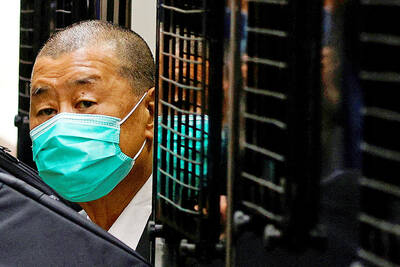
Jailed media entrepreneur Jimmy Lai (黎智英) has been awarded Deutsche Welle’s (DW) freedom of speech award for his contribution to Hong Kong’s pro-democracy movement. The German public broadcaster on Thursday said Lai would be presented in absentia with the 12th iteration of the award on June 23 at the DW Global Media Forum in Bonn. Deutsche Welle director-general Barbara Massing praised the 78-year-old founder of the now-shuttered news outlet Apple Daily for standing “unwaveringly for press freedom in Hong Kong at great personal risk.” “With Apple Daily, he gave journalists a platform for free reporting and a voice to the democracy movement in
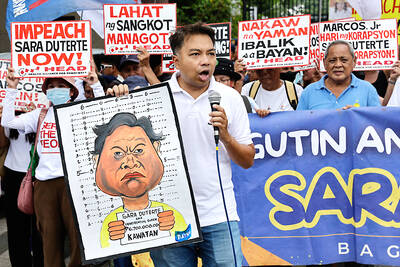
PHILIPPINE COMMITTEE: The head of the committee that made the decision said: ‘If there is nothing to hide, there is no reason to hide, there is no reason to obstruct’ A Philippine congressional committee on Wednesday ruled that there was “probable cause” to impeach Philippine Vice President Sara Duterte after hearing allegations of unexplained wealth, misuse of state funds and threats to have the president assassinated. The unanimous decision of the 53-member committee in the Philippine House of Representatives sends the two impeachment complaints to deliberations and voting by the entire lower chamber, which has more than 300 lawmakers. The complaints centered on Duterte’s alleged illegal use and mishandling of intelligence funds from the vice president’s office, and from her time as education secretary under Philippine President Ferdinand Marcos Jr. Duterte and the

Burmese President Min Aung Hlaing yesterday cut all prisoners’ sentences by one-sixth, a blanket measure that a source close to deposed leader Aung San Suu Kyi said would further shorten her detention. Aung San Suu Kyi has been sequestered since a 2021 military coup, but the senior member of her dissolved National League for Democracy (NLD) party said that while her term had been reduced, her remaining sentence is still unclear. “We also don’t know exactly how many years she has left,” the source told reporters, speaking on condition of anonymity for security reasons. The military toppled Aung San Suu Kyi’s elected government


 RSS
RSS