


Armed soldiers yesterday guarded Nepal’s parliament, amid streets deserted after an indefinite curfew was clamped on the capital, Kathmandu, following two days of deadly anti-graft protests that spurred Nepalese Prime Minister Khadga Prasad Sharma Oli to resign.
The worst upheaval in decades in the Himalayan nation was unleashed by a social media ban announced last week, but rolled back after 19 people died on Monday as police fired tear gas and rubber bullets to control crowds.
Burnt vehicles and twisted metal heaps littered the area around parliament, where army firefighters battled to douse a blaze in the main hall, while the exterior was charred after angry protesters set it ablaze on Tuesday.
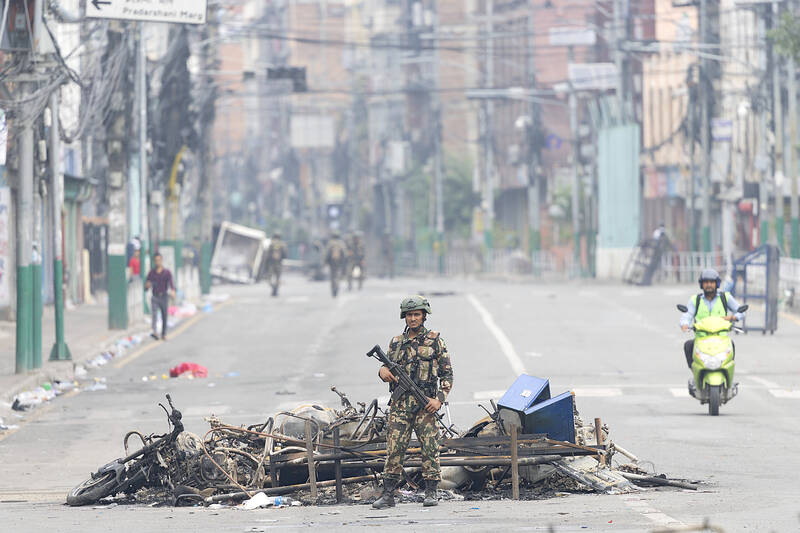
Photo: EPA
“We are trying to normalize the situation first,” army spokesman Raja Ram Basnet said. “We are committed to protect the life and property of people.”
Armored vehicles kept vigil in deserted streets, with shops and markets shut.
Several other government buildings, from the supreme court to ministers’ homes, including Oli’s private residence, were also set ablaze in Tuesday’s protests, with the unrest subsiding only after the resignation.
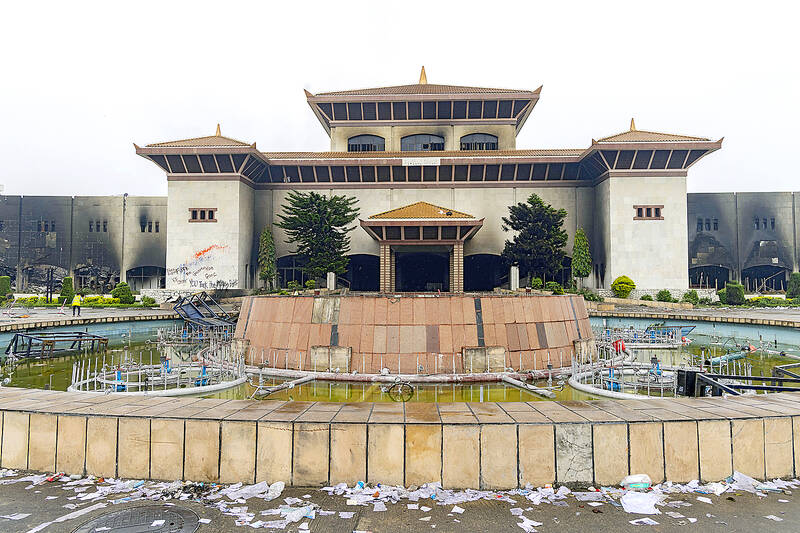
Photo: EPA
Flights were disrupted, with the main airport in Kathmandu shut until 6pm, an airport spokesperson said.
In an appeal on social media, the army said prohibitory orders would stay until this morning, adding that relevant parties were coordinating to tackle the situation after the protest and resolve the issue.
Media also said preparations were being made for authorities and protesters to hold talks, without giving details. Reuters could not independently confirm the information.
Former Nepalese Supreme Court judge Balaram K.C. urged the protesters to set up a negotiation team, with the army helping to maintain law and order, and called for fresh elections.
“Parliament should be dissolved and fresh elections held,” the constitutional expert said. “They should discuss forming the next caretaker government.”
Most of the protesters were young people voicing frustration at the government’s perceived failure to fight corruption and boost economic opportunities.
For years a lack of jobs has driven millions to seek work in Malaysia, the Middle East and South Korea, mainly on construction sites, to send money home.

An American scientist convicted of lying to US authorities about payments from China while he was at Harvard University has rebuilt his research lab in Shenzhen, China, to pursue technology the Chinese government has identified as a national priority: embedding electronics into the human brain. Charles Lieber, 67, is among the world’s leading researchers in brain-computer interfaces. The technology has shown promise in treating conditions such as amyotrophic lateral sclerosis and restoring movement in paralyzed people. It also has potential military applications: Scientists at the Chinese People’s Liberation Army have investigated brain interfaces as a way to engineer super soldiers by boosting
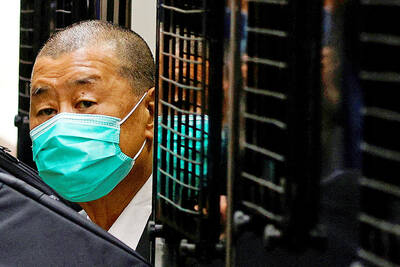
Jailed media entrepreneur Jimmy Lai (黎智英) has been awarded Deutsche Welle’s (DW) freedom of speech award for his contribution to Hong Kong’s pro-democracy movement. The German public broadcaster on Thursday said Lai would be presented in absentia with the 12th iteration of the award on June 23 at the DW Global Media Forum in Bonn. Deutsche Welle director-general Barbara Massing praised the 78-year-old founder of the now-shuttered news outlet Apple Daily for standing “unwaveringly for press freedom in Hong Kong at great personal risk.” “With Apple Daily, he gave journalists a platform for free reporting and a voice to the democracy movement in
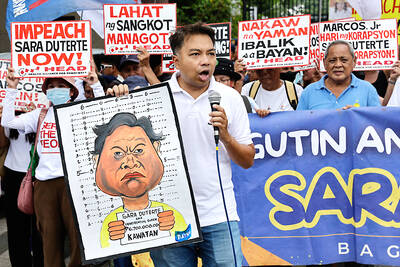
PHILIPPINE COMMITTEE: The head of the committee that made the decision said: ‘If there is nothing to hide, there is no reason to hide, there is no reason to obstruct’ A Philippine congressional committee on Wednesday ruled that there was “probable cause” to impeach Philippine Vice President Sara Duterte after hearing allegations of unexplained wealth, misuse of state funds and threats to have the president assassinated. The unanimous decision of the 53-member committee in the Philippine House of Representatives sends the two impeachment complaints to deliberations and voting by the entire lower chamber, which has more than 300 lawmakers. The complaints centered on Duterte’s alleged illegal use and mishandling of intelligence funds from the vice president’s office, and from her time as education secretary under Philippine President Ferdinand Marcos Jr. Duterte and the

Burmese President Min Aung Hlaing yesterday cut all prisoners’ sentences by one-sixth, a blanket measure that a source close to deposed leader Aung San Suu Kyi said would further shorten her detention. Aung San Suu Kyi has been sequestered since a 2021 military coup, but the senior member of her dissolved National League for Democracy (NLD) party said that while her term had been reduced, her remaining sentence is still unclear. “We also don’t know exactly how many years she has left,” the source told reporters, speaking on condition of anonymity for security reasons. The military toppled Aung San Suu Kyi’s elected government


 RSS
RSS