


South Koreans suspected of working in the US illegally were the majority of 475 people arrested in a raid on a Hyundai-LG battery plant being built in the southern state of Georgia, a US official said on Friday.
The operation was the largest single-site raid carried out so far as part of US President Donald Trump’s nationwide anti-migrant drive, said Steven Schrank, a US Homeland Security Investigations special agent in Atlanta, Georgia.
Thursday’s raid stemmed from a “criminal investigation into allegations of unlawful employment practices and serious federal crimes” at the Hyundai Motor-LG Energy Solution joint venture plant in the town of Ellabell, Schrank said.
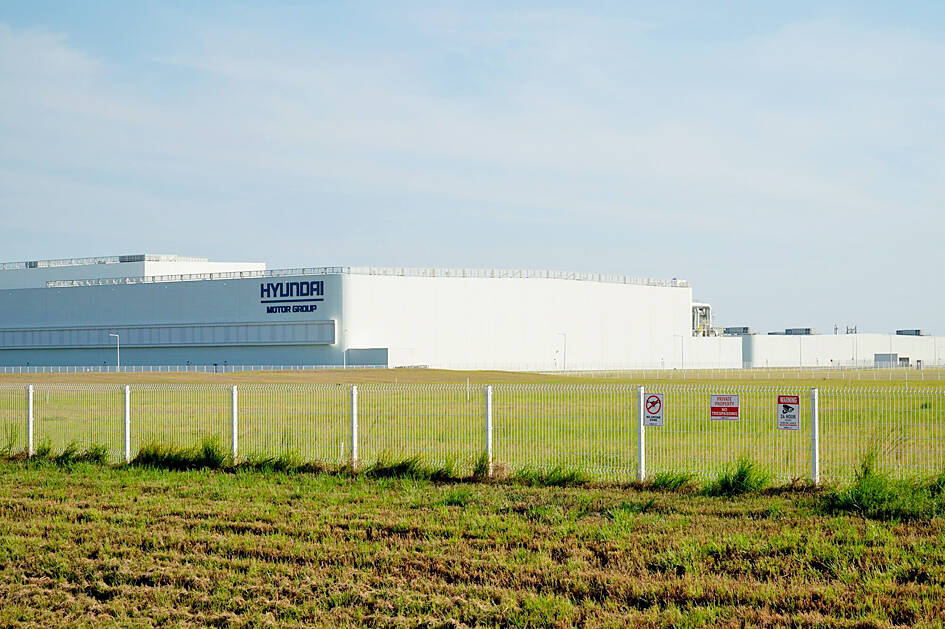
Photo: Bloomberg
“This was not an immigration operation where agents went into the premises, rounded up folks and put them on buses,” he said. “This has been a multi-month criminal investigation.”
Asked by reporters at the White House about the raid, Trump said: “I would say that they were illegal aliens, and ICE [US Immigration and Customs Enforcement] was just doing its job.”
South Korea expressed “concern and regret” over the raid, and urged Washington to respect the rights of its citizens.
“The economic activities of our investors, and the legitimate rights and interests of our nationals must not be unjustly infringed in the course of US law enforcement,” South Korean Ministry of Foreign Affairs spokesman Lee Jae-woong said.
Schrank said the 475 arrested were “illegally present” in the US and “working unlawfully.”
“There was a majority of [South] Korean nationals,” he said, adding that it was the “largest single-site enforcement operation in the history of Homeland Security Investigations.”
In Seoul, a source familiar with the matter said that about 300 South Korean nationals had been detained.
Schrank said he could not give a breakdown of how many of those arrested at the plant, which is intended to supply batteries for electric vehicles, were employed by Hyundai, LG or subcontractors.
Those taken into custody have been turned over to ICE for potential removal, he said.
Schrank said some of those detained had illegally crossed the US border, others arrived with visas that prohibited them from working and others overstayed their work visas.
“This operation underscores our commitment to protecting jobs for Georgians and Americans, ensuring a level playing field for businesses that comply with the law, safeguarding the integrity of our economy and protecting workers from exploitation,” he said.
South Korea, Asia’s fourth-biggest economy, is a key automaker and electronics producer with multiple plants in the US.
South Korean companies have invested billions of dollars to build factories in the US in a bid to access the US market and avoid tariff threats from Trump.
South Korean President Lee Jae-myung met Trump during a visit last month, and Seoul pledged US$350 billion in US investment in July.
Trump has pledged to revive the manufacturing sector in the US, while also vowing to deport millions of undocumented migrants.
In a statement, Hyundai said it was “closely monitoring” the situation at the Georgia construction site and “working to understand the specific circumstances.”
“As of today, it is our understanding that none of those detained is directly employed by Hyundai Motor Company,” the firm said.
LG Energy Solution said it was “gathering all relevant details.”
“We will fully cooperate with the relevant authorities,” it added.
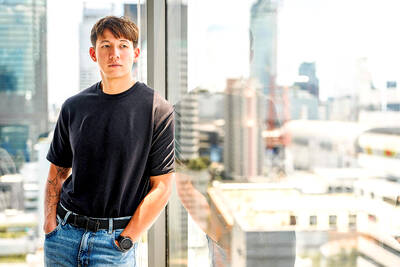
SPEAKING OUT: After Siranudh Scott’s allegations surfaced, celebrities and public figures took to social media to share their own experiences of sexual misconduct and abuse A high-profile alleged sexual abuse case within a wealthy Thai beer brewing family has prompted a wave of painful accounts from survivors of unconnected abuse in the conservative nation. Siranudh Scott, a member of the billionaire Thai family that founded the ubiquitous Singha beer brand, posted an emotional video this month accusing his elder brother Sunit of repeatedly abusing him when he was a teenager. Sunit, who is in his 30s, later denied the allegations in a video posted online, but Singha parent Boonrawd dismissed him from his executive role with the company on Tuesday last week. “I felt I needed to speak

A Hong Kong astronaut is to join a Chinese space mission for the first time as part of a three-person crew launching today, as Beijing edges closer to its goal of landing people on the moon. The Tiangong space station — crewed by teams of three astronauts that are typically rotated every six months — is the crown jewel of China’s space program, boosted by billions in state investment in a bid to catch up with the US and Russia. The Shenzhou-23 mission is to blast off at 11:08pm from the Jiuquan Satellite Launch Center in northwestern China, carrying three astronauts to

SEEKING ORDER: Rodrigo Paz said that ‘anyone who wants to destroy the nation will have to deal with this president and the full force of the constitution’ Bolivian President Rodrigo Paz on Wednesday said that the nation was at a “breaking point” after nearly a month of protests that have caused shortages of food, fuel and medicine. Paz, who took office six months ago amid the worst economic crisis there in four decades, is battling a groundswell of fury over his policies. The political capital, La Paz, has been besieged by low-income workers and members of the indigenous majority calling for his resignation. “The country needs order and is reaching breaking point,” the 58-year-old said at a public event in La Paz, renewing his appeal for dialogue. On Tuesday, the Bolivian
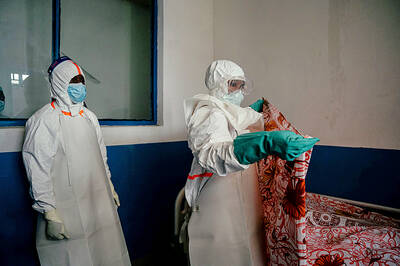
UPGRADED ALERT: The risk inside DR Congo is now considered ‘very high,’ while neighboring countries face a ‘high’ threat as the outbreak continues, the WHO said Ebola is spreading faster than responders can track it in eastern Congo, where health workers managed to follow up with barely one in five identified contacts in a single day. Authorities in the Democratic Republic of the Congo (DR Congo) reported 83 confirmed infections, 746 suspected cases and 1,603 identified contacts as of Thursday, but health workers were able to follow up on only 342 contacts that day — about 21 percent of the total under monitoring — data released by the DR Congo Ministry of Public Health on Friday showed. The figures suggest the response is falling behind the outbreak itself,


 RSS
RSS