


Former Thai deputy prime minister Anutin Charnvirakul appeared poised to lead the next government in Thailand, with the conservative politician promising to call elections within months to end political uncertainty caused by the sacking of former Thai prime minister Paetongtarn Shinawatra.
Anutin, whose father briefly served as Thailand’s caretaker leader in 2008, said late on Friday that he had support of enough lawmakers to become prime minister. Much would depend on the main opposition People’s Party — the largest bloc in the 500-member House of Representatives — which has yet to declare its stance, although it has made clear that any support would be conditional.
Anutin was a deputy prime minister in Paetongtarn’s government until his Bhumjaithai Party exited the coalition following the controversy over her leaked phone call with former Cambodian prime minister Hun Sen, which eventually led to her sacking by the Constitutional Court. His party is also known for championing the liberalization of cannabis in Thailand.
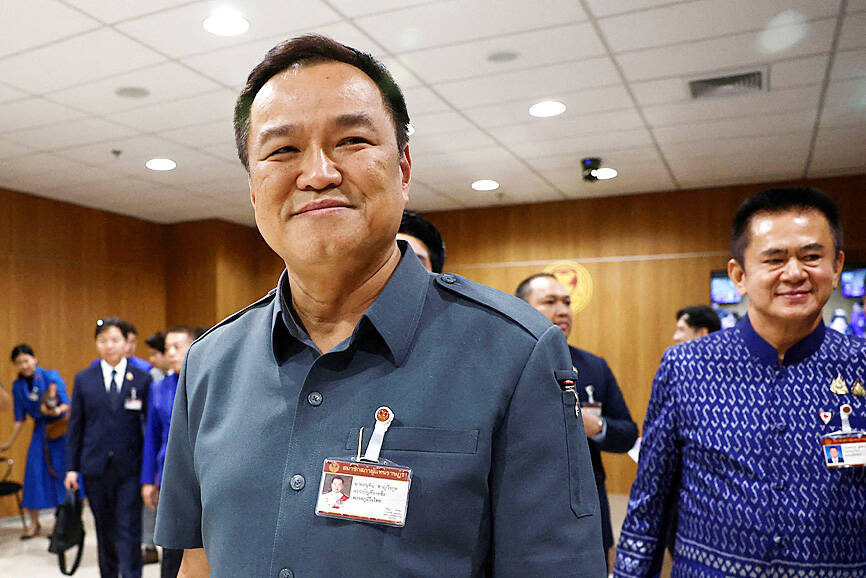
Photo: REUTERS
Anutin said an “interim government” under him would dissolve the parliament in four months, hold a referendum on amending the constitution and take steps to resolve the Thai-Cambodia border dispute as demanded by the People’s Party.
“We cannot allow Thailand to come to a standstill,” Anutin told reporters. “After we’ve completed the missions, we will return power to the people within four months by dissolving the house, so the country can be reset once again.”
A fracture within the current coalition headed by Pheu Thai, the political party backed by the Shinawatra clan, might also help Anutin’s bid for power. While the group said it would attempt to form a government and reached out to the People’s Party for support, Anutin claimed to have the support of about 47 lawmakers who previously supported Paetongtarn’s administration.
The People’s Party has said it would not join a new government, but was open to supporting a new leader who would be willing to meet its demands. With its 143 lawmakers, the group is emerging as a key player in the formation of the new government. The party has no prime ministerial candidate after the Constitutional Court dissolved its earlier incarnation — the Move Forward Party — and banned its executives, including leader Pita Limjaroenrat, from politics for 10 years.
A parliamentary vote to select a new premier is likely to be held between Wednesday and Friday. Under the Thai constitution, a prime ministerial candidate needs the support of the majority of the sitting members in the elected lower house.
Even if Anutin ascends to power, his administration is unlikely to have a strong parliamentary mandate, potentially leading to a policy paralysis at a time when Thailand’s economic outlook is worsened by the blow from US tariffs and the region’s highest household debt levels.
Paetongtarn, like her immediate predecessor former Thai prime minister Srettha Thavisin, lasted just about a year in office before being booted out. The judges said her remarks on a phone call with Cambodia’s Hun Sen over a border dispute undermined national interests and the dignity of the premiership.
The court, set up in 1997, has now ejected five sitting Thai prime ministers linked to Paetongtarn’s father, former Thai prime minister Thaksin Shinawatra, including his sister and brother-in-law.
The sackings highlight how the country’s conservative establishment — identified by analysts as an amalgamation of bureaucrats, the military and business elites — can thwart elected governments, disband political parties and engineer long stretches of military-backed rule.
“The court’s removal of Paetongtarn affirms a troubling precedent of unelected judges overruling the mandate of millions,” said Napon Jatusripitak, acting coordinator of the Thailand Studies Program at ISEAS-Yusof Ishak Institute. “With no clear successor, Thailand risks deadlock and a leadership vacuum just as it faces economic turbulence from a US trade deal and renewed border tensions with Cambodia.”
Paetongtarn’s ouster throws into doubt a compromise her father reached with his rivals that kept his hands on the levers of power.
The deal had helped him return to Thailand after 15 years in self-imposed exile and paved the way for Pheu Thai to form a government with conservative groups that were opposed to him previously.

SPEAKING OUT: After Siranudh Scott’s allegations surfaced, celebrities and public figures took to social media to share their own experiences of sexual misconduct and abuse A high-profile alleged sexual abuse case within a wealthy Thai beer brewing family has prompted a wave of painful accounts from survivors of unconnected abuse in the conservative nation. Siranudh Scott, a member of the billionaire Thai family that founded the ubiquitous Singha beer brand, posted an emotional video this month accusing his elder brother Sunit of repeatedly abusing him when he was a teenager. Sunit, who is in his 30s, later denied the allegations in a video posted online, but Singha parent Boonrawd dismissed him from his executive role with the company on Tuesday last week. “I felt I needed to speak

A Hong Kong astronaut is to join a Chinese space mission for the first time as part of a three-person crew launching today, as Beijing edges closer to its goal of landing people on the moon. The Tiangong space station — crewed by teams of three astronauts that are typically rotated every six months — is the crown jewel of China’s space program, boosted by billions in state investment in a bid to catch up with the US and Russia. The Shenzhou-23 mission is to blast off at 11:08pm from the Jiuquan Satellite Launch Center in northwestern China, carrying three astronauts to

SEEKING ORDER: Rodrigo Paz said that ‘anyone who wants to destroy the nation will have to deal with this president and the full force of the constitution’ Bolivian President Rodrigo Paz on Wednesday said that the nation was at a “breaking point” after nearly a month of protests that have caused shortages of food, fuel and medicine. Paz, who took office six months ago amid the worst economic crisis there in four decades, is battling a groundswell of fury over his policies. The political capital, La Paz, has been besieged by low-income workers and members of the indigenous majority calling for his resignation. “The country needs order and is reaching breaking point,” the 58-year-old said at a public event in La Paz, renewing his appeal for dialogue. On Tuesday, the Bolivian

UPGRADED ALERT: The risk inside DR Congo is now considered ‘very high,’ while neighboring countries face a ‘high’ threat as the outbreak continues, the WHO said Ebola is spreading faster than responders can track it in eastern Congo, where health workers managed to follow up with barely one in five identified contacts in a single day. Authorities in the Democratic Republic of the Congo (DR Congo) reported 83 confirmed infections, 746 suspected cases and 1,603 identified contacts as of Thursday, but health workers were able to follow up on only 342 contacts that day — about 21 percent of the total under monitoring — data released by the DR Congo Ministry of Public Health on Friday showed. The figures suggest the response is falling behind the outbreak itself,


 RSS
RSS