


Members of an indigenous tribe who live deep in Peru’s Amazon rainforest and avoid contact with outsiders have been reported entering a neighboring village in what rights groups consider an alarming sign that the group is under stress from development.
The sightings of members of the Mashco Piro group come as a logging company is building a bridge that could give outsiders easier access to the group’s territory, a move that could raise the risk of disease and conflict, said Survival International, which advocates for indigenous rights.
The Mashco Piro are among the world’s largest uncontacted groups, living without regular interaction with outside society to protect their culture and health. Even a simple cold can be deadly to the group because it lacks immunity to common diseases.
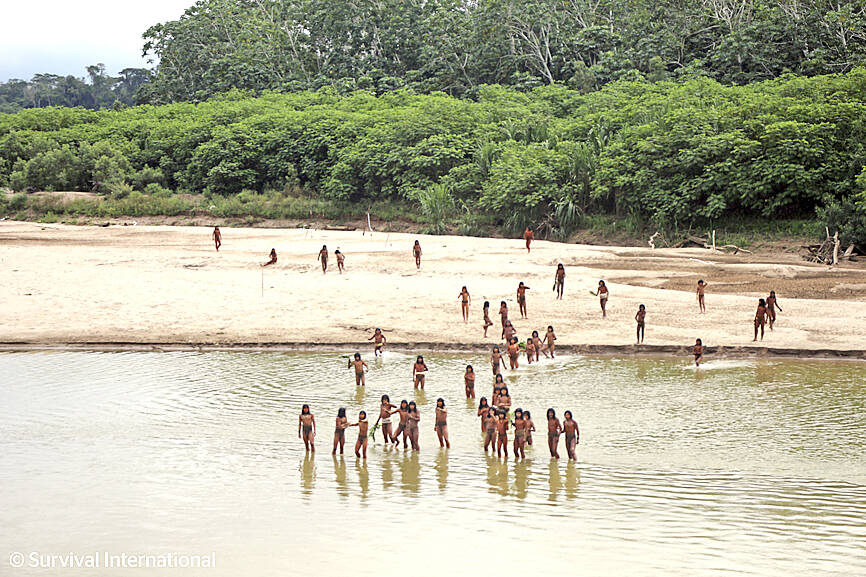
Photo: AP
Loggers who encroached on the group’s lands have previously been killed.
Enrique Anez, president of the nearby Yine community, another indigenous group, said in a statement on Tuesday that Mashco Piro members had been seen around the Yine village of Nueva Oceania.
“It is very worrying; they are in danger,” Anez said.
Anez said heavy machinery near Nueva Oceania is cutting paths through the jungle and across rivers into the Mashco Piro territory. The village sits at a key access point to the Mashco Piro’s territory, making it one of the few places where members of the group have occasionally been seen.
Survival International last year released photos showing dozens of Mashco Piro close to active logging zones. The group said that contact with outsiders could spread disease or lead to violent conflict — risks that have previously wiped out other isolated groups in the Amazon.
Last year, two loggers were killed in bow-and-arrow attacks after entering Mashco Piro territory.
“Exactly one year after the encounters and the deaths, nothing has changed in terms of land protection, and the Yine are now reporting to have seen both the Mashco Piro and the loggers exactly in the same space almost at the same time,” Survival International researcher Teresa Mayo said.
The Peruvian Ministry of Culture — tasked with promoting cultural identity and overseeing Indigenous rights — said that it is reviewing Survival International’s report.
Asked about what measures the government is taking to protect groups like the Mashco Piro, it said it has created eight reserves for indigenous peoples in isolation, has five more pending and operates 19 control posts with 59 protection agents.
More than 440 patrols have been carried out this year, it said, adding that its budget for protecting isolated communities more than doubled this year.
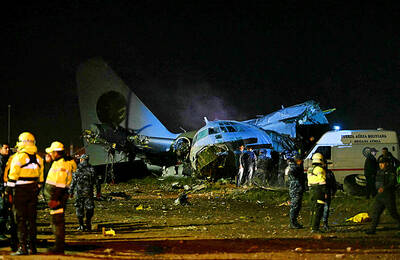
MONEY GRAB: People were rushing to collect bills scattered on the ground after the plane transporting money crashed, which an official said hindered rescue efforts A cargo plane carrying money on Friday crashed near Bolivia’s capital, damaging about a dozen vehicles on highway, scattering bills on the ground and leaving at least 15 people dead and others injured, an official said. Bolivian Minister of Defense Marcelo Salinas said the Hercules C-130 plane was transporting newly printed Bolivian currency when it “landed and veered off the runway” at an airport in El Alto, a city adjacent to La Paz, before ending up in a nearby field. Firefighters managed to put out the flames that engulfed the aircraft. Fire chief Pavel Tovar said at least 15 people died, but

LIKE FATHER, LIKE DAUGHTER: By showing Ju-ae’s ability to handle a weapon, the photos ‘suggest she is indeed receiving training as a successor,’ an academic said North Korea on Saturday released a rare image of leader Kim Jong-un’s teenage daughter firing a rifle at a shooting range, adding to speculation that she is being groomed as his successor. Kim’s daughter, Ju-ae, has long been seen as the next in line to rule the secretive, nuclear-armed state, and took part in a string of recent high-profile outings, including last week’s military parade marking the closing stages of North Korea’s key party congress. Pyongyang’s official Korean Central News Agency (KCNA) released a photo of Ju-ae shooting a rifle at an outdoor shooting range, peering through a rifle scope

South Korea would soon no longer be one of the few countries where Google Maps does not work properly, after its security-conscious government reversed a two-decade stance to approve the export of high-precision map data to overseas servers. The approval was made “on the condition that strict security requirements are met,” the South Korean Ministry of Land, Infrastructure and Transport said. Those conditions include blurring military and other sensitive security-related facilities, as well as restricting longitude and latitude coordinates for South Korean territory on products such as Google Maps and Google Earth, it said. The decision is expected to hurt Naver and Kakao
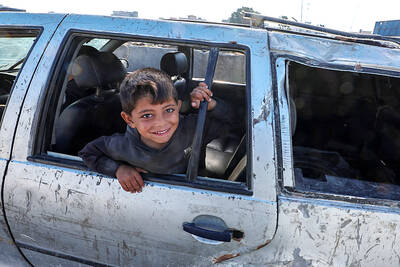
Gaza is rapidly running out of its limited fuel supply and stocks of food staples might become tight, officials said, after Israel blocked the entry of fuel and goods into the war-shattered territory, citing fighting with Iran. The Israeli military closed all Gaza border crossings on Saturday after announcing airstrikes on Iran carried out jointly with the US. Israeli authorities late on Monday night said that they would reopen the Kerem Shalom crossing from Israel to Gaza yesterday, for “gradual entry of humanitarian aid” into the strip, without saying how much. Israeli authorities previously said the crossings could not be operated safely during


 RSS
RSS