

Three Republican-led states on Saturday said that they were deploying hundreds of US National Guard members to Washington to bolster US President Donald Trump’s effort to overhaul policing in the capital through a federal crackdown on crime and homelessness.
West Virginia said it was deploying 300 to 400 Guard troops, while South Carolina pledged 200 and Ohio said it would send 150 in the coming days, marking a significant escalation of the federal intervention.
The moves came as protesters pushed back on federal law enforcement and National Guard troops fanning out in the heavily Democratic city following an executive order federalizing local police forces and activating about 800 District of Columbia National Guard members.
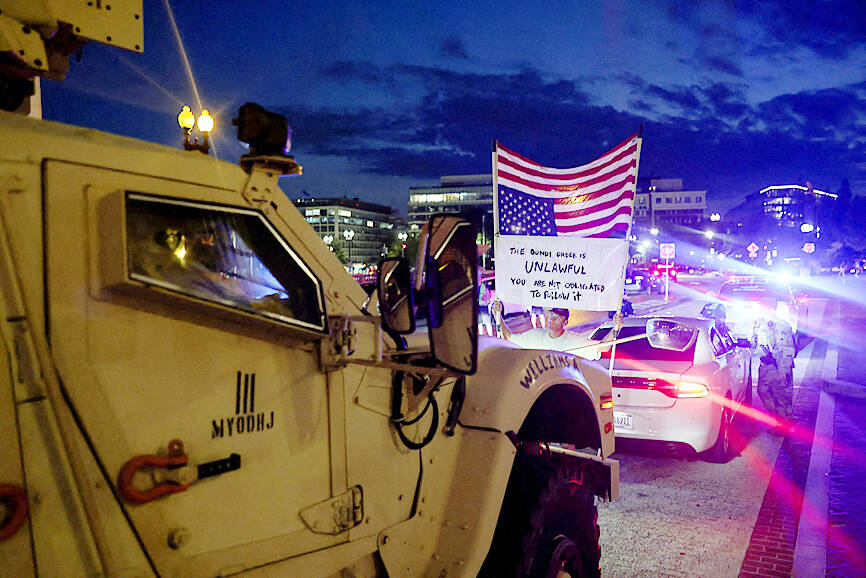
Photo: Reuters
By adding outside troops to the existing DC Guard deployment and federal law enforcement presence, Trump is exercising even tighter control over the city. It is a power play that the president has justified as an emergency response to crime and homelessness, even though city officials have noted that violent crime is lower than it was during Trump’s first term in office.
National Guard members have played a limited role in the federal intervention so far, and it is unclear why additional troops are needed. They have been patrolling at landmarks like the National Mall and Union Station, and assisting law enforcement with tasks including crowd control.
The Republican governors of the three states said they were sending hundreds of troops at the request of the Trump administration.
West Virginia Governor Patrick Morrisey said that the state “is proud to stand with President Trump in his effort to restore pride and beauty to our nation’s capital.”
South Carolina Governor Henry McMaster said he authorized the deployment of his state’s National Guard to help law enforcement in Washington at the Pentagon’s request, adding that if a hurricane or other natural disaster strikes, they would be recalled.
Ohio Governor Mike DeWine said he would send 150 military police to “carry out presence patrols and serve as added security,” and that they were expected to arrive in the coming days. His statement said that US Secretary of the Army Dan Driscoll requested the troops.
The activations suggest the Trump administration sees the need for additional manpower after the president personally played down the need for Washington to hire more police officers.
A protest against Trump’s intervention drew scores on Saturday to march to the White House. Demonstrators assembled behind a banner that said: “No fascist takeover of D.C.,” and some in the crowd held signs saying, “No military occupation.”
Morgan Taylor, one of the protest organizers, said they were hoping to spark enough backlash to Trump’s actions that the administration would be forced to pull back on its crime and immigration agenda.
Fueling the protests were concerns about Trump overreaching and that he had used crime as a pretext to impose his will on Washington.
John Finnigan, 55, was taking a bike ride when he ran into the protest in downtown Washington. The real estate construction manager who has lived in the capital for 27 years said Trump’s moves were “ridiculous” because crime is down.
“Hopefully, some of the mayors and some of the residents will get out in front of it and try and make it harder for it to happen in other cities,” Finnigan said.
Jamie Dickstein, a 24-year-old teacher, said she was “very uncomfortable and worried” for the safety or her students given the “unmarked officers of all types” now roaming Washington and detaining people.

Japan has started its first nationwide survey of animal cafes amid concerns over animal welfare, hygiene and public health, a government official said, bringing greater scrutiny to the popular but lightly regulated sector. The desktop survey, which began this month, will examine the number of facilities, the types of animals they house and the conditions they are held in, and how visitors interact with the animals. Exotic animal cafes, where visitors can interact with species ranging from otters to owls and marmots, have become popular attractions for Japanese and foreign tourists. However, researchers say some facilities keep threatened species, raising
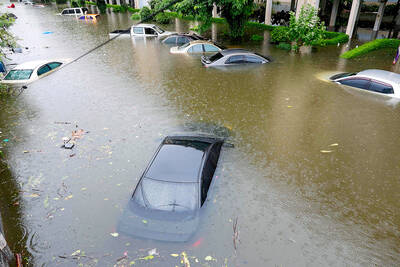
Several areas of Thailand’s capital city Bangkok were inundated by continuous rain from Thursday afternoon to yesterday morning that has disrupted traffic and forced some residents to evacuate. Major canals in Bangkok filled with accumulated rainfall exceeding 20cm, officials said yesterday. Floodwaters spread across the city, particularly in the central and eastern parts, blocking roads and stopping traffic. The Thai Meteorological Department warned that the heavy rain would continue in most parts of the country through today, citing a strong low-pressure system over the central region and strengthening southwest monsoon conditions. More than 84,000 people in 21 provinces nationwide were

Yemen’s Saudi-led coalition early yesterday said it had intercepted two ballistic missiles and two drones launched by the Iran-backed Houthis toward the kingdom. The coalition said in posts on social media that the missiles were headed towards Khamis Mushait and the drones toward the capital, Riyadh, adding that it was monitoring the missile threat and drones launched at the kingdom, without providing further details. The Saudi Civil Defense had sent alerts overnight for Khamis Mushait and Abha, but not for Riyadh. The Houthis, who control the most populous parts of Yemen and much of the north, have been launching attacks
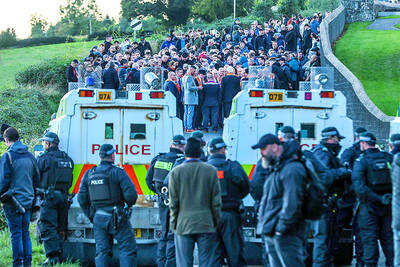
OLD WOUNDS: Protestant marchers seized on an overturned injunction to stage a march, which drew thousands of counterprotesters to block the road in Portadown UK leaders called for calm as a tense standoff with residents seeking to halt a pro-British Protestant march through a primarily Catholic area stretched into the night on Sunday, in one of the worst crises for Northern Ireland in the past few years. The tensions were triggered after a Belfast appeal court overturned a High Court injunction in the early hours of Sunday to clear the march by the Orange Order to go ahead for the first time since 1997. The Parades Commission, Northern Ireland’s independent body regulating contentious processions, had authorized 35 Orangemen to march silently along Garvaghy Road in Portadown,


 RSS
RSS