


Japan marked the 80th anniversary of its World War II defeat yesterday, with at least one Cabinet minister joining thousands of visitors at a shrine that Japan’s Asian neighbors view as a symbol of its wartime aggression.
Japanese Minister of Agriculture Shinchiro Koizumi, a contender in the ruling Liberal Democratic Party’s (LDP) leadership race last year, arrived at the Yasukuni Shrine in Tokyo early yesterday, local media reported.
Among the 2.5 million war dead commemorated at the shrine are 14 wartime leaders convicted of the most serious war crimes, along with more than 1,000 others found guilty by Allied tribunals after Japan’s 1945 defeat, as well as 30,304 Taiwanese soldiers killed in the war.
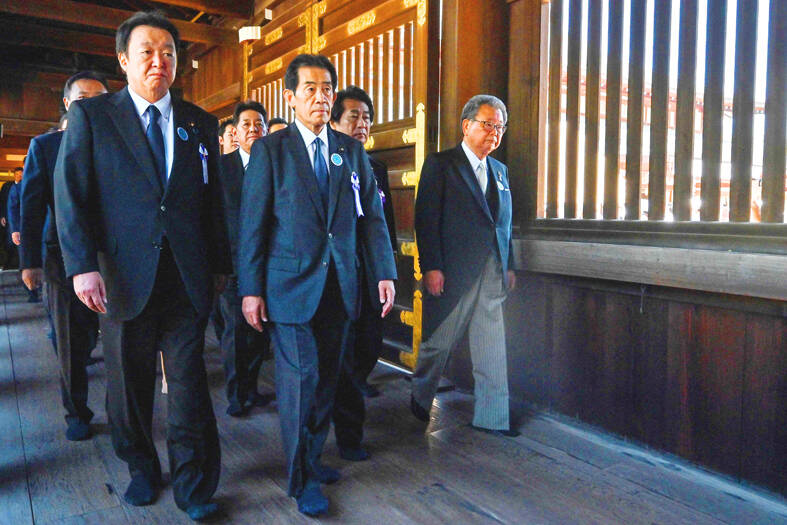
Photo: AFP
China and South Korea have criticized past visits by senior Japanese officials that they say gloss over Tokyo’s wartime actions and damage diplomatic ties.
Supporters say the shrine honors all of Japan’s war dead, regardless of their roles.
No sitting Japanese prime minister has visited the shrine since then-Japanese prime minister Shinzo Abe in December 2013, drawing an expression of disappointment from then-US president Barack Obama.
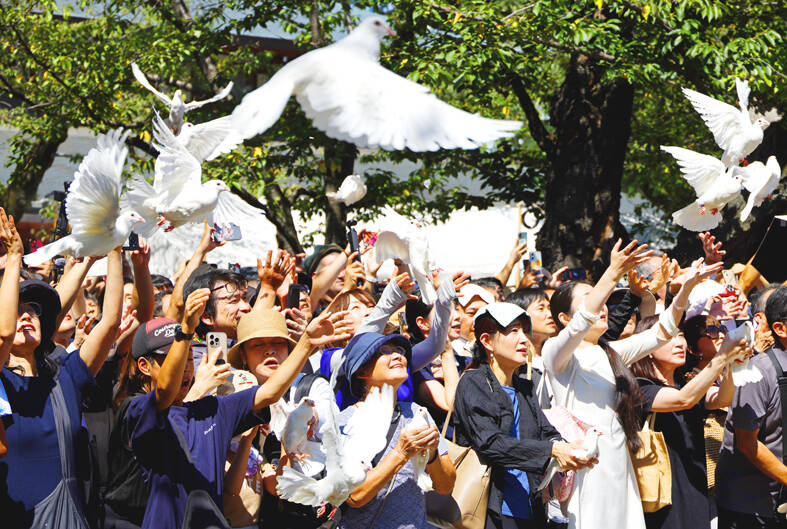
Photo: EPA
The last prime minister to visit on the anniversary of Japan’s surrender was Koizumi’s father, former Japanese prime minister Junichiro Koizumi, in 2006. Japanese Prime Minister Shigeru Ishiba yesterday sent an offering to the shrine, Kyodo News reported.
Another offering Ishiba made in October last year provoked criticism from South Korea, a Japanese colony for 35 years, and China, whose territories were occupied by Japanese forces in World War II.
Ishiba is expected to meet South Korean President Lee Jae-myung when he visits Japan on Saturday next week and Aug. 24 to discuss regional security and trilateral ties with the US.
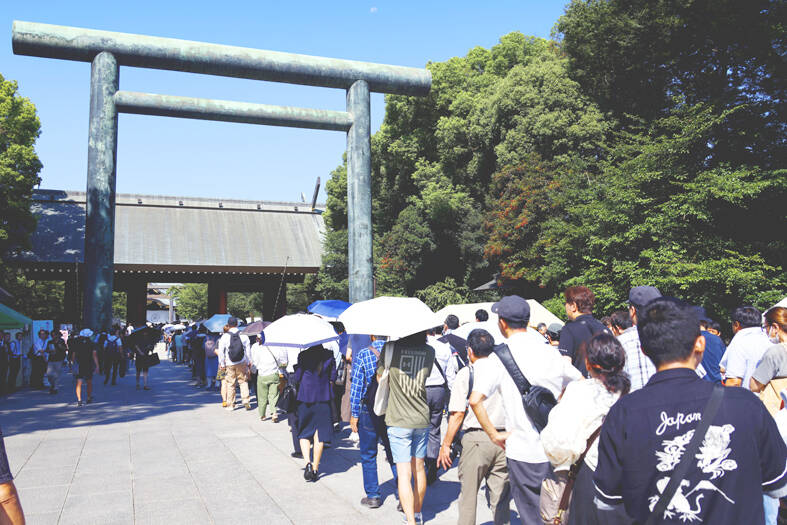
Photo: EPA
While relations between Tokyo and Seoul have often been strained, in recent years the two countries have deepened security cooperation to counter China’s growing influence and the threat posed to both by North Korea.
Koizumi was joined at Yasukuni by former Japanese minister of state for economic security Takayuki Kobayashi, local media reported. He also ran in last year’s LDP leadership election.
As many as 60 national and local lawmakers from Japan’s far-right Sanseito Party were also expected at Yasukuni. The “Japanese First” party wants to curb immigration, which it says is a threat to Japanese culture.
In July’s upper house election, it won 13 new seats, drawing support away from Ishiba’s LDP.
Additional reporting by staff writer

A humanoid robot that won a half-marathon race for robots in Beijing on Sunday ran faster than the human world record in a show of China’s technological leaps. The winner from Honor, a Chinese smartphone maker, completed the 21km race in 50 minutes and 26 seconds, said a WeChat post by the Beijing Economic-Technological Development Area, also known as Beijing E-Town, where the race began. That was faster than the human world record holder, Ugandan Jacob Kiplimo, who finished the same distance in about 57 minutes in March at the Lisbon road race. The performance by the robot marked a significant step forward

Four contenders are squaring up to succeed Antonio Guterres as secretary-general of the UN, which faces unprecedented global instability, wars and its own crushing budget crisis. Chile’s Michelle Bachelet, Argentina’s Rafael Grossi, Costa Rica’s Rebeca Grynspan and Senegal’s Macky Sall are each to face grillings by 193 member states and non-governmental organizations for three hours today and tomorrow. It is only the second time the UN has held a public question-and-answer, a format created in 2016 to boost transparency. Ultimately the five permanent members of the UN’s top body, the Security Council, hold the power, wielding vetoes over who leads the

South Korea’s air force yesterday apologized for a 2021 midair collision involving two fighter jets, a day after auditors said the pilots were taking selfies and filming during the flight and held them responsible for the accident. “We sincerely apologize to the public for the concern caused by the accident that occurred in 2021,” an air force spokesman told a news conference, adding that one of the pilots involved had been suspended from flying duties, received severe disciplinary action and has since left the military. The apology followed a report released on Wednesday by the South Korean Board of Audit and Inspection,
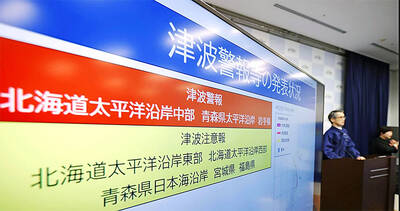
An earthquake registering a preliminary magnitude of 7.7 off northern Japan on Monday prompted a short-lived tsunami alert and the advisory of a higher risk of a possible mega-quake for coastal areas there. The Cabinet Office and the Japan Meteorological Agency said there was a 1% chance for a mega-quake, compared to a 0.1% chance during normal times, in the next week or so following the powerful quake near the Chishima and Japan trenches. Officials said the advisory was not a quake prediction but urged residents in 182 towns along the northeastern coasts to raise their preparedness while continuing their daily lives. Prime


 RSS
RSS