


The US Department of the Treasury on Wednesday announced sanctions on Brazilian Supreme Court Justice Alexandre de Moraes over alleged suppression of freedom of expression and the ongoing trial of former Brazilian president Jair Bolsonaro.
De Moraes oversees the criminal case against Bolsonaro, who is accused of masterminding a plot to stay in power despite his 2022 election defeat to current Brazilian President Luiz Inacio Lula da Silva.
“De Moraes is responsible for an oppressive campaign of censorship, arbitrary detentions that violate human rights and politicized prosecutions — including against former president Jair Bolsonaro,” US Secretary of the Treasury Scott Bessent said in a statement.
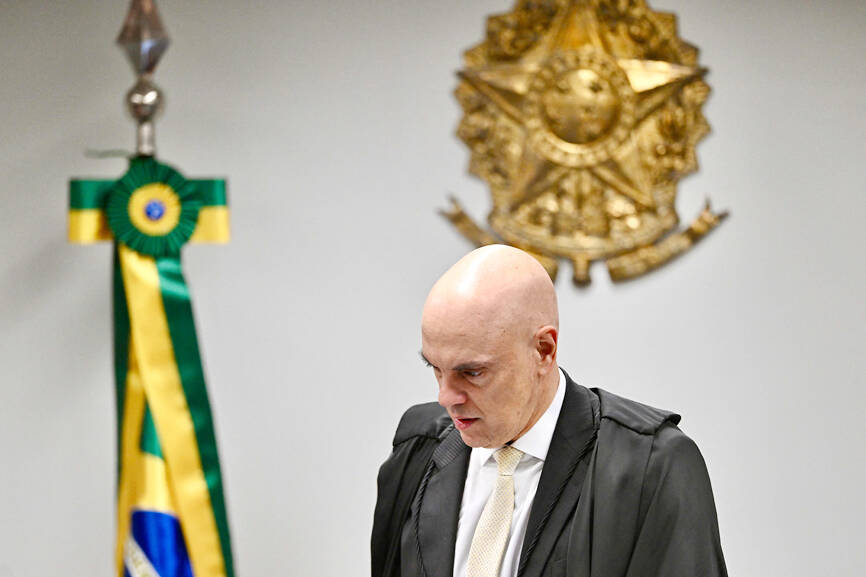
Photo: AFP
The department cited the Global Magnitsky Human Rights Accountability Act, which targets perpetrators of human rights abuse and corrupt officials, as its authority to issue the sanctions.
The decision orders the freezing of any assets or property De Moraes might have in the US.
The Brazilian Supreme Court and the Presidential Palace did not immediately respond to a request for comment.
Wednesday’s sanctions follow the US Department of State’s announcement on July 18 of visa restrictions on Brazilian judicial officials, including De Moraes.
They also came after US President Donald Trump on July 9 announced a 50 percent tariff on Brazilian imported goods. In a letter announcing the tariff, Trump explicitly linked the import tax to what he called the “witch hunt” trial of Bolsonaro under way in Brazil.
Trump on Wednesday signed an executive order to implement the 50 percent tariff.
Trump appears to identify with Bolsonaro, who is accused of trying to overturn the results of his 2022 loss to Lula. Similarly, Trump was indicted in 2023 on allegations that he tried to overturn the results of the 2020 US presidential election.
Flavia Loss, an international relations professor at Foundation School of Sociology and Politics in Sao Paulo, said the sanctions against De Moraes and the tariffs order marked an escalation in the tensions between the US and Brazil.
“We are not talking about a normal commercial dispute between countries, we are talking about using commercial tools to coerce what happens in Brazil,” Loss said.
Human Rights Watch in Brazil wrote on X that the sanctions “are a clear violation of judicial independence, a pillar of democracy.”

SPEAKING OUT: After Siranudh Scott’s allegations surfaced, celebrities and public figures took to social media to share their own experiences of sexual misconduct and abuse A high-profile alleged sexual abuse case within a wealthy Thai beer brewing family has prompted a wave of painful accounts from survivors of unconnected abuse in the conservative nation. Siranudh Scott, a member of the billionaire Thai family that founded the ubiquitous Singha beer brand, posted an emotional video this month accusing his elder brother Sunit of repeatedly abusing him when he was a teenager. Sunit, who is in his 30s, later denied the allegations in a video posted online, but Singha parent Boonrawd dismissed him from his executive role with the company on Tuesday last week. “I felt I needed to speak
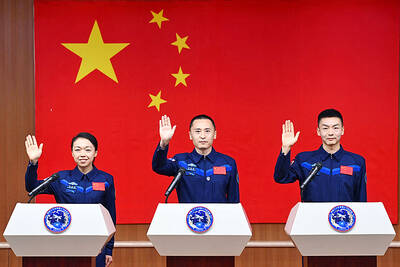
A Hong Kong astronaut is to join a Chinese space mission for the first time as part of a three-person crew launching today, as Beijing edges closer to its goal of landing people on the moon. The Tiangong space station — crewed by teams of three astronauts that are typically rotated every six months — is the crown jewel of China’s space program, boosted by billions in state investment in a bid to catch up with the US and Russia. The Shenzhou-23 mission is to blast off at 11:08pm from the Jiuquan Satellite Launch Center in northwestern China, carrying three astronauts to
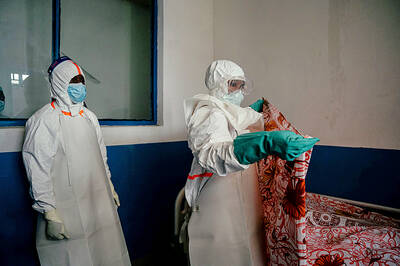
UPGRADED ALERT: The risk inside DR Congo is now considered ‘very high,’ while neighboring countries face a ‘high’ threat as the outbreak continues, the WHO said Ebola is spreading faster than responders can track it in eastern Congo, where health workers managed to follow up with barely one in five identified contacts in a single day. Authorities in the Democratic Republic of the Congo (DR Congo) reported 83 confirmed infections, 746 suspected cases and 1,603 identified contacts as of Thursday, but health workers were able to follow up on only 342 contacts that day — about 21 percent of the total under monitoring — data released by the DR Congo Ministry of Public Health on Friday showed. The figures suggest the response is falling behind the outbreak itself,

SEEKING ORDER: Rodrigo Paz said that ‘anyone who wants to destroy the nation will have to deal with this president and the full force of the constitution’ Bolivian President Rodrigo Paz on Wednesday said that the nation was at a “breaking point” after nearly a month of protests that have caused shortages of food, fuel and medicine. Paz, who took office six months ago amid the worst economic crisis there in four decades, is battling a groundswell of fury over his policies. The political capital, La Paz, has been besieged by low-income workers and members of the indigenous majority calling for his resignation. “The country needs order and is reaching breaking point,” the 58-year-old said at a public event in La Paz, renewing his appeal for dialogue. On Tuesday, the Bolivian


 RSS
RSS