


Former South Korean president Yoon Suk-yeol was indicted yesterday on additional criminal charges related to his ill-fated imposition of martial law, about three months after he was formally thrown out of office.
Yoon’s additional indictments mean he would remain in jail for up to six months as he faces a trial at the Seoul Central District Court on his Dec. 3 last year declaration of martial law that plunged South Korea into huge political turmoil.
Yoon was sent back to prison last week after the Seoul court approved his arrest warrant requested by a team of investigators headed by independent counsel Cho Eun-suk.
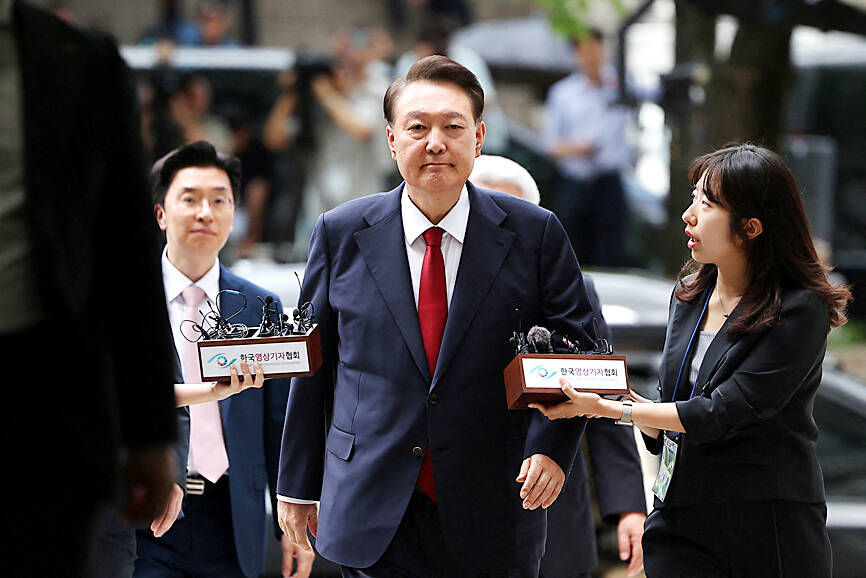
Photo: Reuters
Cho’s team indicted Yoon on abuse of power that obstructed the rights of some of his Cabinet members.
The charge was imposed because Yoon summoned only select Cabinet members to approve his emergency martial law when South Korean law requires approval of all Cabinet members for such a measure, Park Ji-young, a senior investigator at Cho’s team, told a briefing.
Park said Yoon was also charged with fabricating an official document in an attempt to satisfy a formal requirement for a martial law declaration before he eventually destroyed it.
After declaring martial law, Yoon sent troops and police officers to the opposition-controlled National Assembly, but enough lawmakers managed to enter the assembly chamber and voted down his decree, forcing his Cabinet to lift it.
Yoon was later impeached by the assembly, with some of his ruling party lawmakers voting to suspend his presidential powers.
Yoon said that his decree was a desperate attempt to draw public support for his fight against the “wickedness” of the main liberal opposition Democratic Party, which had obstructed his agenda, impeached top officials and slashed the government’s budget bill. He earlier called the National Assembly “a den of criminals” and “anti-state forces.”
In January, state prosecutors arrested and indicted him on rebellion, a grave charge that would incur the death penalty or life imprisonment if convicted.
However, in March, Yoon was released from prison after a judge at the Seoul District Court canceled his arrest to allow him to stand trial without being held in custody.
In April, the South Korean Constitutional Court formally dismissed Yoon as president, prompting a snap election to choose his successor. After winning that election, new President Lee Jae-myung, a former Democratic Party leader, approved legislation to launch independent investigations to uncover fuller details of Yoon’s martial law declaration and delve into other criminal allegations involving his wife, Kim Keon-hee, and administration.
Lee named Cho an independent counsel to lead an investigation into Yoon’s martial law decree.
In May, state prosecutors indicted Yoon on charges of abusing power and forcing soldiers and police officers to try to seal the assembly and election offices, acts that are not part of their duties.

SPEAKING OUT: After Siranudh Scott’s allegations surfaced, celebrities and public figures took to social media to share their own experiences of sexual misconduct and abuse A high-profile alleged sexual abuse case within a wealthy Thai beer brewing family has prompted a wave of painful accounts from survivors of unconnected abuse in the conservative nation. Siranudh Scott, a member of the billionaire Thai family that founded the ubiquitous Singha beer brand, posted an emotional video this month accusing his elder brother Sunit of repeatedly abusing him when he was a teenager. Sunit, who is in his 30s, later denied the allegations in a video posted online, but Singha parent Boonrawd dismissed him from his executive role with the company on Tuesday last week. “I felt I needed to speak
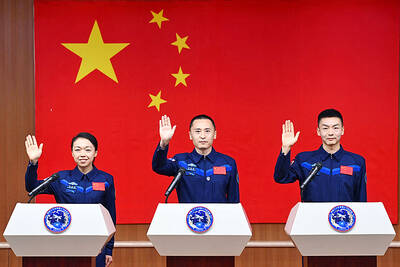
A Hong Kong astronaut is to join a Chinese space mission for the first time as part of a three-person crew launching today, as Beijing edges closer to its goal of landing people on the moon. The Tiangong space station — crewed by teams of three astronauts that are typically rotated every six months — is the crown jewel of China’s space program, boosted by billions in state investment in a bid to catch up with the US and Russia. The Shenzhou-23 mission is to blast off at 11:08pm from the Jiuquan Satellite Launch Center in northwestern China, carrying three astronauts to
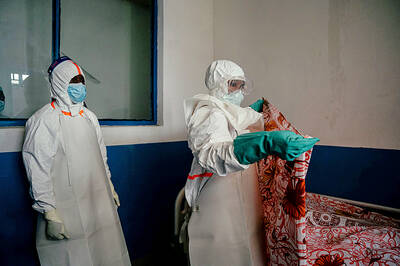
UPGRADED ALERT: The risk inside DR Congo is now considered ‘very high,’ while neighboring countries face a ‘high’ threat as the outbreak continues, the WHO said Ebola is spreading faster than responders can track it in eastern Congo, where health workers managed to follow up with barely one in five identified contacts in a single day. Authorities in the Democratic Republic of the Congo (DR Congo) reported 83 confirmed infections, 746 suspected cases and 1,603 identified contacts as of Thursday, but health workers were able to follow up on only 342 contacts that day — about 21 percent of the total under monitoring — data released by the DR Congo Ministry of Public Health on Friday showed. The figures suggest the response is falling behind the outbreak itself,

SEEKING ORDER: Rodrigo Paz said that ‘anyone who wants to destroy the nation will have to deal with this president and the full force of the constitution’ Bolivian President Rodrigo Paz on Wednesday said that the nation was at a “breaking point” after nearly a month of protests that have caused shortages of food, fuel and medicine. Paz, who took office six months ago amid the worst economic crisis there in four decades, is battling a groundswell of fury over his policies. The political capital, La Paz, has been besieged by low-income workers and members of the indigenous majority calling for his resignation. “The country needs order and is reaching breaking point,” the 58-year-old said at a public event in La Paz, renewing his appeal for dialogue. On Tuesday, the Bolivian


 RSS
RSS