


Japanese Prime Minister Shigeru Ishiba likes the nitty gritty of policy, cigarettes and making models, but his dream job as prime minister could go up in smoke this weekend.
Opinion polls suggest that Ishiba’s coalition could lose its majority in the upper house elections today, a result that might push him to resign.
The Liberal Democratic Party (LDP) has governed Japan almost continuously since 1955, but whether anyone wants to replace Ishiba is another matter.
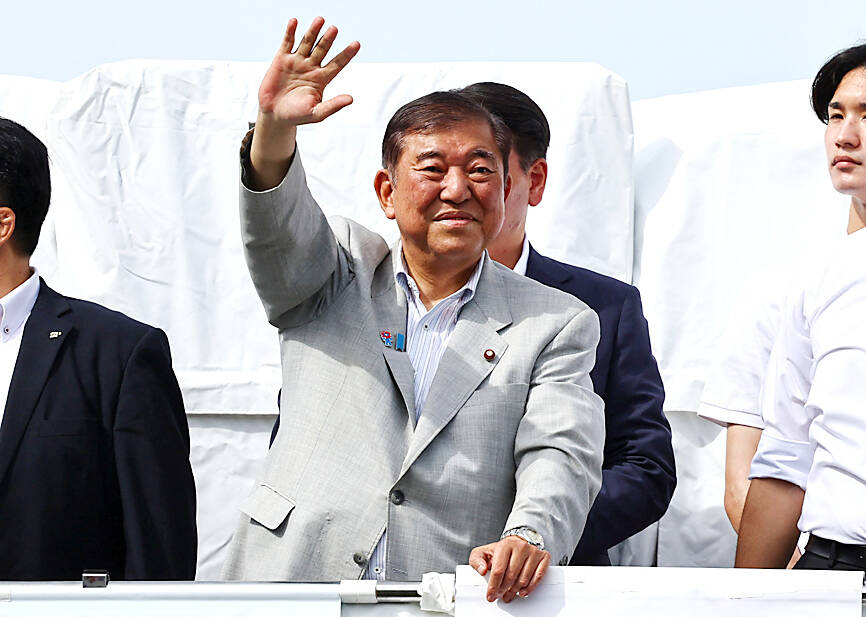
Photo: Reuters
“I wonder who else wants the job,” said Masahisa Endo, a politics professor at Waseda University.
Ishiba, 68, a self-confessed defense “geek,” is the son of a regional governor and is from Japan’s small Christian minority. He won the party leadership in September last year, on his fifth try, to become the LDP’s 10th separate prime minister since 2000, all of them men.
Ishiba pledged to “create a new Japan” and revitalize depressed rural regions, and to address the “quiet emergency” of Japan’s shrinking population.
He immediately called lower house elections for October of that year, but that backfired spectacularly, with the LDP having its worst result in 15 years.
That robbed the LDP and its coalition party Komeito of their majority, forcing them to bargain with opposition parties to pass legislation.
Ishiba’s policies on bringing down inflation and spurring growth have “flip-flopped” as a result, Moody’s Analytics senior economist Stefan Angrick said.
“Ishiba’s government has boxed itself in, promising only some belated and half-hearted financial support that will do little to improve the demand outlook,” Angrick said.
The government’s popularity ratings have plummeted, with voters angry about price rises, especially for rice that is twice as expensive as a year ago.
Ishiba, the father of two daughters, also missed a chance to appear more modern by appointing only two women to his Cabinet, down from five under predecessor Fumio Kishida.
Ishiba’s sometimes clumsy ways — ranging from the less-than-perfectly tidy arrangement of his tuxedo to his table manners — have also been rich fodder for social media memes.
He drew ridicule after being snapped apparently napping in parliament and for failing to stand up to greet other world leaders at a gathering in South America.
Worse was a video that emerged of Ishiba eating an onigiri rice ball — a popular snack — whole and munching on it without closing his mouth.
“He eats like a three-year-old,” one user wrote on X.
“How could he have risen to the top with these manners?” another wrote.
A major challenge has been dealing with US President Donald Trump, who has imposed tariffs on Japanese cars, steel and aluminum.
Further levies of 25 percent on other Japanese imports would come into force on Aug. 1 if there is no trade agreement.
Ishiba secured an early invitation to the White House in February and has sent his tariffs envoy to Washington seven times, but there has been no deal yet.
Former Japanese prime minister Shinzo Abe — dubbed a “Trump whisperer” — fared better during Trump’s first term, managing to shield Japan from any tariffs.
Abe, who was assassinated in 2022, gifted Trump a gold-colored golf club and was a frequent visitor to see the US president.
Trump said that Abe nominated him for the Nobel Prize.
“There will never be another like him,” he said after Abe’s death.
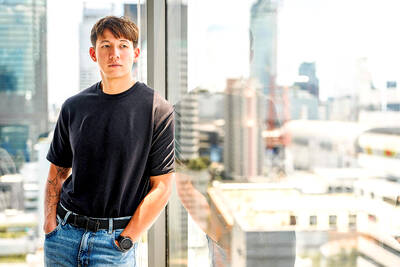
SPEAKING OUT: After Siranudh Scott’s allegations surfaced, celebrities and public figures took to social media to share their own experiences of sexual misconduct and abuse A high-profile alleged sexual abuse case within a wealthy Thai beer brewing family has prompted a wave of painful accounts from survivors of unconnected abuse in the conservative nation. Siranudh Scott, a member of the billionaire Thai family that founded the ubiquitous Singha beer brand, posted an emotional video this month accusing his elder brother Sunit of repeatedly abusing him when he was a teenager. Sunit, who is in his 30s, later denied the allegations in a video posted online, but Singha parent Boonrawd dismissed him from his executive role with the company on Tuesday last week. “I felt I needed to speak

SEEKING ORDER: Rodrigo Paz said that ‘anyone who wants to destroy the nation will have to deal with this president and the full force of the constitution’ Bolivian President Rodrigo Paz on Wednesday said that the nation was at a “breaking point” after nearly a month of protests that have caused shortages of food, fuel and medicine. Paz, who took office six months ago amid the worst economic crisis there in four decades, is battling a groundswell of fury over his policies. The political capital, La Paz, has been besieged by low-income workers and members of the indigenous majority calling for his resignation. “The country needs order and is reaching breaking point,” the 58-year-old said at a public event in La Paz, renewing his appeal for dialogue. On Tuesday, the Bolivian
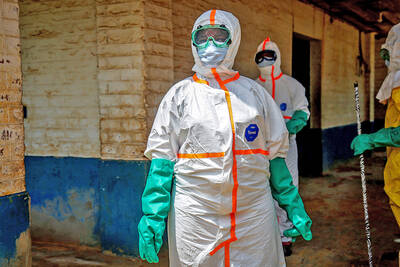
COMMUNITY CONFLICT: Concerns about disease spread from corpses has run up against friends and families’ desire to bury their dead as infection spreads in the area Angry residents of a town at the epicenter of the Ebola outbreak in the Democratic Republic of the Congo (DR Congo) attacked and burned a tent that was part of a health center where people are being treated for the virus, the staff there said Saturday. It was the second such attack in the region in a week. No one was hurt in the attack, according to reports but as patients ran out to escape the fire, 18 people with suspected Ebola infections fled the facility and are unaccounted for, a hospital director said. Angry residents arrived at the clinic in the

Forecasters in Europe yesterday warned of exceptional heat as record temperatures driven by a “heat dome” push temperatures well above seasonal norms across the continent. The surge follows a record-breaking Monday, with France logging its hottest day in the month of May on record, its weather agency said, and the UK also posting unprecedented highs. A so-called “heat dome” of warm air from northern Africa trapped under a high-pressure system over western Europe is behind the high temperatures not usually seen until high summer. Restrictions on outdoor work were imposed in parts of Italy, beaches in southwest France filled earlier than usual and


 RSS
RSS