


Former Thai prime minister Thaksin Shinawatra yesterday testified in court, seeking to defend himself against royal defamation charges in a watershed case for his faltering political dynasty.
Thaksin faces up to 15 years in prison if he is convicted in the closed-door trial in Bangkok, where he stands accused of breaching strict lese-majeste laws that shield Thailand’s royal family from abuse and criticism.
For the past quarter-century, the 75-year-old telecoms magnate has been a defining figure of Thai politics, founding a political clan which has jousted with the traditional pro-royal, pro-military elite.
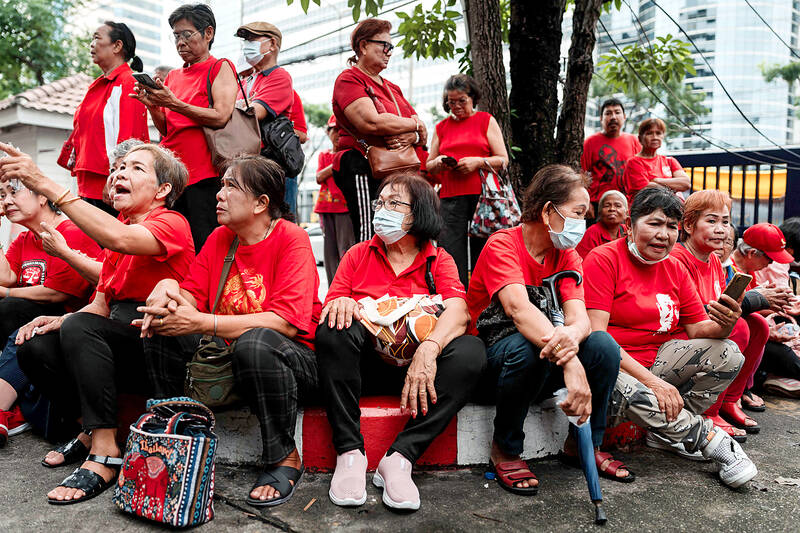
Photo: AFP
However, his prosecution — combined with the suspension of his daughter, Thai Prime Minister Paetongtarn Shinawatra, this month — represents a dramatic waning of their family’s political fortune, analysts said.
The prosecutors’ case revolves around remarks Thaksin made to South Korean media a decade ago.
Thaksin’s lawyer Winyat Chatmontri said he testified in the morning “and will continue throughout the rest of the day.”
The court has scheduled the verdict for Aug. 22, he told reporters.
About 50 Thaksin supporters gathered at the courthouse wearing red shirts — the color of his political movement — emblazoned with his portrait.
“He is a very talented guy,” 79-year-old retired accountant Vaew Wilailak said. “But from past experience, bad people just want to get rid of him.”
Thaksin returned to Thailand in August 2023 after 15 years in exile, following a military coup that ousted him from the prime minister post he was twice elected to.
He returned the day his family’s Pheu Thai Party took office at the head of a coalition government backed by their conservative former enemies, fueling suspicions a backroom deal had been struck.
Thaksin was immediately sentenced to eight years in prison on graft and abuse of power charges — later reduced to one year by a pardon from King Maha Vajiralongkorn.
However, “there is always someone within the establishment who sees him as a threat to Thai society,” Political analyst Yuttaporn Issarachai said.
In recent interviews, Thaksin affirmed his loyalty to the monarchy and expressed gratitude for the king’s pardon.
Speaking outside the court on the trial’s opening day on July 1, Winyat said his client appeared “chill” despite the seriousness of the case.
On the same day, Thaksin’s daughter was suspended by the Constitutional Court pending an ethics probe into her conduct during a leaked diplomatic phone call discussing a deadly border clash between Thailand and neighboring Cambodia.
In the call, Paetongtarn addressed former Cambodian prime minister Hun Sen as “uncle” and described a Thai military commander as an “opponent” — sparking backlash for seeming to kowtow to a foreign statesman and undermine her own country’s military.
Pheu Thai’s coalition has been abandoned by key conservative backers over the call, leaving it with a razor-thin parliamentary majority steered by a caretaker prime minister.
The Thai National Assembly yesterday threw out a draft amnesty bill in its first reading that would have released more than 30 people in prison for royal defamation.
At least 280 people have been prosecuted under the kingdom’s strict lese-majeste law since 2020, which carries a maximum sentence of up to 15 years per offense, Thai Lawyers for Human Rights said.

SPEAKING OUT: After Siranudh Scott’s allegations surfaced, celebrities and public figures took to social media to share their own experiences of sexual misconduct and abuse A high-profile alleged sexual abuse case within a wealthy Thai beer brewing family has prompted a wave of painful accounts from survivors of unconnected abuse in the conservative nation. Siranudh Scott, a member of the billionaire Thai family that founded the ubiquitous Singha beer brand, posted an emotional video this month accusing his elder brother Sunit of repeatedly abusing him when he was a teenager. Sunit, who is in his 30s, later denied the allegations in a video posted online, but Singha parent Boonrawd dismissed him from his executive role with the company on Tuesday last week. “I felt I needed to speak

SEEKING ORDER: Rodrigo Paz said that ‘anyone who wants to destroy the nation will have to deal with this president and the full force of the constitution’ Bolivian President Rodrigo Paz on Wednesday said that the nation was at a “breaking point” after nearly a month of protests that have caused shortages of food, fuel and medicine. Paz, who took office six months ago amid the worst economic crisis there in four decades, is battling a groundswell of fury over his policies. The political capital, La Paz, has been besieged by low-income workers and members of the indigenous majority calling for his resignation. “The country needs order and is reaching breaking point,” the 58-year-old said at a public event in La Paz, renewing his appeal for dialogue. On Tuesday, the Bolivian
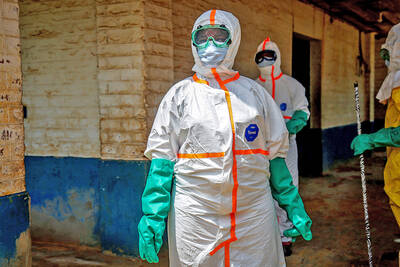
COMMUNITY CONFLICT: Concerns about disease spread from corpses has run up against friends and families’ desire to bury their dead as infection spreads in the area Angry residents of a town at the epicenter of the Ebola outbreak in the Democratic Republic of the Congo (DR Congo) attacked and burned a tent that was part of a health center where people are being treated for the virus, the staff there said Saturday. It was the second such attack in the region in a week. No one was hurt in the attack, according to reports but as patients ran out to escape the fire, 18 people with suspected Ebola infections fled the facility and are unaccounted for, a hospital director said. Angry residents arrived at the clinic in the

Forecasters in Europe yesterday warned of exceptional heat as record temperatures driven by a “heat dome” push temperatures well above seasonal norms across the continent. The surge follows a record-breaking Monday, with France logging its hottest day in the month of May on record, its weather agency said, and the UK also posting unprecedented highs. A so-called “heat dome” of warm air from northern Africa trapped under a high-pressure system over western Europe is behind the high temperatures not usually seen until high summer. Restrictions on outdoor work were imposed in parts of Italy, beaches in southwest France filled earlier than usual and


 RSS
RSS