


Italy is hosting the fourth annual conference on rebuilding Ukraine even as Russia escalates its war, inviting political and business leaders to Rome to promote public-private partnerships on defense, mining, energy and other projects as uncertainty grows about the US’ commitment to Kyiv’s defense.
Italian Prime Minister Giorgia Meloni and Ukrainian President Volodymyr Zelenskiy were opening the meeting yesterday, which gets under way as Russia accelerated its aerial and ground attacks against Ukraine with another night of pounding missile and drone attacks on Kyiv.
Italian organizers said that 100 official delegations were attending, as were 40 international organizations and development banks.
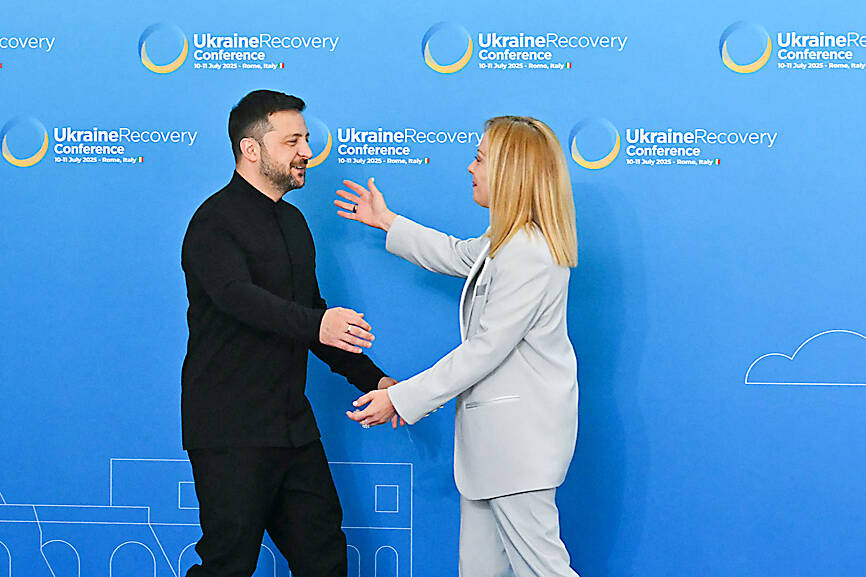
Photo: AFP
There are also 2,000 businesses, civil society and local Ukrainian governments sending representatives, organizers said.
They are participating in a trade fair on the grounds of the ministerial-
level meeting at Rome’s new La Nuvola, or “Cloud,” conference center in the EUR neighborhood.
The aim of the conference is to pair international investors with Ukrainian counterparts to meet, talk and hammer out joint partnerships in hopes of not just rebuilding Ukraine during and after the war, but modernizing it and helping it achieve reforms for admission into the EU.
“It could feel a bit counterintuitive to start speaking about reconstruction when there is a war raging and nearly daily attacks on civilians, but it’s not. It’s actually an urgent priority,” said Eleonora Tafuro Ambrosetti, senior research fellow at the Rome-based Institute for Studies of International Politics.
It is the fourth such conference on Ukraine’s recovery, with earlier editions in Lugano, Switzerland, in 2022, London in 2023 and Berlin last year. The Berlin conference elaborated four main pillars that are continuing in Rome to focus on business, human capital, local and regional issues, and the reforms for EU admission.
“It’s basically a platform where a lot of businesses, European businesses and Ukrainian businesses, meet up and network, where you can actually see this public-private partnership in action, because obviously public money is not enough to undertake this gigantic effort of restructuring a country,” Ambrosetti said.
The World Bank Group, the European Commission and the UN have estimated that Ukraine’s recovery after more than three years of war would cost US$524 billion over the next decade.
Alexander Temerko, a businessman, said that the Rome conference is different from its predecessors because it is focused on specific industries and issues, not just vague talk about the need to rebuild.
The program includes practical workshops on such topics as “de-risking” investment, and panel discussions on investing in Ukraine’s rare earths, pharmaceutical and domestic defense industries.
“This is the first conference which is considering particularly projects in the energy sector, the mining sector, the metallurgical sector, the infrastructure sector, the transport sector, which need to be restored in Ukraine and during the war especially,” Temerko said. “That is the special particularity of this conference.”
Former US special representative for Ukraine negotiations Kurt Volker said that Meloni could make the conference a success if she endorses a coordinating agency to provide follow-up that would give “focused political leadership” behind Ukraine’s recovery.
“If there is a sustainable ceasefire, Ukraine can be expected to experience double-digit economic growth. And yet a high-level focus on economic development is still lacking,” Volker wrote for the Center for European Policy Analysis.
In addition to Meloni and Zelenskiy, German Chancellor Friedrich Merz, Polish Prime Minister Donald Tusk, Dutch Prime Minister Dick Schoof, European Commission President Ursula von der Leyen, as well as economy and or foreign ministers from other European countries, are attending.
French President Emmanuel Macron and British Prime Minister Keir Starmer were to participate in a videoconference call of the “coalition of the willing” — countries willing to deploy troops to Ukraine to police a potential peace agreement with Russia.
Retired US lieutenant general Keith Kellogg, US President Donald Trump’s special envoy to Ukraine and Russia, was in Rome and met with Zelenskiy on Wednesday.
Zelenskiy planned talks with other US officials to discuss the expected adoption of a new US sanctions package, Ukrainian Minister of Foreign Affairs Andrii Sybiha said on Wednesday in a statement on Telegram.
It was a reference to a bill sponsored by US senators Lindsey Graham and Richard Blumenthal, who are both in Rome, calling in part for a 500 percent tariff on goods imported from countries that continue to buy Russian oil.
The move would have huge ramifications for China and India, which buy Russian oil.
“Don’t just watch Russia terrorize people in Ukraine. Act now to defund Russia’s war machine,” Sybiha wrote.
The success of the coalition of the willing’s operation hinges on US backup with air power or other military assistance, but the Trump administration has made no public commitment to provide support, while even current US military support to Ukraine is in question.
Trump on Monday said that the US would have to send more weapons to Ukraine, just days after Washington paused critical weapons deliveries to Kyiv.

When a hiker fell from a 55m waterfall in wild New Zealand bush, rescuers were forced to evacuate the badly hurt woman without her dog, which could not be found. After strangers raised thousands of dollars for a search, border collie Molly was flown to safety by a helicopter pilot who was determined to reunite the pet and the owner. A week earlier, an emergency rescue helicopter found the woman with bruises and lacerations after a fall at a rocky spot at the waterfall on the South Island’s West Coast. She was airlifted on March 24, but they were forced to

CONFIDENCE BOOSTER: ’After parkour ... you dare to do a lot of things that you think only young people can do,’ a 67-year-old parkour enthusiast said In a corner of suburban Singapore, Betty Boon vaults a guardrail, crawls underneath a slide, executes forward shoulder rolls and scales a steep slope, finishing the course to applause. “Good job,” the 69-year-old’s coach cheers. This is “geriatric parkour,” where about 20 retirees learned to tackle a series of relatively demanding exercises, building their agility and enjoying a sense of camaraderie. Boon, an upbeat grandmother, said learning parkour has aided her confidence and independence as she ages. “When you’re weak, you will be dependent on someone,” she said after sweating it out with her parkour classmates in suburban Toa Payoh,

Chinese dissident artist Gao Zhen (高兟), famous for making provocative satirical sculptures of former Chinese leader Mao Zedong (毛澤東), was tried on Monday over accusations of “defaming national heroes and martyrs,” his wife and a rights group said. Gao, 69, who was detained in 2024 during a visit from the US, faces a maximum three-year prison sentence, said his wife, Zhao Yaliang (趙雅良), and Shane Yi, a researcher at the Chinese Human Rights Defenders group which operates outside the nation. The closed-door, one-day trial took place at Sanhe City People’s Court in Hebei Province neighboring the capital, Beijing, and ended without a
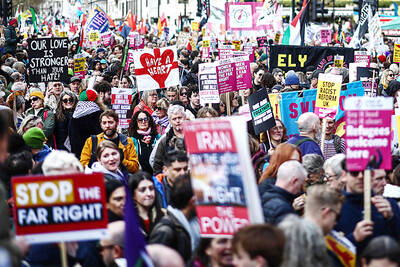
‘TOXIC CLIMATE’: ‘I don’t really recognize Labour anymore... The idea that you can implement far-right ideas in order to stop the far right is nonsense,’ a protester said Tens of thousands of people on Saturday marched through central London to protest against the far right, weeks ahead of local elections and six months after Britain saw one of its largest far-right demonstrations. Organized by hundreds of civic groups, including trade unions, anti-racism campaigners and Muslim representative bodies, Saturday’s Together Alliance event was billed as the biggest in UK history to counter right-wing extremism. A separate pro-Palestinian march had also converged with the main rally. While organizers claimed 500,000 had turned out in total, the police gave a figure of about 50,000. Protesters carrying placards with slogans such as


 RSS
RSS