


BRICS leaders are to meet in Rio de Janeiro from today, with the bloc depleted by the absence of Chinese President Xi Jinping (習近平), who is skipping the annual summit of emerging economies for the first time in 12 years.
The grouping meets as its members face imminent and costly tariff wars with the US.
Conceived two decades ago as a forum for fast-growing economies, the BRICS have come to be dominated by Beijing, which grew much faster and larger than the rest.
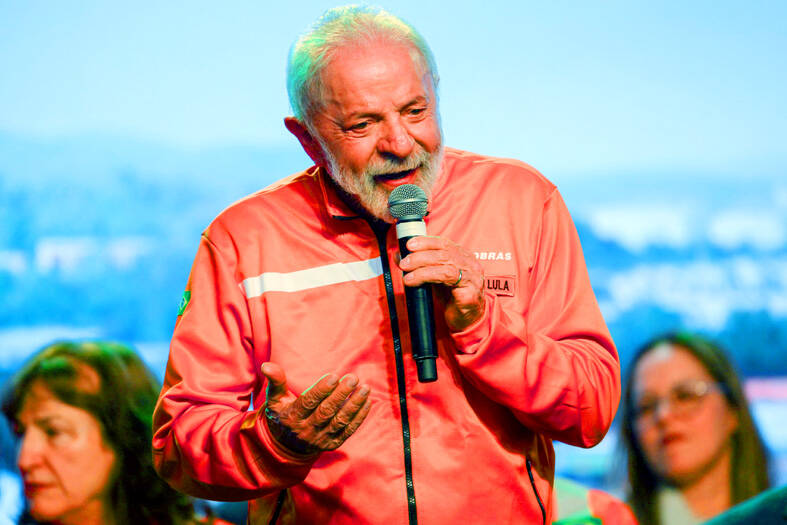
Photo: AFP
China has not said why Xi would miss the summit, a first since he became president in 2013.
“I expect there will be speculation about the reasons for Xi’s absence,” said Ryan Hass, a former China director at the US National Security Council who is now with the Brookings Institution think tank.
“The simplest explanation may hold the most explanatory power. Xi recently hosted Lula in Beijing,” Has said.
The Chinese leader would not be the only notable absentee. War crime-indicted Russian President Vladimir Putin is also opting to stay away, but would participate via video link, according to the Kremlin.
So too would Iranian President Masoud Pezeshkian, whose nation is still reeling from a 12-day conflict with Israel.
Putin’s non-attendance and the fact that Indian Prime Minister Narendra Modi is to be a guest of honor in Brazil could also be factors in Xi’s absence, Hass said.
“Xi does not want to appear upstaged by Modi,” who would receive a state lunch, he said. “I expect Xi’s decision to delegate attendance to [Chinese] Premier Li [Qiang, 李強] rests amidst these factors.”
Still, the Xi no-show is a blow to host Brazilian President Luiz Inacio Lula da Silva, who wants Brazil to play a bigger role on the world stage.
In the year to November, Brazil would have hosted a G20 summit, a BRICS summit, and COP30 international climate talks, all before heading into fiercely contested presidential elections next year.
Lula is expected to run again for an unprecedented fourth term in office.
For BRICS leaders who do make the trip to the cidade maravilhosa — the marvelous city — the economy would be top of the agenda.
Lula on Friday defended the idea of finding an alternative to the dollar for trade among BRICS nations.
“I know it is complicated. There are political problems,” Lula said at a BRICS banking event. “But if we do not find a new formula, we are going to finish the 21st century the way we started the 20th.”
However, with many, including China, locked in difficult trade negotiations with the US, they might be wary of roiling the mercurial US president.
US President Donald Trump has warned that starting tomorrow, countries would receive letters stating the amount their exports to the US would be tariffed.
He has also threatened to impose 100 percent tariffs on countries that challenge the US dollar’s international dominance.
“We’re anticipating a summit with a cautious tone: it will be difficult to mention the United States by name in the final declaration,” said Marta Fernandez, director of the BRICS Policy Center at Rio’s Pontifical Catholic University.
This is particularly the case for China, she said: “This doesn’t seem to be the right time to provoke further friction” between the world’s two leading economies.

SPEAKING OUT: After Siranudh Scott’s allegations surfaced, celebrities and public figures took to social media to share their own experiences of sexual misconduct and abuse A high-profile alleged sexual abuse case within a wealthy Thai beer brewing family has prompted a wave of painful accounts from survivors of unconnected abuse in the conservative nation. Siranudh Scott, a member of the billionaire Thai family that founded the ubiquitous Singha beer brand, posted an emotional video this month accusing his elder brother Sunit of repeatedly abusing him when he was a teenager. Sunit, who is in his 30s, later denied the allegations in a video posted online, but Singha parent Boonrawd dismissed him from his executive role with the company on Tuesday last week. “I felt I needed to speak
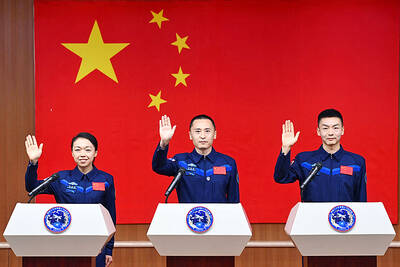
A Hong Kong astronaut is to join a Chinese space mission for the first time as part of a three-person crew launching today, as Beijing edges closer to its goal of landing people on the moon. The Tiangong space station — crewed by teams of three astronauts that are typically rotated every six months — is the crown jewel of China’s space program, boosted by billions in state investment in a bid to catch up with the US and Russia. The Shenzhou-23 mission is to blast off at 11:08pm from the Jiuquan Satellite Launch Center in northwestern China, carrying three astronauts to

SEEKING ORDER: Rodrigo Paz said that ‘anyone who wants to destroy the nation will have to deal with this president and the full force of the constitution’ Bolivian President Rodrigo Paz on Wednesday said that the nation was at a “breaking point” after nearly a month of protests that have caused shortages of food, fuel and medicine. Paz, who took office six months ago amid the worst economic crisis there in four decades, is battling a groundswell of fury over his policies. The political capital, La Paz, has been besieged by low-income workers and members of the indigenous majority calling for his resignation. “The country needs order and is reaching breaking point,” the 58-year-old said at a public event in La Paz, renewing his appeal for dialogue. On Tuesday, the Bolivian
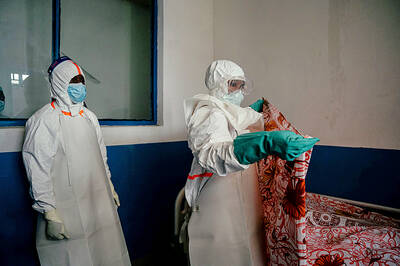
UPGRADED ALERT: The risk inside DR Congo is now considered ‘very high,’ while neighboring countries face a ‘high’ threat as the outbreak continues, the WHO said Ebola is spreading faster than responders can track it in eastern Congo, where health workers managed to follow up with barely one in five identified contacts in a single day. Authorities in the Democratic Republic of the Congo (DR Congo) reported 83 confirmed infections, 746 suspected cases and 1,603 identified contacts as of Thursday, but health workers were able to follow up on only 342 contacts that day — about 21 percent of the total under monitoring — data released by the DR Congo Ministry of Public Health on Friday showed. The figures suggest the response is falling behind the outbreak itself,


 RSS
RSS