


At least 24 people were killed and a frantic search continued overnight for many others missing in the Texas Hill Country, including more than 20 from a girls’ camp, after a storm unleashed nearly a foot of rain and sent floodwaters spilling out of the Guadalupe River.
The destructive force of the fast-rising waters just before dawn on Friday washed out homes and swept away vehicles. There were hundreds of rescues around Kerr County, Texas, including at least 167 by helicopter, authorities said.
The total number of missing was not known, but the sheriff said between 23 and 25 of them were girls who had been attending Camp Mystic, a Christian summer camp along the river.
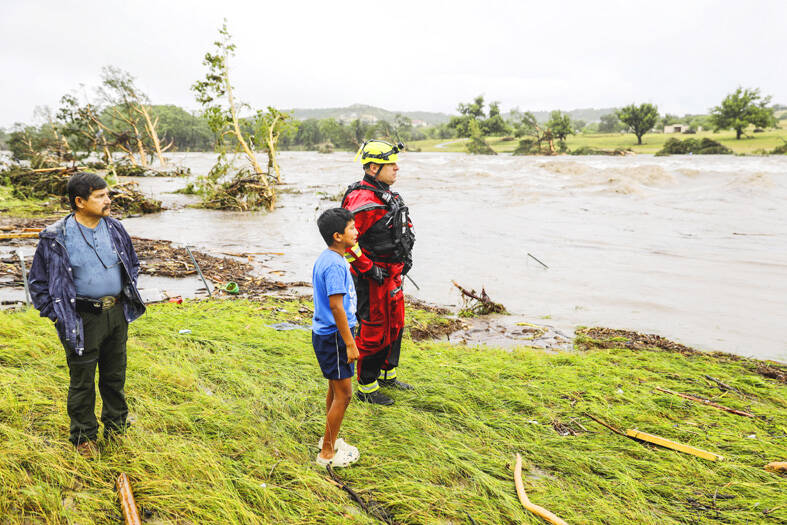
Photo: The San Antonio Express-News via AP
On social media, parents and families posted desperate pleas for information about loved ones caught in the flood zone.
“The camp was completely destroyed,” said Elinor Lester, 13, one of hundreds of campers at Camp Mystic. “A helicopter landed and started taking people away. It was really scary.”
She said a raging storm woke up her cabin around 1:30am on Friday, and when rescuers arrived, they tied a rope for the girls to hold as the children in her cabin walked across bridge with floodwaters whipping around the calves and knees.
The flooding in the middle of the night on the Fourth of July holiday caught many residents, campers and officials by surprise. Officials defended their preparations for severe weather and their response, but said they had not expected such an intense downpour that was, in effect, the equivalent of months’ worth of rain for the area.
One National Weather Service forecast this week had called for only 76mm to 152mm of rain, said Nim Kidd, the chief of the Texas Division of Emergency Management.
“It did not predict the amount of rain that we saw,” he said.
Kerr County Sheriff Larry Leitha told a news conference late on Friday that 24 people had been confirmed killed. Authorities said 237 people had been rescued so far.
A river gauge at Hunt recorded a 6.7m rise in about two hours, according to Bob Fogarty, meteorologist with the National Weather Service’s Austin/San Antonio office. The gauge failed after recording a level of 9m.
“The water’s moving so fast, you’re not going to recognize how bad it is until it’s on top of you,” Fogarty said.
On the Kerr County sheriff’s office Facebook page, people posted pictures of loved ones and begged for help finding them.
At least 400 people were on the ground helping in the response, Texas Lieutenant Governor Dan Patrick said.
Nine rescue teams, 14 helicopters and 12 drones were being used, with some people being rescued from trees.
In Ingram, Texas, Erin Burgess woke to thunder and rain at 3:30am. Just 20 minutes later, water was pouring into her home directly across from the river, she said.
She described an agonizing hour clinging to a tree and waiting for the water to recede enough so they could walk up the hill to a neighbor’s home.
“My son and I floated to a tree where we hung onto it, and my boyfriend and my dog floated away. He was lost for a while, but we found them,” she said.
Of her 19-year-old son, Burgess said: “Thankfully he’s over 6 feet [183cm] tall. That’s the only thing that saved me, was hanging on to him.”
Matthew Stone, 44, of Kerrville, said police came knocking on doors at 5:30am, but that he had received no warning on his phone.
“We got no emergency alert. There was nothing,” Stone said. Then “a pitch black wall of death.”
The area is known as “flash flood alley” because of the hills’ thin layer of soil, said Austin Dickson, CEO of the Community Foundation of the Texas Hill Country, which was collecting donations to help nonprofits responding to the disaster.
“When it rains, water doesn’t soak into the soil,” Dickson said. “It rushes down the hill.”

SPEAKING OUT: After Siranudh Scott’s allegations surfaced, celebrities and public figures took to social media to share their own experiences of sexual misconduct and abuse A high-profile alleged sexual abuse case within a wealthy Thai beer brewing family has prompted a wave of painful accounts from survivors of unconnected abuse in the conservative nation. Siranudh Scott, a member of the billionaire Thai family that founded the ubiquitous Singha beer brand, posted an emotional video this month accusing his elder brother Sunit of repeatedly abusing him when he was a teenager. Sunit, who is in his 30s, later denied the allegations in a video posted online, but Singha parent Boonrawd dismissed him from his executive role with the company on Tuesday last week. “I felt I needed to speak

A Hong Kong astronaut is to join a Chinese space mission for the first time as part of a three-person crew launching today, as Beijing edges closer to its goal of landing people on the moon. The Tiangong space station — crewed by teams of three astronauts that are typically rotated every six months — is the crown jewel of China’s space program, boosted by billions in state investment in a bid to catch up with the US and Russia. The Shenzhou-23 mission is to blast off at 11:08pm from the Jiuquan Satellite Launch Center in northwestern China, carrying three astronauts to

UPGRADED ALERT: The risk inside DR Congo is now considered ‘very high,’ while neighboring countries face a ‘high’ threat as the outbreak continues, the WHO said Ebola is spreading faster than responders can track it in eastern Congo, where health workers managed to follow up with barely one in five identified contacts in a single day. Authorities in the Democratic Republic of the Congo (DR Congo) reported 83 confirmed infections, 746 suspected cases and 1,603 identified contacts as of Thursday, but health workers were able to follow up on only 342 contacts that day — about 21 percent of the total under monitoring — data released by the DR Congo Ministry of Public Health on Friday showed. The figures suggest the response is falling behind the outbreak itself,

SEEKING ORDER: Rodrigo Paz said that ‘anyone who wants to destroy the nation will have to deal with this president and the full force of the constitution’ Bolivian President Rodrigo Paz on Wednesday said that the nation was at a “breaking point” after nearly a month of protests that have caused shortages of food, fuel and medicine. Paz, who took office six months ago amid the worst economic crisis there in four decades, is battling a groundswell of fury over his policies. The political capital, La Paz, has been besieged by low-income workers and members of the indigenous majority calling for his resignation. “The country needs order and is reaching breaking point,” the 58-year-old said at a public event in La Paz, renewing his appeal for dialogue. On Tuesday, the Bolivian


 RSS
RSS