


Years of floods and low food prices have driven a dairy farm in England’s northeast to stop milking its cows and instead charge visitors to cuddle them.
Dumble Farm started as a dairy farm in the 1970s, but in the past few years flooding washed out crops and killed off the type of grass the cows like to eat, while milk prices below cost of production proved an insurmountable challenge.
“The amount of flooding and the pressures on our land were just making it unsustainable for us to carry on,” farm co-owner Fiona Wilson said.

Photo: Reuters
Agriculture is one of the sectors worst-affected by climate change, with farmers in Europe and elsewhere suffering under increasing heat, drought and flooding.
In 2022, Dumble Farm sold all but a few of its dairy cows and, in a scramble to reinvent itself, began offering “cow cuddling” experiences to fund a wildlife conservation scheme.
For £95 (US$127), visitors can cuddle, brush and stroke the cows as they lie down on a straw-covered enclosure inside a barn. The experience includes a safari to see Highland cattle.
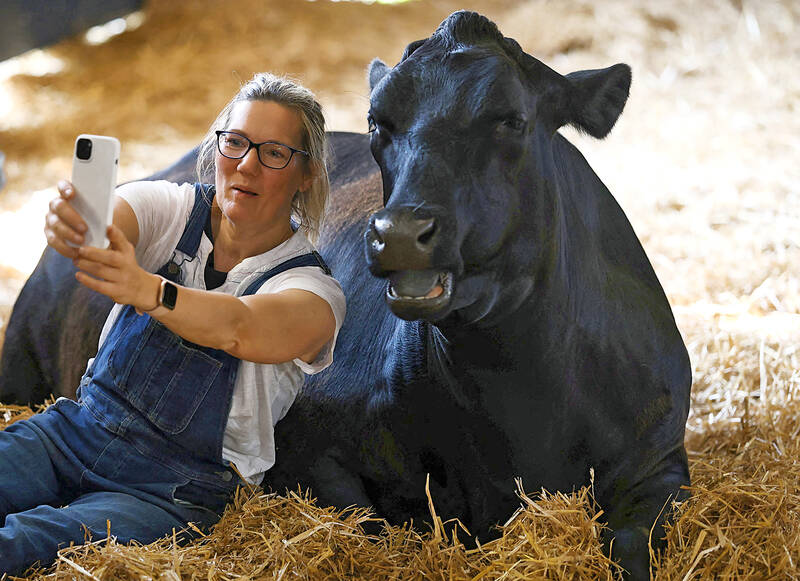
Photo: Reuters
“It’s been so worth it, just to get so close to the cows, and they are so loving and gentle,” visitor Emma Hutton, 25, said after she spent some time cuddling one of the cows.
It took more than a year to train the cows to feel comfortable with cuddling, but now the animals have fully adjusted, farmer James McCune said.
“They like being pampered. They are like big dogs... It’s more of a spa day for the cows,” he said.
The farm uses the proceeds to create habitats to protect wildlife and support declining species, such as lapwing birds.
“It’s great that we can fund the conservation scheme by having visitors to the farm, and that’s really the bigger picture,” Wilson said.

FAKE NEWS? ‘When the government demands the press become a state mouthpiece under the threat of punishment, something has gone very wrong,’ a civic group said The top US broadcast regulator on Saturday threatened media outlets over negative coverage of the Middle East war, after US President Donald Trump slammed critical headlines from the “Fake News Media.” The US president since his first term has derided mainstream media as “fake news” and has sued major outlets over what he sees as unfair coverage. Brendan Carr, head of the US Federal Communications Commission — which oversees the nation’s radio, television and Internet media — said broadcasters risked losing their licenses over news coverage. “The law is clear. Broadcasters must operate in the public interest, and they will

INFLUTENTIAL THEORIST: Habermas was particularly critical of the ‘limited interest’ shown by German politicians in ‘shaping a politically effective Europe Jurgen Habermas, whose work on communication, rationality and sociology made him one of the world’s most influential philosophers and a key intellectual figure in his native Germany, has died. He was 96. Habermas’ publisher, Suhrkamp, said he died on Saturday in Starnberg, near Munich. Habermas frequently weighed in on political matters over several decades. His extensive writing crossed the boundaries of academic and philosophical disciplines, providing a vision of modern society and social interaction. His best-known works included the two-volume Theory of Communicative Action. Habermas, who was 15 at the time of Nazi Germany’s defeat, later recalled the dawn of

The Chinese public maintains relatively warm sentiments toward Taiwan and strongly prefers non-military paths to improving cross-strait relations, a recent survey conducted by the Atlanta, Georgia-based Carter Center and Emory University showed. The “China Pulse” research project, which polled 2,506 adults between Oct. 27 last year and Jan. 1 this year, found that 86 percent of respondents support strengthening cultural ties, while 81 percent favor deepening economic interaction. The report, co-authored by political scientists at Emory University and advisors at the Carter Center, indicates that the Chinese public views Taiwan’s importance through a lens of shared history and culture rather than geopolitical

Cannabis-based medicines have shown little evidence of effectiveness for treating most mental health and substance-use disorders, according to a large review of past studies published in a major medical journal on Monday. Medical use of cannabinoids has been expanding, including in the US, Canada and Australia, where many patients report using cannabis products to manage conditions such as anxiety, post-traumatic stress disorder and sleep problems. Researchers reviewed data from 54 randomized clinical trials conducted between 1980 and May last year involving 2,477 participants for their analysis published in The Lancet. The studies assessed cannabinoids as a primary treatment for mental disorders or substance-use


 RSS
RSS