


Former Nicaraguan president Violeta Chamorro, who brought peace to Nicaragua after years of war and was the first woman elected president in the Americas, died on Saturday at the age of 95, her family said.
Chamorro, who ruled the poor Central American country from 1990 to 1997, “died in peace, surrounded by the affection and love of her children,” said a statement issued by her four children.
As president, Chamorro ended a civil war that had raged for much of the 1980s as US-backed rebels known as the “Contras” fought the leftist Sandinista government. That conflict made Nicaragua one of the big proxy battlegrounds of the Cold War.
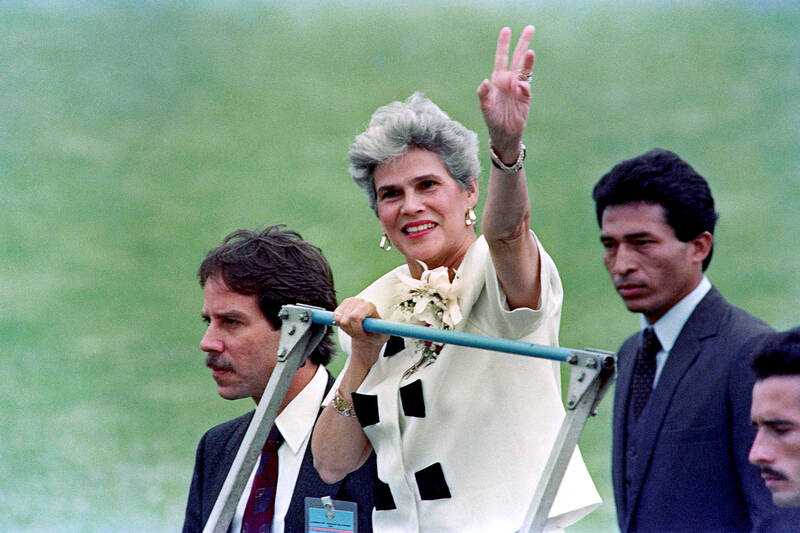
Photo: AFP
Chamorro put her country on the path to democracy in the difficult years following the Sandinista revolution of 1979, which had toppled the US-backed right-wing regime of then-Nicaraguan president Anastasio Somoza.
In a country known for macho culture, Chamorro had a maternal style and was known for her patience and a desire for reconciliation.
When she won the 1990 election at the head of a broad coalition, she defeated Daniel Ortega, the Sandinista guerrilla leader and icon who is now president again. Ortega has been in power for 17 years and is widely criticized by governments and rights groups as having crushed personal freedoms, all political opposition and judicial independence with autocratic rule.
Chamorro “represented a contribution for the peace necessary in our country,” Ortega and his wife, Rosario Murillo, who has the title of copresident, said in a statement.
The former leader died in Costa Rica, where she moved in 2023, to be close to her children, three of whom are living here in exile because of their opposition to Ortega.
Chamorro — Nicaraguans referred to her affectionately as “Dona Violeta” — had been living far removed from public life for decades. In her later years, she had Alzheimer’s disease.
“Her legacy is unquestionable,” said Felix Madariaga, a Nicaraguan academic and political activist living in exile in the US.
“She led the transition from war to peace, healing a country destroyed by war. The contrast with Ortega is clear and deep,” Madariaga said.
Chamorro was the widow of Pedro Joaquin Chamorro, who came from one of Nicaragua’s most prominent families. As owner and chief editor of the newspaper La Prensa, he was killed in 1978 in an attack blamed on the regime of Somoza.
His death propelled Chamorro to take over the newspaper and, eventually, to get into politics.
After the Sandinistas seized power in 1979, she became the only female member of a national reconstruction government.
However, she quit that junta in 1980, believing the Sandinistas were moving too far to the left and into the sphere of communist Cuba.
Chamorro became prominent in the opposition to the Sandinistas as they fought the “Contra” rebels financed by the US under then-US president Ronald Reagan.
In 1990, she stunned the country by winning the presidency — and beating Ortega — as leader of a coalition of 14 parties.

SPEAKING OUT: After Siranudh Scott’s allegations surfaced, celebrities and public figures took to social media to share their own experiences of sexual misconduct and abuse A high-profile alleged sexual abuse case within a wealthy Thai beer brewing family has prompted a wave of painful accounts from survivors of unconnected abuse in the conservative nation. Siranudh Scott, a member of the billionaire Thai family that founded the ubiquitous Singha beer brand, posted an emotional video this month accusing his elder brother Sunit of repeatedly abusing him when he was a teenager. Sunit, who is in his 30s, later denied the allegations in a video posted online, but Singha parent Boonrawd dismissed him from his executive role with the company on Tuesday last week. “I felt I needed to speak

A Hong Kong astronaut is to join a Chinese space mission for the first time as part of a three-person crew launching today, as Beijing edges closer to its goal of landing people on the moon. The Tiangong space station — crewed by teams of three astronauts that are typically rotated every six months — is the crown jewel of China’s space program, boosted by billions in state investment in a bid to catch up with the US and Russia. The Shenzhou-23 mission is to blast off at 11:08pm from the Jiuquan Satellite Launch Center in northwestern China, carrying three astronauts to
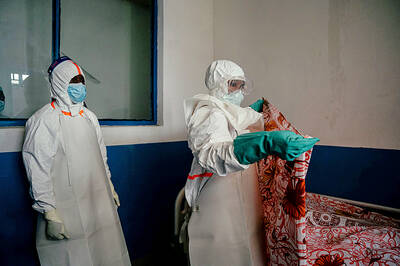
UPGRADED ALERT: The risk inside DR Congo is now considered ‘very high,’ while neighboring countries face a ‘high’ threat as the outbreak continues, the WHO said Ebola is spreading faster than responders can track it in eastern Congo, where health workers managed to follow up with barely one in five identified contacts in a single day. Authorities in the Democratic Republic of the Congo (DR Congo) reported 83 confirmed infections, 746 suspected cases and 1,603 identified contacts as of Thursday, but health workers were able to follow up on only 342 contacts that day — about 21 percent of the total under monitoring — data released by the DR Congo Ministry of Public Health on Friday showed. The figures suggest the response is falling behind the outbreak itself,

SEEKING ORDER: Rodrigo Paz said that ‘anyone who wants to destroy the nation will have to deal with this president and the full force of the constitution’ Bolivian President Rodrigo Paz on Wednesday said that the nation was at a “breaking point” after nearly a month of protests that have caused shortages of food, fuel and medicine. Paz, who took office six months ago amid the worst economic crisis there in four decades, is battling a groundswell of fury over his policies. The political capital, La Paz, has been besieged by low-income workers and members of the indigenous majority calling for his resignation. “The country needs order and is reaching breaking point,” the 58-year-old said at a public event in La Paz, renewing his appeal for dialogue. On Tuesday, the Bolivian


 RSS
RSS