

A clutch of one-off and hitherto unseen ceramic plates and dishes by Pablo Picasso are to go under the hammer in Geneva on Thursday next week.
Emblematic motifs from Picasso’s artistic universe — pigeons, fish, a goat, a bull and a bird adorn the colorful plates and dishes.
“It’s a truly exceptional collection. The plates and dishes we have here are real Picasso works,” said Bernard Piguet, director of the Piguet auction house in Geneva.
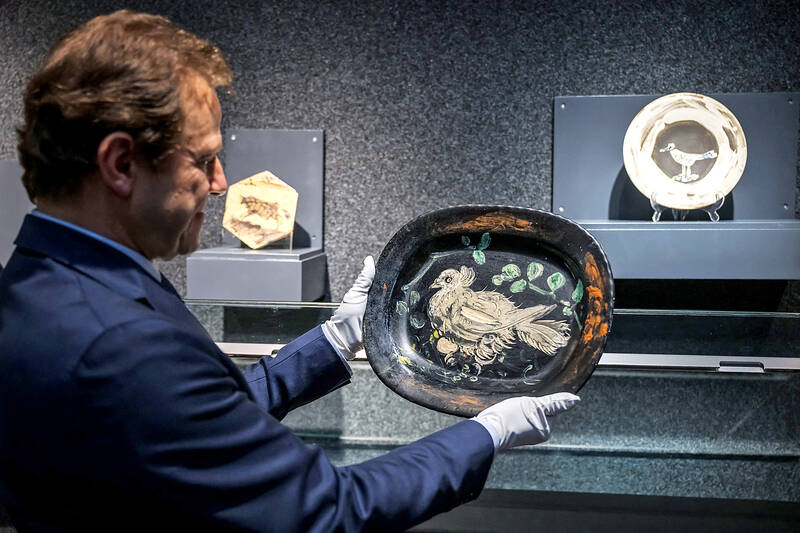
Photo: Fabrice Coffrini, AFP
“These unique pieces belonged to Picasso’s estate, and in the early 1980s, his heirs gave them to one of their friends,” he said.
The close friend, a French art lover whose name has not been revealed, kept them until his death. His heirs have decided to put the ceramics up for sale.
Made between 1947 and 1963 in the Madoura workshop in Vallauris on the southeast French coast, the ceramic artworks are being exhibited to the general public for the first time ahead of the auction.
‘REASONABLE PRICES’
The seven pieces are being sold in separate lots.
Two large platters decorated with pigeons are expected to fetch between 30,000 and 50,000 Swiss francs (US$36,900 to US$61,485). A third plate depicting three blue, pink and brick-colored fish on a white background, resembling a child’s drawing, is estimated at SF20,000 to SF30,000.
A thin brick, titled Head of a Bearded Man, and painted with ceramic pastels in yellow, white, garnet, brown, blue orange and green, has the same estimate.
Glazed on a painted background in shades of gray, brown and black, a terracotta plate depicting a goat’s head bears the prestigious stamp “Original Picasso print” on the back. It is valued at SF20,000 to SF30,000.
The two others feature a bull on a hexagonal terracotta tile (SF15,000 to SF20,000) and a stylized bird on a plate painted in black and white (SF15,000 to SF25,000).
“It’s a lot,” Piguet said of the price.
“But don’t forget that these are works of art in their own right and unique pieces” without replicas, he said.
“If you step back from Picasso’s work and his drawings, which are becoming practically unaffordable today, you have here original works by Picasso that command a reasonable estimate,” Piguet said.
The house is also auctioning two Picasso works “never before seen on the art market,” from the same family friend’s collection: Serenade (1919), an Indian ink and watercolor painting estimated at SF20,000 to SF30,000, and the pencil drawing Famille balzacienne (1962), valued at SF80,000 to SF120,000.
Picasso was one of the most influential artists of the 20th century. He created thousands of plates, platters, vases, pitchers and other earthenware utensils in the Madoura ceramics studio.
UNSEEN KLEIN
The auction would is also to include one of French artist Yves Klein’s first blue monochromes, its first appearance on the art market, the auction house said.
From 1959, Monochrome bleu sans titre (IKB 328), estimated at SF100,000 to SF150,000, is painted in International Klein Blue, the deep blue hue developed by the artist himself.
“In daylight, it really has this luminous blue, this completely fascinating Klein blue. And when you put it indoors, you see it as a dark blue, almost midnight blue,” Piguet said.
The piece comes from the collection of Swiss artist couple Muriel and Gerald Minkoff, who liked to exchange their works with their contemporaries.
It was discovered by their successors in their Geneva apartment, Piguet said.
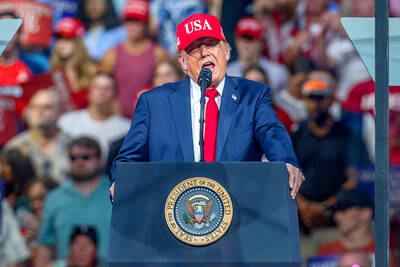
US President Donald Trump on Wednesday threatened to take action against the EU if it moves forward with European Commission President Ursula von der Leyen’s proposal to make Canada the bloc’s first associate member. “If they do that, if I think it’s at all a hostile act; I will put very serious tariffs or stop trading with Europe on many things,” Trump told reporters en route to an event in North Carolina, calling the proposal “laughable.” “If it’s a good intention, that’s fine. If it’s a bad intention, we’ll put very heavy tariffs on Europe,” he said. Von der Leyen made the proposal

SECRET FOOTAGE: A 17-year-old girl told British broadcaster Channel 4 that she had been approached by a man who covertly recorded her and their interaction Calls are growing louder in Europe for action against “pervert” smart glasses after secretly filmed footage of girls and women appeared online — with a petition in Britain demanding a ban on their sale. Anyone wearing smart glasses can take photos, film videos, listen to music, make phone calls, translate text or interact with an artificial intelligence (AI) assistant, with sales now hitting millions. The devices grabbed attention this summer after a marketing tie-up between Kylie Jenner, beauty mogul and member of the Kardashian dynasty, and tech giant Meta. Since smartphones are now embedded in daily life, “big tech” is
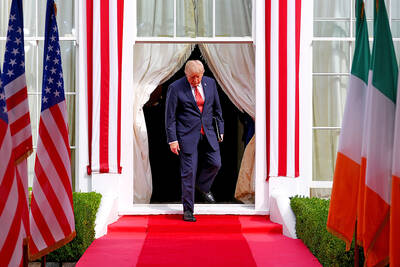
FROSTY RECEPTION: ‘I conveyed the strong view of the Irish people that the normalization of war and genocide can never be accepted,’ the Irish president said US President Donald Trump on Saturday said that he would “love to see” a united Ireland, wading into a politically sensitive subject as he embarked on a two-day Irish visit that blurs the lines between his presidency and personal business interests. After meeting Irish Prime Minister Micheal Martin in Dublin, Trump said reunification of the Republic of Ireland and Northern Ireland — split for more than a century — would be “a fantastic thing.” “It’s going to happen eventually. It may as well happen now,” he told reporters, adding that “the UK will have something to say about it, obviously.”
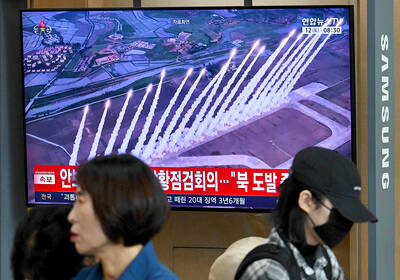
North Korea yesterday fired multiple ballistic missiles, Seoul said, a day after South Korea concluded five days of joint maritime drills with the US and Japan that were focused on the North. Pyongyang last month slammed plans for the so-called Freedom Edge joint exercises in international waters off South Korea as a “threat” to North Korea and other countries of the region. Yesterday, Seoul’s military detected “multiple short-range ballistic missiles launched from the Wonsan area toward the East Sea [the Sea of Japan],” the South Korean Joint Chiefs of Staff said in a statement. The missiles were detected at about


 RSS
RSS