


US President Donald Trump, whose second term has been devoted to going it alone, makes his return to the G7 in crisis mode after Israel attacked Iran.
The G7 summit starting tomorrow in Kananaskis, Canada, marks the first major global gathering of Trump’s second term, in which he has been even more brash in shattering diplomatic norms.
Canadian Prime Minister Mark Carney had set the agenda on largely uncontroversial themes such as building global supply chains for critical minerals.
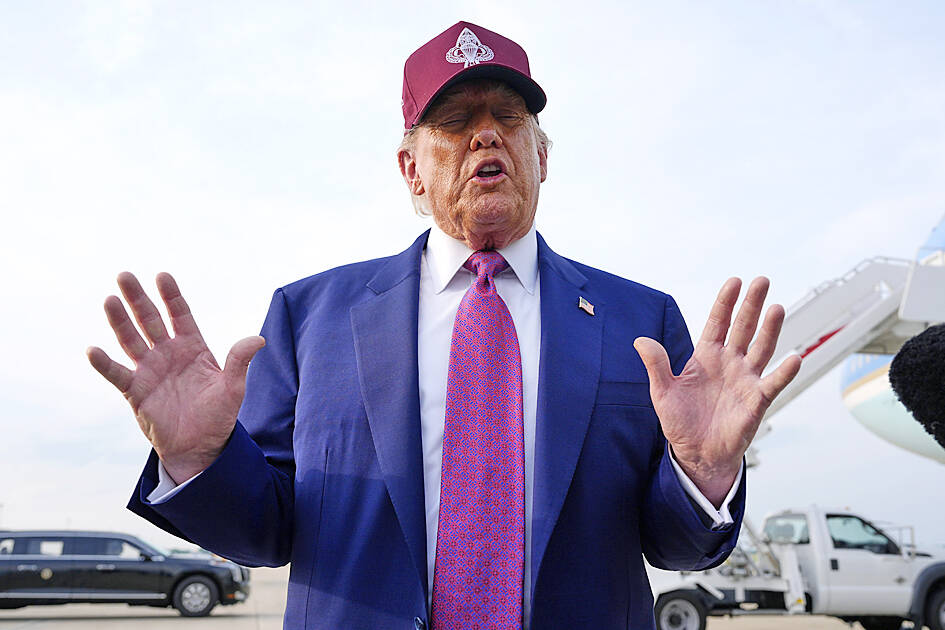
Photo: AP
That agenda could now be upended, as Israel launched a massive military campaign against Iran yesterday, saying it was taking pre-emptive action against its adversary’s contested nuclear program.
The Trump administration has closely aligned the US with Israel, taking aim even at close allies who criticize its offensive in Gaza. However, Israeli Prime Minister Benjamin Netanyahu openly defied Trump, who hours earlier had called for a diplomatic solution, and whose Special Envoy to the Middle East Steve Witkoff had been due to hold new talks with Iran tomorrow.
A NEW LEADER
The last time Trump attended a G7 summit in Canada in 2018, he stormed out early and took to social media to disassociate the US from the G7 statement and brand then-Canadian prime minister Justin Trudeau as “dishonest and weak.”
The bad blood never ended, and Trump upon returning to office mockingly said Canada should be the 51st US state.
Trudeau handed over the premiership in March to Carney, who told Trump firmly that Canada was “never for sale.”
Carney has patched up with Trump through his analytical skills and competence, G7 Research Group founder John Kirton said.
Trump also has an incentive to keep the peace in Kananaskis — the US is to lead the G7 in 2027.
“He doesn’t want to kill the G7 golden goose before he can produce the ‘biggest, best summit ever’ for the whole world stage two years from now,” Kirton said.
‘AMERICA FIRST’
Trump is expected to push back in Kananaskis if allies seek to moderate him, Atlantic Council senior fellow Rachel Rizzo said.
“He does not view these organizations as ways to deepen and expand American power and influence. He sees these fora as constraining America,” she said.
Europeans would observe Trump at the G7 to see how he treats their alliance, Center for Strategic and International Studies Europe, Russia and Eurasia program director Max Bergmann said.
“Our allies and partners in Europe are really questioning the US commitment and they are asking themselves, is this a relationship that is going to be maintained?” he said.

An American scientist convicted of lying to US authorities about payments from China while he was at Harvard University has rebuilt his research lab in Shenzhen, China, to pursue technology the Chinese government has identified as a national priority: embedding electronics into the human brain. Charles Lieber, 67, is among the world’s leading researchers in brain-computer interfaces. The technology has shown promise in treating conditions such as amyotrophic lateral sclerosis and restoring movement in paralyzed people. It also has potential military applications: Scientists at the Chinese People’s Liberation Army have investigated brain interfaces as a way to engineer super soldiers by boosting
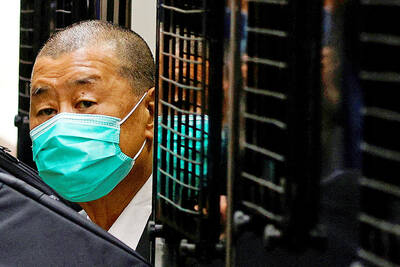
Jailed media entrepreneur Jimmy Lai (黎智英) has been awarded Deutsche Welle’s (DW) freedom of speech award for his contribution to Hong Kong’s pro-democracy movement. The German public broadcaster on Thursday said Lai would be presented in absentia with the 12th iteration of the award on June 23 at the DW Global Media Forum in Bonn. Deutsche Welle director-general Barbara Massing praised the 78-year-old founder of the now-shuttered news outlet Apple Daily for standing “unwaveringly for press freedom in Hong Kong at great personal risk.” “With Apple Daily, he gave journalists a platform for free reporting and a voice to the democracy movement in
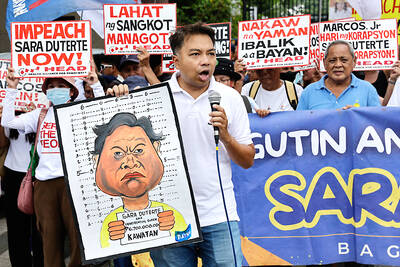
PHILIPPINE COMMITTEE: The head of the committee that made the decision said: ‘If there is nothing to hide, there is no reason to hide, there is no reason to obstruct’ A Philippine congressional committee on Wednesday ruled that there was “probable cause” to impeach Philippine Vice President Sara Duterte after hearing allegations of unexplained wealth, misuse of state funds and threats to have the president assassinated. The unanimous decision of the 53-member committee in the Philippine House of Representatives sends the two impeachment complaints to deliberations and voting by the entire lower chamber, which has more than 300 lawmakers. The complaints centered on Duterte’s alleged illegal use and mishandling of intelligence funds from the vice president’s office, and from her time as education secretary under Philippine President Ferdinand Marcos Jr. Duterte and the

Burmese President Min Aung Hlaing yesterday cut all prisoners’ sentences by one-sixth, a blanket measure that a source close to deposed leader Aung San Suu Kyi said would further shorten her detention. Aung San Suu Kyi has been sequestered since a 2021 military coup, but the senior member of her dissolved National League for Democracy (NLD) party said that while her term had been reduced, her remaining sentence is still unclear. “We also don’t know exactly how many years she has left,” the source told reporters, speaking on condition of anonymity for security reasons. The military toppled Aung San Suu Kyi’s elected government


 RSS
RSS