


South Korea's new liberal President Lee Jae-myung began his term today, vowing to raise the country from the turmoil of a martial law crisis and revive an economy reeling from slowing growth and the threat of global protectionism.
Lee's decisive victory in yesterday's snap election stands to usher in a sea change in Asia's fourth-largest economy, after backlash against a botched attempt at military rule brought down Yoon Suk-yeol just three years into his troubled presidency.
He faces what could be the most daunting set of challenges for a South Korean leader in nearly three decades, ranging from healing a country deeply scarred by the martial law attempt to tackling unpredictable protectionist moves by the US.
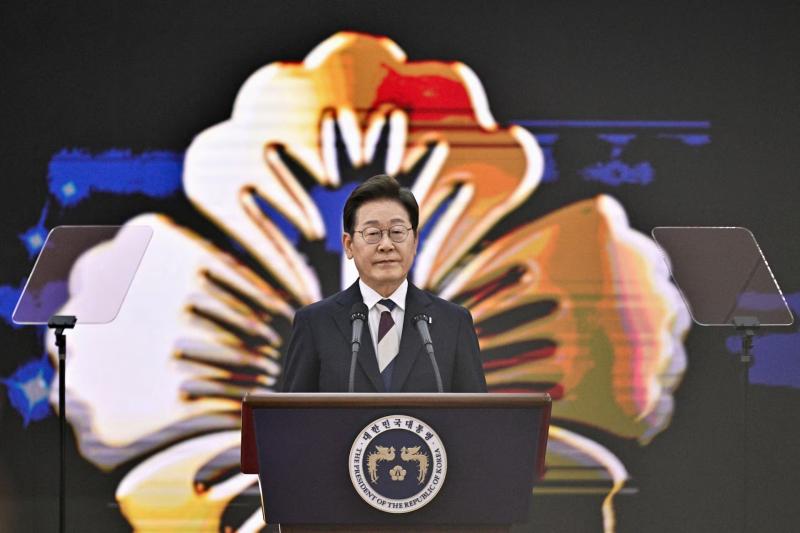
Photo: Reuters
With 100 percent of the ballots counted, Lee won 49.42 percent of the nearly 35 million votes cast, while conservative rival Kim Moon-soo took 41.15 percent in the polls that brought the highest turnout for a presidential election since 1997, South Korean National Election Commission data showed.
The 61-year-old former human rights lawyer called the election "judgement day" against Yoon's martial law and his People Power Party's failure to stop the ill-fated move.
"The first mission is to decisively overcome insurrection and to ensure there will never be another military coup with guns and swords turned against the people," Lee said in a victory speech outside parliament.
"We can overcome this temporary difficulty with the combined strength of our people, who have great capabilities," he said.
Lee was officially confirmed as president by the commission today and immediately assumed the powers of the presidency and commander in chief.
An abbreviated inauguration was planned at parliament at 11am, a South Korean Ministry of the Interior official said.
Lee has said he would address urgent economic challenges facing the country on the first day in office with a focus on the cost-of-living concerns affecting middle and low-income families and the struggles of small business owners.
He also faces a deadline set by the White House on negotiating import duties that Washington has blamed for a large trade imbalance between the countries.
The government under a caretaker acting president had made little progress in trying to assuage crushing tariffs announced by US President Donald Trump's administration that would hit some of the country's major industries, including autos and steel.
"President Lee will find himself with little to no time to spare before tackling the most important task of his early presidency: reaching a deal with Trump," the Washington-based Center for Strategic and International Studies said in an analysis.
The White House said the election of Lee was "free and fair," but the US remained concerned and opposed to Chinese interference and influence in democracies around the world, a White House official said.
Lee has expressed more conciliatory plans for ties with China and North Korea, in particular singling out the importance of China as a major trading partner while indicating reluctance to take a firm stance on security tensions in the Taiwan strait.
Still, Lee has pledged to continue Yoon's engagement with Japan and said the alliance with the US is the backbone of South Korea's global diplomacy.
The martial law decree and the six months of ensuing turmoil, which saw three different acting presidents and multiple criminal insurrection trials for Yoon and several top officials, marked a stunning political self-destruction for the former leader and a drag on an economy already slowing growth.
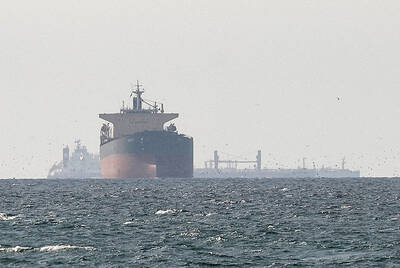
A ship that appears to be taking on the identity of a scrapped gas carrier exited the Strait of Hormuz on Friday, showing how strategies to get through the waterway are evolving as the Middle East war progresses. The vessel identifying as liquefied natural gas (LNG) carrier Jamal left the Strait on Friday morning, ship-tracking data show. However, the same tanker was also recorded as having beached at an Indian demolition yard in October last year, where it is being broken up, according to market participants and port agent’s reports. The ship claiming to be Jamal is likely a zombie vessel that
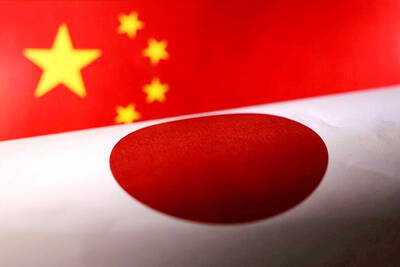
Japan is to downgrade its description of ties with China from “one of its most important” in an annual diplomatic report, according to a draft reviewed by Reuters, as relations with Beijing worsen. This year’s Diplomatic Bluebook, which Japanese Prime Minister Sanae Takaichi’s government is expected to approve next month, would instead describe China as an important neighbor and the relationship as “strategic” and “mutually beneficial.” The draft cites a series of confrontations with Beijing over the past year, including export controls on rare earths, radar lock-ons targeting Japanese military aircraft and increased pressure around Taiwan. The shift in tone underscores a deterioration
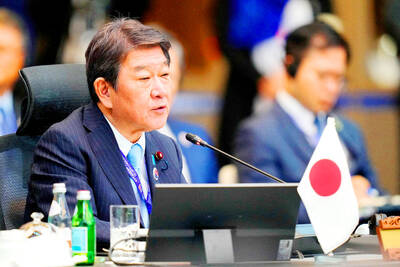
LAW CONSTRAINTS: The US has been pressing allies to send warships to open the Strait, but Tokyo’s military actions are limited under its postwar pacifist constitution Japan could consider deploying its military for minesweeping in the Strait of Hormuz if a ceasefire is reached in the war on Iran, Japanese Minister of Foreign Affairs Toshimitsu Motegi said yesterday. “If there were to be a complete ceasefire, hypothetically speaking, then things like minesweeping could come up,” Motegi said. “This is purely hypothetical, but if a ceasefire were established and naval mines were creating an obstacle, then I think that would be something to consider.” Japan’s military actions are limited under its postwar pacifist constitution, but 2015 security legislation allows Tokyo to use its Self-Defense Forces overseas if an attack,

German Chancellor Friedrich Merz’s conservative Christian Democratic Union (CDU) yesterday faced a regional election battle in Rhineland-Palatinate, now held by the center-left Social Democratic Party (SPD). Merz’s CDU has enjoyed a narrow poll lead over the SPD — their coalition partners at the national level — who have ruled the mid-sized state for 35 years. Polling third is the far-right Alternative for Germany (AfD), which spells a greater threat to the two centrist parties in several state elections in September in the country’s ex-communist east. The picturesque state of Rhineland-Palatinate, bordering France, Belgium and Luxembourg and with a population of about 4 million,


 RSS
RSS