


Hundreds of young Mongolians turned out this week in the country’s capital calling for the prime minister’s resignation on allegations of corruption, a longstanding source of deep public anger in the landlocked democracy.
Mongolia has for decades struggled with endemic graft and the widespread view that the proceeds of a coal mining boom are being hoarded by a wealthy elite has sparked frequent protests and unrest.
Under Mongolian Prime Minister Luvsannamsrain Oyun-Erdene — in power since 2021 — Mongolia has plummeted in Transparency International’s Corruption Perceptions Index.

Photo: AFP
Fueling public outrage are allegations that the prime minister’s family are enjoying wealth far beyond that expectation of a civil servant on the public dime — claims sparked by a social media post by his son’s girlfriend showing a lavish birthday gift.
The prime minister’s office said it “vehemently” denied allegations of impropriety, describing them as a “smear.”
However, hundreds of mostly young protesters have gathered for eight consecutive days at Sukhbaatar Square, also known as Genghis Khan square, in the capital, Ulaanbaatar, demanding the premier’s resignation.
“The prime minister has to resign,” protest organizer O. Ulamsaikhan, 24, said.
“What we are trying to achieve is to establish a new political culture in which unethical behavior by public officials leads to accountability and resignation,” he said.
Also deepening anger in the country are worries over the economy and cost of living. Inflation, which soared following neighboring Russia’s invasion of Ukraine in 2022 — reached 9 percent last year, national news agency Montsame reported.
“Young people are working hard to make a living,” said university freshman O. Khulan, 19, who was among the crowd holding placards reading: “It’s easy to resign.”
“Yet it is unfair that the prime minister’s son and his girlfriend have a lavish lifestyle, while I’m buying my bag from a thrift shop,” she said.


Showcasing phallus-shaped portable shrines and pink penis candies, Japan’s annual fertility festival yesterday teemed with tourists, couples and families elated by its open display of sex. The spring Kanamara Matsuri near Tokyo features colorfully dressed worshipers carrying a trio of giant phallic-shaped objects as they parade through the street with glee. The festival, as legend has it, honors a local blacksmith in the Edo Period (1603-1868) who forged an iron dildo to break the teeth of a sharp-toothed demon inhabiting a woman’s vagina that had been castrating young men on their wedding nights. A 1m black steel phallus sits in the courtyard of

JAN. 1 CLAUSE: As military service is voluntary, applications for permission to stay abroad for over three months for men up to age 45 must, in principle, be granted A little-noticed clause in sweeping changes to Germany’s military service policy has triggered an uproar after it emerged that the law requires men aged up to 45 to get permission from the armed forces before any significant stay abroad, even in peacetime. The legislation, which went into effect on Jan. 1 aims to bolster the military and demands all 18-year-old men fill out a questionnaire to gauge their suitability to serve in the armed forces, but stops short of conscription. If the “modernized” model fails to pull in enough recruits, parliament will be compelled to discuss the reintroduction of compulsory service, German
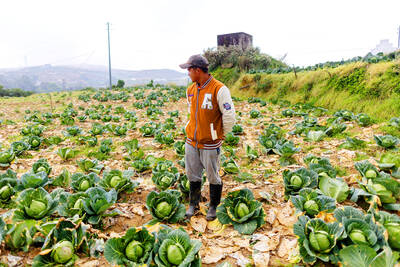
Filipino farmers like Romeo Wagayan have been left with little choice but to let their vegetables rot in the field rather than sell them at a loss, as rising oil prices linked to the Iran war drive up the cost of harvesting, labor and transport. “There’s nothing we can do,” said Wagayan, a 57-year old vegetable farmer in the northern Philippine province of Benguet. “If we harvest it, our losses only increase because of labor, transportation and packing costs. We don’t earn anything from it. That’s why we decided not to harvest at all,” he said. Soaring costs caused by the Middle East

Hungarian Prime Minister Viktor Orban’s officially declared wealth is fairly modest: some savings and a jointly owned villa in Budapest. However, voters in what Transparency International deems the EU’s most corrupt country believe otherwise — and they might make Orban pay in a general election this Sunday that could spell an end to his 16-year rule. The wealth amassed by Orban’s inner circle is fueling the increasingly palpable frustration of a population grappling with sluggish growth, high inflation and worsening public services. “The government’s communication machine worked well as long as our economic situation remained relatively good,” said Zoltan Ranschburg, a political analyst


 RSS
RSS