


Massive fires fueled by climate change led global forest loss to smash records last year, a report issued yesterday showed.
Loss of tropical pristine forests alone reached 6.7 million hectares, an 80 percent spike compared with 2023 and an area about the size of Panama, mainly because Brazil, the host of the next global climate summit in November, struggled to contain fires in the Amazon amid the worst drought ever recorded in the rainforest. A myriad of other countries, including Bolivia and Canada, were also ravaged by wildfires.
It was the first time the annual report, issued by the World Resources Institute (WRI) and the University of Maryland, showed fires as the leading cause of tropical forest loss, a grim milestone for a naturally humid ecosystem that is not supposed to burn.
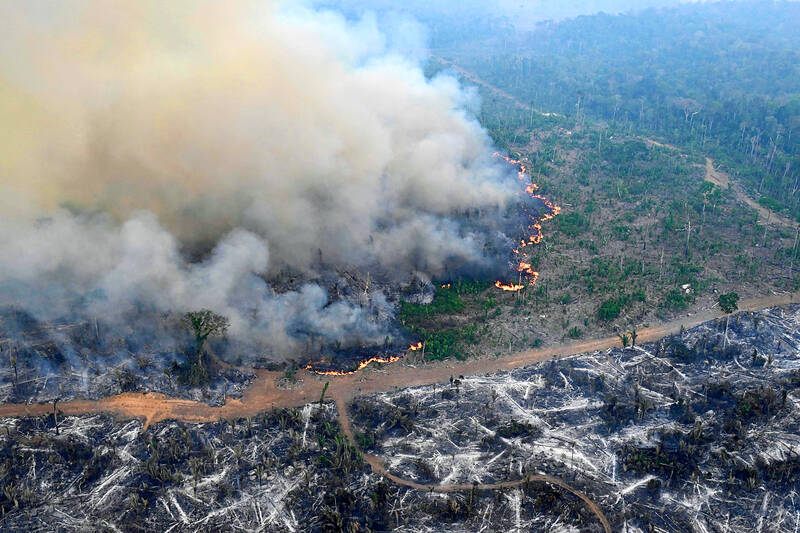
Photo: AFP
“The signals in these data are particularly frightening,” said Matthew Hansen, the codirector of a lab at the University of Maryland that compiled and analyzed the data. “The fear is that the climate signal is going to overtake our ability to respond effectively.”
Latin America was hit particularly hard, with the Amazon biome reaching its highest level of primary forest loss since 2016, the report said.
Brazil, which holds the largest share of the world’s tropical forests, lost 2.8 million hectares, the most of any country. It was a reversal of the progress made in 2023, when Brazilian President Luiz Inacio Lula da Silva took office promising to protect the world’s largest rainforest.
“This was unprecedented, which means we have to adapt all our policy to a new reality,” said Andre Lima, who oversees deforestation control policies for the Brazilian Ministry of Environment.
Fire, which was never among the leading causes of forest loss, is now a top priority for the government, Lima said.
Bolivia overtook the Democratic Republic of the Congo as the second country with the most tropical forest loss, despite having less than half the amount of forest as the African nation, which also saw a spike in forest loss last year.
Bolivia’s forest loss surged 200 percent last year, with a drought, wildfires and a government-incentivized agricultural expansion as the leading causes. Across Latin America, the report showed similar trends in Mexico, Peru, Nicaragua and Guatemala.
Conflicts in Colombia and the Democratic Republic of the Congo also boosted deforestation rates, as armed groups used up natural resources.
Outside the tropics, boreal forests, which evolved with seasonal fires, also posted record-high tree loss last year, with Canada and Russia each losing 5.2 million hectares, as wildfires got out of control.
Southeast Asia bucked the global trend with Malaysia, Laos and Indonesia all posting double-digit percentage decreases in primary forest loss, as domestic conservation policies, combined with efforts by communities and the private sector, continued to effectively contain fires and agricultural expansion.
WRI global director for forests Rod Taylor said that as leaders descend on the Amazonian city of Belem for the next climate summit, he would like to see countries make progress in introducing better funding mechanisms for conservation.
“At the moment, there’s more money to be paid by chopping forests down than keeping them standing,” he said.

An American scientist convicted of lying to US authorities about payments from China while he was at Harvard University has rebuilt his research lab in Shenzhen, China, to pursue technology the Chinese government has identified as a national priority: embedding electronics into the human brain. Charles Lieber, 67, is among the world’s leading researchers in brain-computer interfaces. The technology has shown promise in treating conditions such as amyotrophic lateral sclerosis and restoring movement in paralyzed people. It also has potential military applications: Scientists at the Chinese People’s Liberation Army have investigated brain interfaces as a way to engineer super soldiers by boosting

Jailed media entrepreneur Jimmy Lai (黎智英) has been awarded Deutsche Welle’s (DW) freedom of speech award for his contribution to Hong Kong’s pro-democracy movement. The German public broadcaster on Thursday said Lai would be presented in absentia with the 12th iteration of the award on June 23 at the DW Global Media Forum in Bonn. Deutsche Welle director-general Barbara Massing praised the 78-year-old founder of the now-shuttered news outlet Apple Daily for standing “unwaveringly for press freedom in Hong Kong at great personal risk.” “With Apple Daily, he gave journalists a platform for free reporting and a voice to the democracy movement in
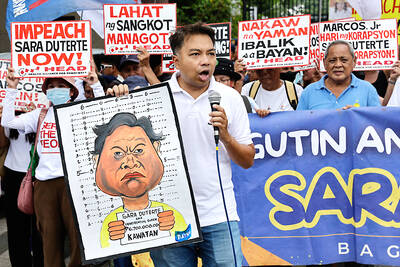
PHILIPPINE COMMITTEE: The head of the committee that made the decision said: ‘If there is nothing to hide, there is no reason to hide, there is no reason to obstruct’ A Philippine congressional committee on Wednesday ruled that there was “probable cause” to impeach Philippine Vice President Sara Duterte after hearing allegations of unexplained wealth, misuse of state funds and threats to have the president assassinated. The unanimous decision of the 53-member committee in the Philippine House of Representatives sends the two impeachment complaints to deliberations and voting by the entire lower chamber, which has more than 300 lawmakers. The complaints centered on Duterte’s alleged illegal use and mishandling of intelligence funds from the vice president’s office, and from her time as education secretary under Philippine President Ferdinand Marcos Jr. Duterte and the

Burmese President Min Aung Hlaing yesterday cut all prisoners’ sentences by one-sixth, a blanket measure that a source close to deposed leader Aung San Suu Kyi said would further shorten her detention. Aung San Suu Kyi has been sequestered since a 2021 military coup, but the senior member of her dissolved National League for Democracy (NLD) party said that while her term had been reduced, her remaining sentence is still unclear. “We also don’t know exactly how many years she has left,” the source told reporters, speaking on condition of anonymity for security reasons. The military toppled Aung San Suu Kyi’s elected government


 RSS
RSS