


The far-right Chega party climbed to joint second place in Portugal’s snap general election on Sunday, posing a major challenge for Prime Minister Luis Montenegro as he prepared to lead another minority government.
Near complete official results yesterday showed Montenegro’s center-right Democratic Alliance (AD) had boosted its tally in the 230-seat parliament to 89 in Sunday’s poll, short of the 116 seats required for a ruling majority.
Chega, led by former television sports commentator Andre Ventura, and the Socialist Party (PS) tied in second place with 58 seats each.
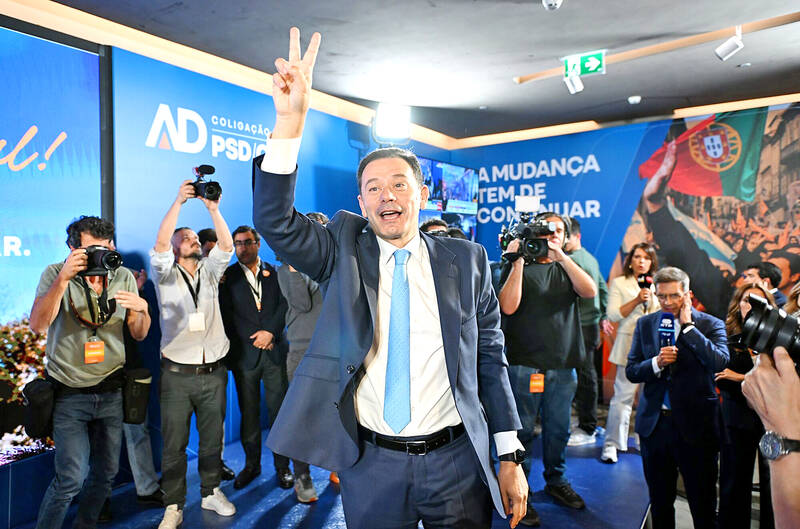
Photo: Bloomberg
There are still four seats left to be assigned representing Portuguese who live abroad.
Ventura said he was confident Chega would pick up a couple, as it did in the previous general election last year to overtake the PS, making it Portugal’s main opposition party for the first time.
“We didn’t win these elections, but we made history,” Ventura told his supporters, who chanted “Portugal is ours and it always will be.”
“The system of two-party rule in Portugal is over,” he said.
Even with the backing of the recently formed business-friendly party Liberal Initiative (IL), which won nine seats, the AD would still need the support of Chega or the PS to pass legislation.
However, Montenegro, 52, a lawyer by profession, has refused any alliance with anti-establishment, far-right Chega, saying it is “unreliable” and “not suited to governing.”
His previous minority AD government was able to pass a budget, because the PS abstained in key votes in parliament.
However, relations between Portugal’s two mainstream parties have soured during the campaign and it is unclear if a weakened PS — which had its lowest score in decades, losing 20 seats — will be willing to allow the center-right to govern this time around.
Montenegro said he expected a “sense of state, a sense of responsibility” from other parties so he could “continue to work.”
However, Portugal will stay in campaign mode, with local elections later this year and a presidential election in January.
This could reduce the incentive for parties to cooperate while they focus on highlighting their differences to sway voters.
Montenegro would be shielded from the threat of fresh polls in the near future since the constitution prohibits snap elections within six months of a vote, and the final six months of a presidential term.
Sunday’s election — Portugal’s third in three years — was triggered when Montenegro lost a parliamentary vote of confidence in March after less than a year in power. He called for the confidence vote following allegations of conflicts of interest related to his family’s consultancy business, which has several clients holding government contracts.
Montenegro has denied any wrongdoing, saying he was not involved in the day-to-day operations of the firm.
“It is not clear that there will be increased governability following these results,” University of Lisbon political scientist Marina Costa Lobo said.
Chega was “the big winner of the night,” she said.
Support for Chega has grown in every general election since the party was founded by Ventura in 2019, advocating tougher sentences for criminals and restrictions on immigration.
It won 1.3 percent of the vote in a general election in 2019, the year it was founded, giving it a seat in parliament.
That was the first time an extreme-right party had been represented in Portugal’s parliament since a coup in 1974 toppled a decades-long far-right dictatorship.
Chega became the third-largest force in parliament in the next general election in 2022.
It quadrupled its parliamentary seats last year to 50, cementing its place in Portugal’s political landscape and mirroring gains by extreme-right parties in other parts of Europe.

SPEAKING OUT: After Siranudh Scott’s allegations surfaced, celebrities and public figures took to social media to share their own experiences of sexual misconduct and abuse A high-profile alleged sexual abuse case within a wealthy Thai beer brewing family has prompted a wave of painful accounts from survivors of unconnected abuse in the conservative nation. Siranudh Scott, a member of the billionaire Thai family that founded the ubiquitous Singha beer brand, posted an emotional video this month accusing his elder brother Sunit of repeatedly abusing him when he was a teenager. Sunit, who is in his 30s, later denied the allegations in a video posted online, but Singha parent Boonrawd dismissed him from his executive role with the company on Tuesday last week. “I felt I needed to speak

SEEKING ORDER: Rodrigo Paz said that ‘anyone who wants to destroy the nation will have to deal with this president and the full force of the constitution’ Bolivian President Rodrigo Paz on Wednesday said that the nation was at a “breaking point” after nearly a month of protests that have caused shortages of food, fuel and medicine. Paz, who took office six months ago amid the worst economic crisis there in four decades, is battling a groundswell of fury over his policies. The political capital, La Paz, has been besieged by low-income workers and members of the indigenous majority calling for his resignation. “The country needs order and is reaching breaking point,” the 58-year-old said at a public event in La Paz, renewing his appeal for dialogue. On Tuesday, the Bolivian

A Hong Kong astronaut is to join a Chinese space mission for the first time as part of a three-person crew launching today, as Beijing edges closer to its goal of landing people on the moon. The Tiangong space station — crewed by teams of three astronauts that are typically rotated every six months — is the crown jewel of China’s space program, boosted by billions in state investment in a bid to catch up with the US and Russia. The Shenzhou-23 mission is to blast off at 11:08pm from the Jiuquan Satellite Launch Center in northwestern China, carrying three astronauts to
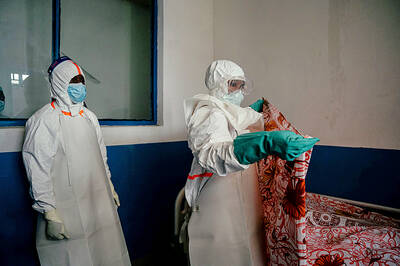
UPGRADED ALERT: The risk inside DR Congo is now considered ‘very high,’ while neighboring countries face a ‘high’ threat as the outbreak continues, the WHO said Ebola is spreading faster than responders can track it in eastern Congo, where health workers managed to follow up with barely one in five identified contacts in a single day. Authorities in the Democratic Republic of the Congo (DR Congo) reported 83 confirmed infections, 746 suspected cases and 1,603 identified contacts as of Thursday, but health workers were able to follow up on only 342 contacts that day — about 21 percent of the total under monitoring — data released by the DR Congo Ministry of Public Health on Friday showed. The figures suggest the response is falling behind the outbreak itself,


 RSS
RSS