


A bomb exploded on Saturday outside a California fertility clinic, killing one person in what the FBI labeled a terror attack.
The blast tore through downtown Palm Springs, ripping a hole in the clinic and blowing out the windows and doors of nearby buildings, an Agence France-Presse journalist on the scene reported.
“Make no mistake, this is an intentional act of terrorism,” Akil Davis, the head of the FBI’s Los Angeles field office, told reporters near the site of the fatal explosion.
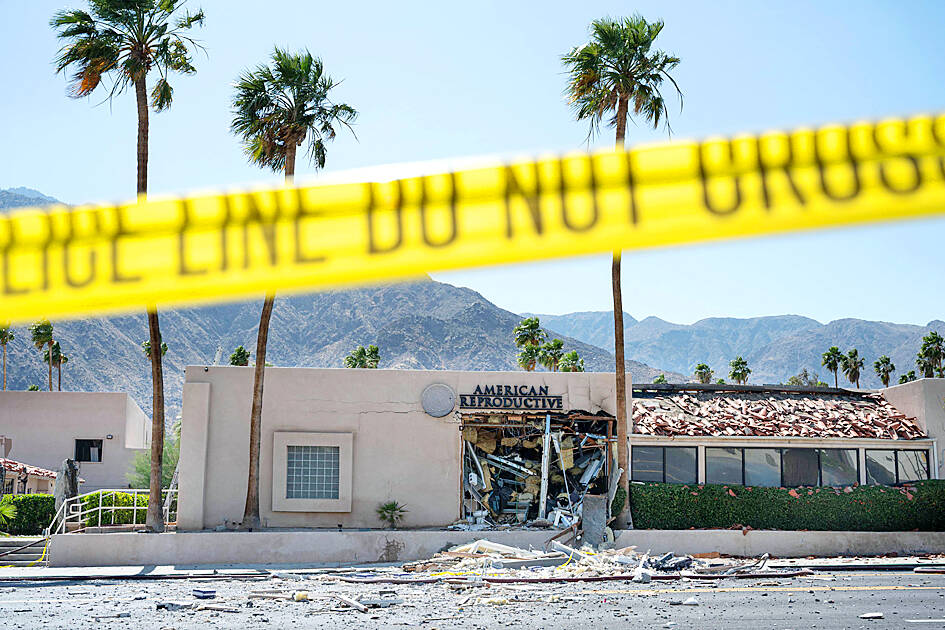
Photo: AFP
“This is probably one of the largest bombing investigations that we’ve had in southern California,” he added.
He confirmed that one person near the clinic at the time of blast had been killed and that four others were wounded.
Work was ongoing to identify the deceased, he added.
In response to a reporter’s question on whether the clinic in Palm Springs was deliberately targeted, Davis answered: “We believe so, yes.”
Palm Springs Mayor Ron deHarte had earlier told that investigators confirmed a bomb exploded in or near a vehicle outside the clinic.
Eyewitnesses told local media they had seen human remains near the American Reproductive Centers clinic, with aerial footage of the scene showing the building roof had collapsed.
The charred remnants of a vehicle lay in a parking lot, some distance from the apparent epicenter of the explosion.
Debris was blown straight through the building and scattered across the road, while the roofs of a number of nearby buildings had been damaged, indicating the intense force of the blast.
Davis described the explosion as “significant” and said debris had been thrown more than 180m from the scene, but declined to comment further on the characteristics of the bomb.
The local ABC affiliate, which cited an unnamed law enforcement source, said the person who died was a suspect in the blast.
Davis told reporters that although the FBI was working to identify the deceased, “we are keeping that close hold in order to protect the integrity of the investigation.”
A statement posted on social media by the clinic said no staff had been hurt, and that its lab — “including all eggs, embryos, and reproductive materials — remains fully secure and undamaged.”
It said that “a vehicle exploded in the parking lot near our building.”
Reproductive care, including abortion and fertility services, remains controversial in the US, where some conservatives believe the procedures should be outlawed for religious reasons.
Violence against clinics providing such services is rare, but not unheard of.
US President Donald Trump’s Attorney General Pam Bondi said federal agents were working to determine exactly what had happened.
“But let me be clear: the Trump administration understands that women and mothers are the heartbeat of America. Violence against a fertility clinic is unforgivable,” she said in a statement on social media.
People living near the clinic reported feeling the shaking from the blast throughout the city.
Matt Spencer, who lives in a nearby apartment complex, told the Palm Springs Post he ran outside as soon as he heard the blast, and was confronted with the sight of the burned out car and what appeared to be a body in the middle of the road.
“In front of the building [the car] was blown clear across four lanes into the parking lot of [Desert Regional Medical Center],” he told the paper.
“I could see the back of the car still on fire and the rims, that was the only thing that distinguished it as a car,” he added.

SPEAKING OUT: After Siranudh Scott’s allegations surfaced, celebrities and public figures took to social media to share their own experiences of sexual misconduct and abuse A high-profile alleged sexual abuse case within a wealthy Thai beer brewing family has prompted a wave of painful accounts from survivors of unconnected abuse in the conservative nation. Siranudh Scott, a member of the billionaire Thai family that founded the ubiquitous Singha beer brand, posted an emotional video this month accusing his elder brother Sunit of repeatedly abusing him when he was a teenager. Sunit, who is in his 30s, later denied the allegations in a video posted online, but Singha parent Boonrawd dismissed him from his executive role with the company on Tuesday last week. “I felt I needed to speak

SEEKING ORDER: Rodrigo Paz said that ‘anyone who wants to destroy the nation will have to deal with this president and the full force of the constitution’ Bolivian President Rodrigo Paz on Wednesday said that the nation was at a “breaking point” after nearly a month of protests that have caused shortages of food, fuel and medicine. Paz, who took office six months ago amid the worst economic crisis there in four decades, is battling a groundswell of fury over his policies. The political capital, La Paz, has been besieged by low-income workers and members of the indigenous majority calling for his resignation. “The country needs order and is reaching breaking point,” the 58-year-old said at a public event in La Paz, renewing his appeal for dialogue. On Tuesday, the Bolivian

A Hong Kong astronaut is to join a Chinese space mission for the first time as part of a three-person crew launching today, as Beijing edges closer to its goal of landing people on the moon. The Tiangong space station — crewed by teams of three astronauts that are typically rotated every six months — is the crown jewel of China’s space program, boosted by billions in state investment in a bid to catch up with the US and Russia. The Shenzhou-23 mission is to blast off at 11:08pm from the Jiuquan Satellite Launch Center in northwestern China, carrying three astronauts to
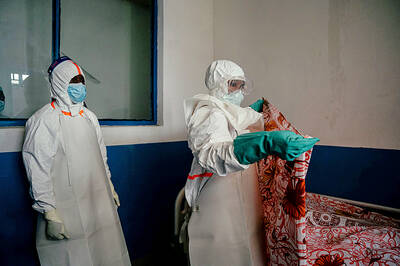
UPGRADED ALERT: The risk inside DR Congo is now considered ‘very high,’ while neighboring countries face a ‘high’ threat as the outbreak continues, the WHO said Ebola is spreading faster than responders can track it in eastern Congo, where health workers managed to follow up with barely one in five identified contacts in a single day. Authorities in the Democratic Republic of the Congo (DR Congo) reported 83 confirmed infections, 746 suspected cases and 1,603 identified contacts as of Thursday, but health workers were able to follow up on only 342 contacts that day — about 21 percent of the total under monitoring — data released by the DR Congo Ministry of Public Health on Friday showed. The figures suggest the response is falling behind the outbreak itself,


 RSS
RSS