


A documentary whose main subject, 25-year-old photojournalist Fatima Hassouna, was killed in an Israeli airstrike in Gaza weeks before it premiered at Cannes stunned viewers into silence at the festival on Thursday.
As the cinema lights came back on, filmmaker Sepideh Farsi held up an image of the young Palestinian woman killed with younger siblings on April 16, and encouraged the audience to stand up and clap to pay tribute.
“To kill a child, to kill a photographer is unacceptable,” Farsi said.
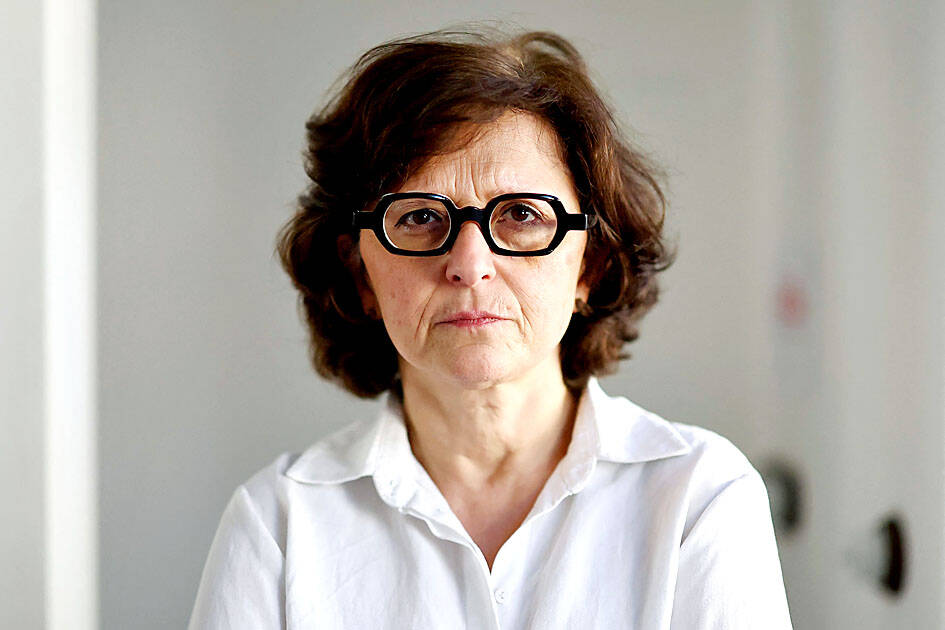
Photo: Reuters
“There are still children to save. It must be done fast,” the exiled Iranian filmmaker added.
With Israel banning foreign media from entering the besieged Palestinian territory, Farsi last year reached out to Hassouna through video call, and turned more than 200 days of conversations into the documentary Put Your Soul on Your Hand and Walk.
In often disjointed discussions due to bad Internet connection, Hassouna smiles widely and bravely says that she is ok.
She recounts how she dreams of eating chicken amid dire food shortages, how she lost 14 relatives including a one-year-old in Israeli bombardment and what she photographed that day.
In one of her many pictures edited into the film, a little girl laughs on her father’s lap in front of a tower block reduced to rubble.
However, in another, a boy aims a water hose at the bloodied pavement, trying to clean away the remains of his own family.
A day after Hassouna was told the documentary had been selected for a sidebar section at the world’s most prestigious film festival, an Israeli missile pummeled her home in northern Gaza, killing her and 10 relatives.
Israel has claimed it was targeting Palestinian militant group Hamas.
“Why would you kill someone and decimate an entire family just because she was taking photos?” Farsi asked.
“They were normal people. Her father was a taxi driver, she was a photographer, her sister was a painter and her little brother was 10 years old,” she said. “My heart goes out to her mother, who lost six of her children, her husband and her home.”
On Thursday, British filmmaker Ken Loach — a double Palme d’Or winner — on X called on people to honor Hassouna and fellow Palestinian journalists “who gave their lives to bear witness to mass murder.”
Tens of thousands have been killed in Gaza and an aid blockade threatens famine, while Israeli leaders continue to express a desire to empty the territory of Palestinians as part of the war sparked by Hamas’s unprecedented Oct. 7, 2023, attack.
Reporters Without Borders estimated about 200 journalists have been killed in 18 months of Israeli strikes on Gaza.
As the Gaza death toll mounts, with rescuers saying 120 people were killed in Israeli strikes on Thursday alone, the conflict has cast a shadow over Cannes.
Several actors have walked its red carpet wearing Palestinian flags pinned to their jackets, while others have sported a yellow ribbon for Israeli hostages still held in Gaza.
Exiled Gazan filmmakers Arab and Tarzan Nasser on Monday are to screen Once Upon a Time in Gaza, a portrait of two friends set in 2007, the year Hamas started tightening its grip on the territory.
On the eve of the festival, Schindler’s List actor Ralph Fiennes and Hollywood star Richard Gere were among more than 380 figures to slam what they see as silence over “genocide” in Gaza.
The English Patient actor Juliette Binoche, who heads the main competition jury, paid homage to Hassouna on opening night.
Sepideh said she had believed until the very end that Hassouna “would survive, that she would come [to Cannes], that the war would stop.”
“But reality caught up with us,” she said.
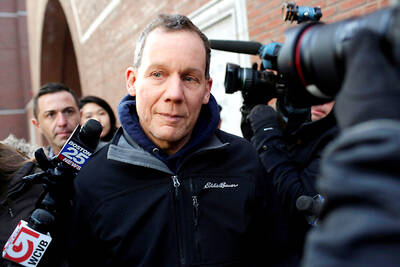
An American scientist convicted of lying to US authorities about payments from China while he was at Harvard University has rebuilt his research lab in Shenzhen, China, to pursue technology the Chinese government has identified as a national priority: embedding electronics into the human brain. Charles Lieber, 67, is among the world’s leading researchers in brain-computer interfaces. The technology has shown promise in treating conditions such as amyotrophic lateral sclerosis and restoring movement in paralyzed people. It also has potential military applications: Scientists at the Chinese People’s Liberation Army have investigated brain interfaces as a way to engineer super soldiers by boosting
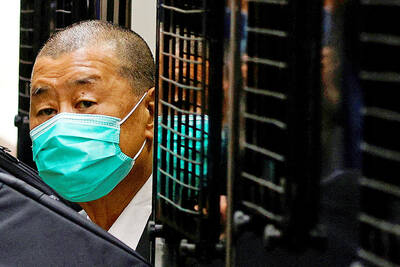
Jailed media entrepreneur Jimmy Lai (黎智英) has been awarded Deutsche Welle’s (DW) freedom of speech award for his contribution to Hong Kong’s pro-democracy movement. The German public broadcaster on Thursday said Lai would be presented in absentia with the 12th iteration of the award on June 23 at the DW Global Media Forum in Bonn. Deutsche Welle director-general Barbara Massing praised the 78-year-old founder of the now-shuttered news outlet Apple Daily for standing “unwaveringly for press freedom in Hong Kong at great personal risk.” “With Apple Daily, he gave journalists a platform for free reporting and a voice to the democracy movement in
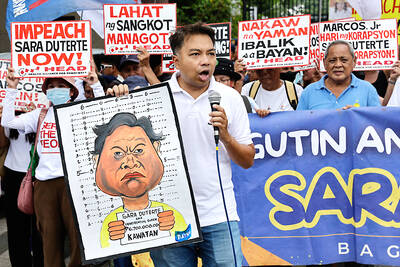
PHILIPPINE COMMITTEE: The head of the committee that made the decision said: ‘If there is nothing to hide, there is no reason to hide, there is no reason to obstruct’ A Philippine congressional committee on Wednesday ruled that there was “probable cause” to impeach Philippine Vice President Sara Duterte after hearing allegations of unexplained wealth, misuse of state funds and threats to have the president assassinated. The unanimous decision of the 53-member committee in the Philippine House of Representatives sends the two impeachment complaints to deliberations and voting by the entire lower chamber, which has more than 300 lawmakers. The complaints centered on Duterte’s alleged illegal use and mishandling of intelligence funds from the vice president’s office, and from her time as education secretary under Philippine President Ferdinand Marcos Jr. Duterte and the

As evening falls in Fiji’s capital, a steady stream of people approaches a makeshift clinic that is a first line of defense against one of the world’s fastest-growing HIV epidemics. In the South Pacific nation — a popular tourist destination of just under a million people — more than 2,000 new HIV cases were recorded last year, a 26 percent increase from 2024. The government has declared an HIV outbreak and described it as a national crisis. “It’s spreading like wildfire,” said Siteri Dinawai, 46, who came to be tested. The Moonlight Clinic, a converted minibus parked in a suburban cul-de-sac in Suva, is


 RSS
RSS