


Myanmar’s junta chief met Chinese President Xi Jinping (習近平) for the first time since seizing power, state media reported yesterday, the highest-level meeting with a key ally for the internationally sanctioned military leader.
Senior General Min Aung Hlaing led a military coup in 2021, overthrowing Myanmar’s brief experiment with democracy and plunging the nation into civil war.
In the four years since, his armed forces have battled dozens of ethnic armed groups and rebel militias — some with close links to China — opposed to its rule.
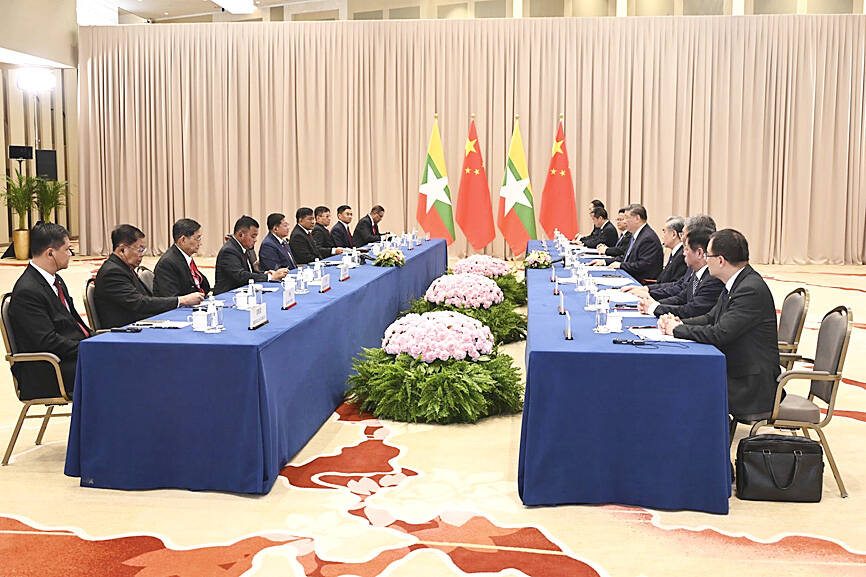
Photo: Myanmar Military True News Information Team via AP
The conflict has seen Min Aung Hlaing draw condemnation from rights groups and pursued by the International Criminal Court for crimes against humanity, but he has maintained close ties to allies China and Russia.
He met Xi in Moscow on the sidelines of Russia’s Victory Day celebrations on Friday and thanked China for its humanitarian assistance following a 7.7-magnitude earthquake in March, reported junta media the Global New Light of Myanmar.
He also thanked China “for its support of Myanmar’s stance on regional and international fronts,” it said.
Chinese state media Xinhua news reported that Xi expressed his country’s support for Myanmar pursuing development “suited to its national conditions, safeguarding its sovereignty, independence, territorial integrity and national stability, and steadily advancing its domestic political agenda.”
Xi said he hoped Myanmar would take “concrete measures to ensure the safety of Chinese personnel, institutions and projects in Myanmar, and intensify efforts to combat cross-border crimes.”
More than 6,600 people have been killed since the coup, according to the Assistance Association for Political Prisoners, and millions displaced. Concerned about the violence on its doorstep destabilizing regional peace and its economic ambitions, China has reportedly mediated talks between Myanmar’s junta and key rebel groups.
China is a major ally and arms supplier to the junta, but analysts say it also maintains ties with armed ethnic groups in Myanmar that hold territory near its border.
Beijing has long been eyeing Myanmar’s resource-rich northern Shan state — now under rebel control — for infrastructure investment under its trillion-dollar Belt and Road Initiative.
While Min Aung Hlaing’s Friday meeting with Xi was his first time in his role as junta chief, the general had previously met the Chinese leader in Myanmar’s capital Naypyidaw in January 2020, a year before seizing power.

‘CROSSING THE LINE’: China’s embassy in Seoul criticized US Forces Korea Commander General Xavier Brunson, asking if his ‘hostile’ remarks were authorized by Washington South Korea and the US are in talks over recent public remarks by the commander of US Forces Korea, Seoul’s presidential office said yesterday, after the comments drew sharp criticism from China. In a recent podcast interview, US Forces Korea Commander General Xavier Brunson described South Korea as “the dagger in the heart of Asia” from China’s east coast, prompting the Chinese embassy in Seoul to say that he had “truly crossed the line.” The interview came amid growing speculation that Washington might seek to expand the role of US Forces Korea in countering the growing regional influence of China, a key

SEEKING ORDER: Rodrigo Paz said that ‘anyone who wants to destroy the nation will have to deal with this president and the full force of the constitution’ Bolivian President Rodrigo Paz on Wednesday said that the nation was at a “breaking point” after nearly a month of protests that have caused shortages of food, fuel and medicine. Paz, who took office six months ago amid the worst economic crisis there in four decades, is battling a groundswell of fury over his policies. The political capital, La Paz, has been besieged by low-income workers and members of the indigenous majority calling for his resignation. “The country needs order and is reaching breaking point,” the 58-year-old said at a public event in La Paz, renewing his appeal for dialogue. On Tuesday, the Bolivian

Through the noise of rushing papers and whirring belts at a print factory in Kyoto, two creators watch their photo essay come to life in broadsheet form — part of an effort to win new audiences in the age of artificial intelligence (AI). Despite the decline of the publishing industry, self-publication and handmade “zine” magazines are growing in popularity in Japan, reflecting the nation’s enduring love of paper in the digital era. While speaking to Agence France-Presse at the plant, his hands black with ink, one of the creators, Kazuma Obara, said: “I think [paper] is a medium that engages all five

Australian researchers have trained lab-grown brain cells on a silicon computer chip to play the 1990s shooter game Doom and said they are just scratching the surface of what the neurons could be capable of doing. It is the science-fiction work of biotech boffins at Cortical Labs, who researched and developed the technology that harnesses the workings of the brain’s networking system. Each so-called “biological computer” contains about 200,000 living human brain cells, grown from stem cells that were harvested from blood donations. Having mastered the simple computer game Pong, where a paddle is moved up and down to send a ball


 RSS
RSS