


New German Chancellor Friedrich Merz yesterday set off on his first trip abroad to France and Poland in a bid to renew relations with the country’s top allies and show that Germany is back on the world stage despite a bumpy start to his government.
While already planned, the trip comes only a day after Merz was elected chancellor by parliament on the second round of voting. His unprecedented failure to succeed on the first round underscored disunity in the coalition of his conservatives and Social Democrats.
Still, hopes are high among Germany’s allies that Merz will restore German leadership in Europe after years of infighting within former chancellor Olaf Scholz’s three-way coalition and its implosion in November last year.
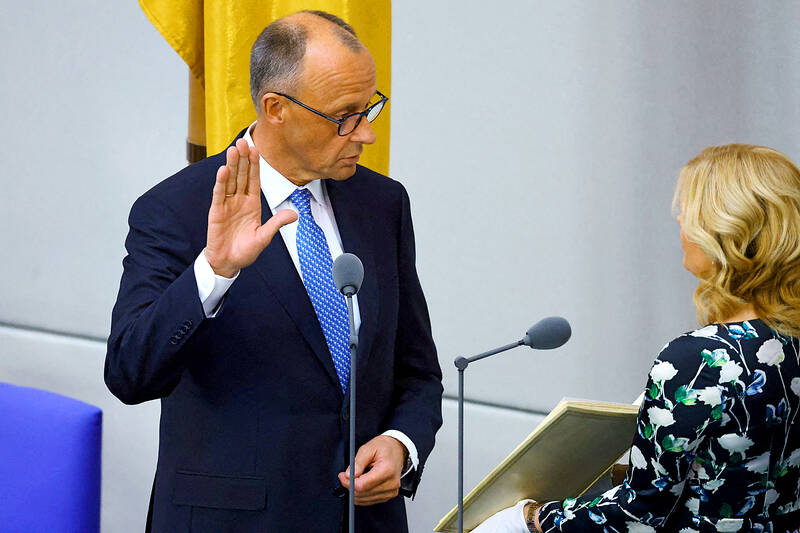
Photo: Reuters
Merz was taking office as Europe scrambles to agree on security guarantees for Ukraine as part of any ceasefire deal with Russia and to negotiate a trade accord with Washington after US President Donald Trump announced sweeping tariffs.
“After years of internal bickering and political navel-gazing under the previous government, what’s needed now is German leadership that doesn’t just observe European policy, but helps shape it,” said Jana Puglierin, head of the Berlin office of the European Council on Foreign Relations think tank.
“Merz’s chances of achieving this are good. He plans to centralize foreign and European policy in the chancellery — making it the nerve center of decisionmaking,” she said.
For the first time in years, the chancellery and the foreign ministry would be run by the same party. Merz also wants to establish a national security council in the chancellery to better coordinate foreign, development and defense policy.
The 69-year-old conservative, who was a deputy in the European Parliament from 1989 to 1994 and later took a hiatus from politics to work as a business consultant, has said he wants to fix relations with top European allies.
Fractious relations with the US have made that all the more imperative. The very night of his election, Merz emphasized the need for Europe to pursue greater independence in defense from the US.
He has also expressed uncertainty about the future of the NATO alliance. As such, he appears more receptive to French proposals on European strategic autonomy and common defense, analysts said.

An American scientist convicted of lying to US authorities about payments from China while he was at Harvard University has rebuilt his research lab in Shenzhen, China, to pursue technology the Chinese government has identified as a national priority: embedding electronics into the human brain. Charles Lieber, 67, is among the world’s leading researchers in brain-computer interfaces. The technology has shown promise in treating conditions such as amyotrophic lateral sclerosis and restoring movement in paralyzed people. It also has potential military applications: Scientists at the Chinese People’s Liberation Army have investigated brain interfaces as a way to engineer super soldiers by boosting
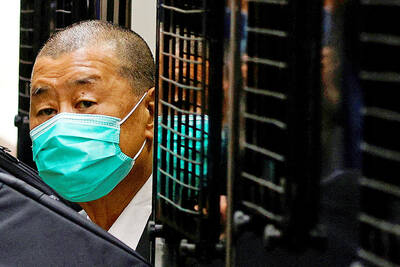
Jailed media entrepreneur Jimmy Lai (黎智英) has been awarded Deutsche Welle’s (DW) freedom of speech award for his contribution to Hong Kong’s pro-democracy movement. The German public broadcaster on Thursday said Lai would be presented in absentia with the 12th iteration of the award on June 23 at the DW Global Media Forum in Bonn. Deutsche Welle director-general Barbara Massing praised the 78-year-old founder of the now-shuttered news outlet Apple Daily for standing “unwaveringly for press freedom in Hong Kong at great personal risk.” “With Apple Daily, he gave journalists a platform for free reporting and a voice to the democracy movement in

PHILIPPINE COMMITTEE: The head of the committee that made the decision said: ‘If there is nothing to hide, there is no reason to hide, there is no reason to obstruct’ A Philippine congressional committee on Wednesday ruled that there was “probable cause” to impeach Philippine Vice President Sara Duterte after hearing allegations of unexplained wealth, misuse of state funds and threats to have the president assassinated. The unanimous decision of the 53-member committee in the Philippine House of Representatives sends the two impeachment complaints to deliberations and voting by the entire lower chamber, which has more than 300 lawmakers. The complaints centered on Duterte’s alleged illegal use and mishandling of intelligence funds from the vice president’s office, and from her time as education secretary under Philippine President Ferdinand Marcos Jr. Duterte and the

As evening falls in Fiji’s capital, a steady stream of people approaches a makeshift clinic that is a first line of defense against one of the world’s fastest-growing HIV epidemics. In the South Pacific nation — a popular tourist destination of just under a million people — more than 2,000 new HIV cases were recorded last year, a 26 percent increase from 2024. The government has declared an HIV outbreak and described it as a national crisis. “It’s spreading like wildfire,” said Siteri Dinawai, 46, who came to be tested. The Moonlight Clinic, a converted minibus parked in a suburban cul-de-sac in Suva, is


 RSS
RSS