


Flames crackle through piles of hundreds of human skulls and thick gray smoke pours into the Thai sky in a moment as spiritually significant as it is gruesome.
The Lang Pacha ceremony is observed by Thais of Chinese descent to give a dignified funeral to the unclaimed dead.
In Thailand, hospitals hand unidentified bodies and those with no one to give them appropriate last rites to local foundations.
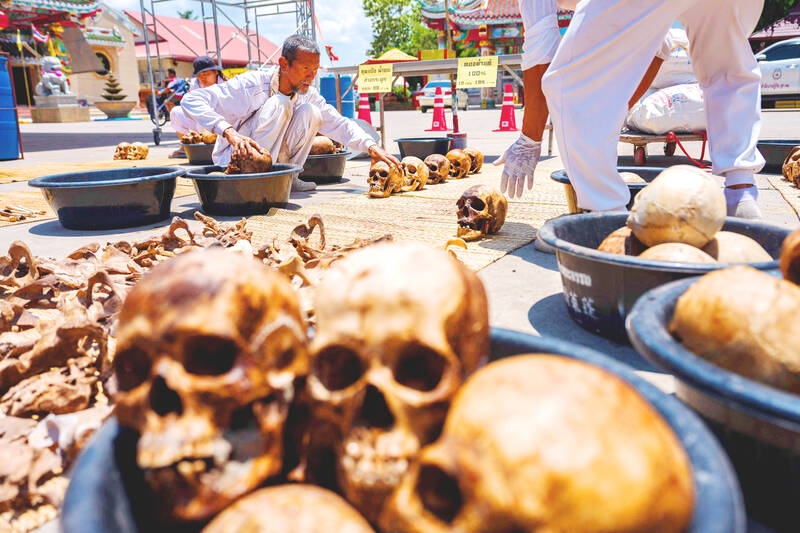
Photo: AFP
They then bury the corpses in graveyards, sometimes for several years, before a weeks-long ritual when they are exhumed, cleaned and all cremated together.
In Buddhist belief, the spirits of the uncremated remain trapped between worlds and cannot be reincarnated until monks perform the proper rites.
“Spirits without cremation still roam,” said Pisit Pongsirisupakul, vice president of the Dhamma of Buddha Nakhon Ratchasima Foundation, which organizes the event.
“They suffer and they can’t be reborn. We help them move on, and that’s why this is an act of merit,” he said.
Buddhists believe death marks the beginning of a new life, and making merit ensures a better rebirth.
“It’s not scary,” Pisit said. “When people die, we all look the same — like skeletons.”
The ritual begins with volunteers digging up the graves — the event’s name translates as “cleaning the jungle” — before brushing dirt and flesh from the remains and washing them in holy water boiled with tea leaves.
One man scrubbed out an empty eyesocket firmly with a toothbrush.
The scene is incongruously cheerful — wearing blue surgical gloves, Pimjai Sornrach grinned broadly as she held a skull, declaring: “It’s so good, it’s so good,” while her smiling friend held up a femur for the camera.
“I just want to be there whenever there’s an event like this,” said Pimjai, a 54-year-old shopkeeper.
She started volunteering at 17 after seeing two people killed in a hit-and-run, and says the ritual is about helping others as well as earning merit.
“My heart tells me to go,” she said.
Accumulated over the course of a decade, some of the 600 corpses were only recently deceased and the smell of death hung over the foundation complex in Nakhon Ratchasima Province, north of Bangkok.
Some will have been Alzheimer’s patients who wandered from their homes, never to be found by their families, others include road accident victims or undocumented laborers from Myanmar.
Laid out to dry, the remains are combined and divided up by bone type, and laid out on mats or piled in buckets — hundreds of skulls, leg bones and others.
It is a family occasion — two young girls sat alongside rows of skulls, each holding an anonymous head in their lap.
In the days running up to the ceremony’s climax, volunteers press gold leaf onto the bones and reconstruct faces on a few.
Each set of bones is loaded by turn into two separate crematorium towers — one for the men, one for the women — with the skulls on top completing the stacks.
Monks chant and pray before the flames are lit.
Later the ashes from each tower are interred in a graveyard.
Thitiwat Pornpiratsakul, 63, began volunteering after he, his wife and two sons survived a bus crash 20 years ago.
“Our bus flipped over and no one came to help us,” he recalled. “My wife and children were with me. We felt helpless.”
Since recovering, he has taken part in the ritual every year.
“My family and I have stayed healthy, and I believe it’s because we help in this ceremony,” he said.
Organizers say the event not only honors the dead, but also highlights a need for legal reform.
Pisit has long campaigned for government support to expand DNA testing and connect the civil registration system to police forensics to help identify the unclaimed.
“We need a centralized database where families can search by ID and find their loved ones,” he said.
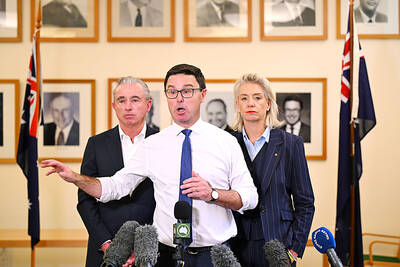
BACKLASH: The National Party quit its decades-long partnership with the Liberal Party after their election loss to center-left Labor, which won a historic third term Australia’s National Party has split from its conservative coalition partner of more than 60 years, the Liberal Party, citing policy differences over renewable energy and after a resounding loss at a national election this month. “Its time to have a break,” Nationals leader David Littleproud told reporters yesterday. The split shows the pressure on Australia’s conservative parties after Prime Minister Anthony Albanese’s center-left Labor party won a historic second term in the May 3 election, powered by a voter backlash against US President Donald Trump’s policies. Under the long-standing partnership in state and federal politics, the Liberal and National coalition had shared power

CONTROVERSY: During the performance of Israel’s entrant Yuval Raphael’s song ‘New Day Will Rise,’ loud whistles were heard and two people tried to get on stage Austria’s JJ yesterday won the Eurovision Song Contest, with his operatic song Wasted Love triumphing at the world’s biggest live music television event. After votes from national juries around Europe and viewers from across the continent and beyond, JJ gave Austria its first victory since bearded drag performer Conchita Wurst’s 2014 triumph. After the nail-biting drama as the votes were revealed running into yesterday morning, Austria finished with 436 points, ahead of Israel — whose participation drew protests — on 357 and Estonia on 356. “Thank you to you, Europe, for making my dreams come true,” 24-year-old countertenor JJ, whose

A documentary whose main subject, 25-year-old photojournalist Fatima Hassouna, was killed in an Israeli airstrike in Gaza weeks before it premiered at Cannes stunned viewers into silence at the festival on Thursday. As the cinema lights came back on, filmmaker Sepideh Farsi held up an image of the young Palestinian woman killed with younger siblings on April 16, and encouraged the audience to stand up and clap to pay tribute. “To kill a child, to kill a photographer is unacceptable,” Farsi said. “There are still children to save. It must be done fast,” the exiled Iranian filmmaker added. With Israel

NO EXCUSES: Marcos said his administration was acting on voters’ demands, but an academic said the move was emotionally motivated after a poor midterm showing Philippine President Ferdinand Marcos Jr yesterday sought the resignation of all his Cabinet secretaries, in a move seen as an attempt to reset the political agenda and assert his authority over the second half of his single six-year term. The order came after the president’s allies failed to win a majority of Senate seats contested in the 12 polls on Monday last week, leaving Marcos facing a divided political and legislative landscape that could thwart his attempts to have an ally succeed him in 2028. “He’s talking to the people, trying to salvage whatever political capital he has left. I think it’s


 RSS
RSS